Zhejiang Provincial Center for Disease Control and Prevention, Hangzhou, China.
State Key Laboratory of Infectious Disease Prevention and Control, Collaborative Innovation Center for Diagnosis and Treatment of Infectious Disease, National Institute for Communicable Disease Control and Prevention, Chinese Center for Disease Control and Prevention, Beijing, China.
PLoS Negl Trop Dis. 2021 Mar 25;15(3):e0009217. doi: 10.1371/journal.pntd.0009217. eCollection 2021 Mar.
Hemorrhagic fever with renal syndrome (HFRS), a rodent-borne disease, is a severe public health threat. Previous studies have discovered the influence of meteorological factors on HFRS incidence, while few studies have concentrated on the stratified analysis of delayed effects and interaction effects of meteorological factors on HFRS.
Huludao City is a representative area in north China that suffers from HFRS with primary transmission by Rattus norvegicus. This study aimed to evaluate the climate factors of lag, interaction, and stratified effects of meteorological factors on HFRS incidence in Huludao City.
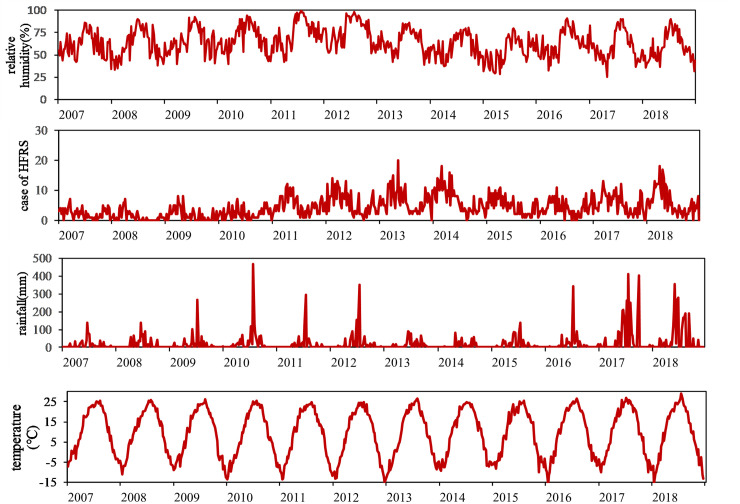
Our researchers collected meteorological data and epidemiological data of HFRS cases in Huludao City during 2007-2018. First, a distributed lag nonlinear model (DLNM) for a maximum lag of 16 weeks was developed to assess the respective lag effect of temperature, precipitation, and humidity on HFRS incidence. We then constructed a generalized additive model (GAM) to explore the interaction effect between temperature and the other two meteorological factors on HFRS incidence and the stratified effect of meteorological factors.
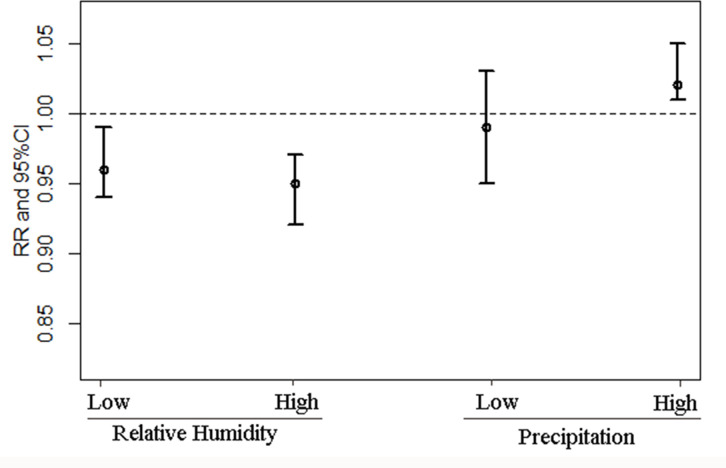
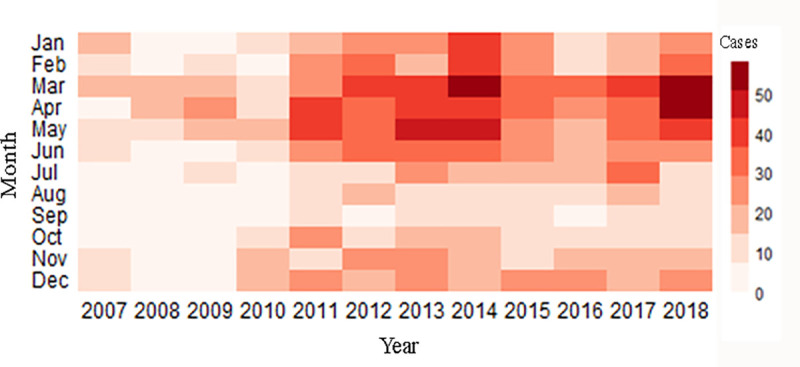
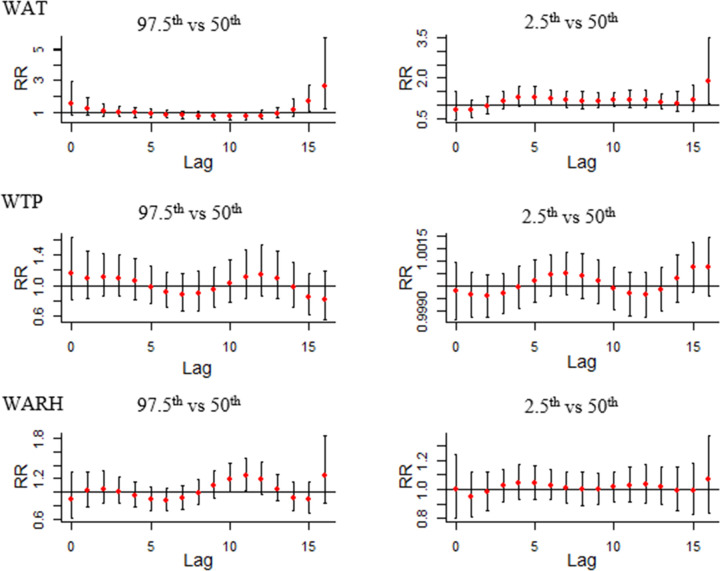
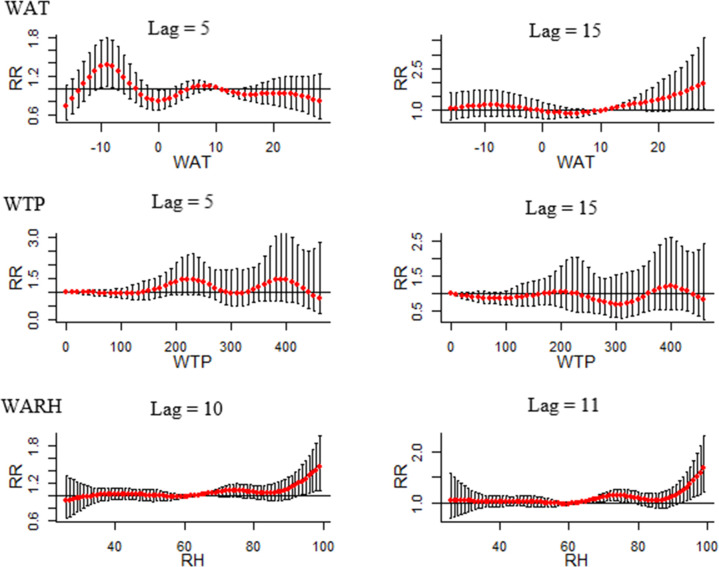
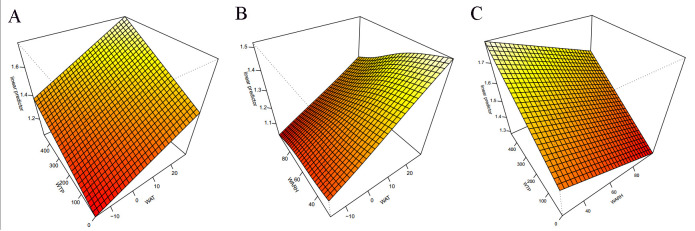
During the study period, 2751 cases of HFRS were reported in Huludao City. The incidence of HFRS showed a seasonal trend and peak times from February to May. Using the median WAT, median WTP, and median WARH as the reference, the results of DLNM showed that extremely high temperature (97.5th percentile of WAT) had significant associations with HFRS at lag week 15 (RR = 1.68, 95% CI: 1.04-2.74) and lag week 16 (RR = 2.80, 95% CI: 1.31-5.95). Under the extremely low temperature (2.5th percentile of WAT), the RRs of HFRS infection were significant at lag week 5 (RR = 1.28, 95% CI: 1.01-1.67) and lag 6 weeks (RR = 1.24, 95% CI: 1.01-1.57). The RRs of relative humidity were statistically significant at lag week 10 (RR = 1.19, 95% CI: 1.00-1.43) and lag week 11 (RR = 1.24, 95% CI: 1.02-1.50) under extremely high relative humidity (97.5th percentile of WARH); however, no statistically significance was observed under extremely low relative humidity (2.5th percentile of WARH). The RRs were significantly high when WAT was -10 degrees Celsius (RR = 1.34, 95% CI: 1.02-1.76), -9 degrees Celsius (1.37, 95% CI: 1.04-1.79), and -8 degrees Celsius (RR = 1.34, 95% CI: 1.03-1.75) at lag week 5 and more than 23 degrees Celsius after 15 weeks. Interaction and stratified analyses showed that the risk of HFRS infection reached its highest when both temperature and precipitation were at a high level.
Our study indicates that meteorological factors, including temperature and humidity, have delayed effects on the occurrence of HFRS in the study area, and the effect of temperature can be modified by humidity and precipitation. Public health professionals should pay more attention to HFRS control when the weather conditions of high temperature with more substantial precipitation and 15 weeks after the temperature is higher than 23 degrees Celsius.
肾综合征出血热(HFRS)是一种由啮齿动物传播的疾病,是严重的公共卫生威胁。先前的研究已经发现气象因素对 HFRS 发病率的影响,而很少有研究集中于气象因素对 HFRS 发病率的滞后效应和交互效应的分层分析。
葫芦岛市是中国北方 HFRS 的代表性地区,主要由褐家鼠传播。本研究旨在评估气象因素对葫芦岛市 HFRS 发病率的滞后、交互和分层效应。
研究人员收集了 2007-2018 年葫芦岛市的气象数据和 HFRS 病例的流行病学数据。首先,采用最大滞后 16 周的分布式滞后非线性模型(DLNM)评估温度、降水和湿度对 HFRS 发病率的各自滞后效应。然后,构建广义加性模型(GAM)探索温度与其他两个气象因素对 HFRS 发病率的交互效应以及气象因素的分层效应。
在研究期间,葫芦岛市报告了 2751 例 HFRS 病例。HFRS 的发病率呈季节性趋势,高峰期在 2 月至 5 月。使用中位 WAT、中位 WTP 和中位 WARH 作为参考,DLNM 的结果表明,极高温度(WAT 的第 97.5 百分位数)与滞后 15 周(RR=1.68,95%CI:1.04-2.74)和滞后 16 周(RR=2.80,95%CI:1.31-5.95)的 HFRS 发病有显著关联。在极低温度(WAT 的第 2.5 百分位数)下,滞后 5 周(RR=1.28,95%CI:1.01-1.67)和滞后 6 周(RR=1.24,95%CI:1.01-1.57)的 HFRS 感染风险显著增加。相对湿度的 RR 在滞后 10 周(RR=1.19,95%CI:1.00-1.43)和滞后 11 周(RR=1.24,95%CI:1.02-1.50)时具有统计学意义,在滞后 11 周时,极端高湿度(WARH 的第 97.5 百分位数)下的 RR 显著增加;然而,在极端低湿度(WARH 的第 2.5 百分位数)下,RR 没有统计学意义。当温度为-10 摄氏度(RR=1.34,95%CI:1.02-1.76)、-9 摄氏度(RR=1.37,95%CI:1.04-1.79)和-8 摄氏度(RR=1.34,95%CI:1.03-1.75)时,滞后 5 周时 RR 显著升高,并且在滞后 15 周后温度超过 23 摄氏度时 RR 显著升高。交互和分层分析表明,当温度和降水都处于高水平时,HFRS 感染的风险达到最高。
本研究表明,气象因素(包括温度和湿度)对研究区域 HFRS 的发生具有滞后效应,并且温度的影响可以通过湿度和降水来调节。当高温天气伴有大量降水时,以及在温度高于 23 摄氏度后 15 周时,公共卫生专业人员应更加关注 HFRS 的控制。