Jeong Byeong Ho, Ko Myeong Gyun, Nam Jimyoung, Yoo Hongseok, Chung Chi Ryang, Suh Gee Young, Jeon Kyeongman
Division of Pulmonary and Critical Care Medicine, Department of Medicine, Samsung Medical Center, Sungkyunkwan University School of Medicine, Seoul, Korea.
Intensive Care Unit Nursing Department, Samsung Medical Center, Sungkyunkwan University School of Medicine, Seoul, Korea.
PLoS One. 2015 Apr 15;10(4):e0122810. doi: 10.1371/journal.pone.0122810. eCollection 2015.
Although the weaning classification based on the difficulty and duration of the weaning process has been evaluated in the different type of intensive care units (ICUs), little is known about clinical outcomes and validity among the three groups in medical ICU. The objectives of this study were to evaluate the clinical relevance of weaning classification and its association with hospital mortality in a medical ICU with a protocol-based weaning program.
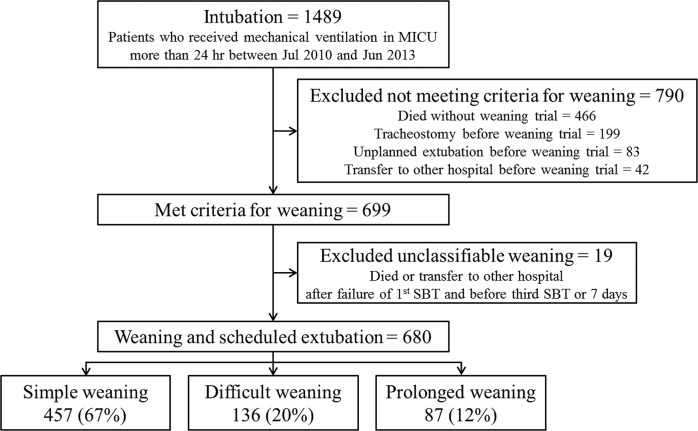
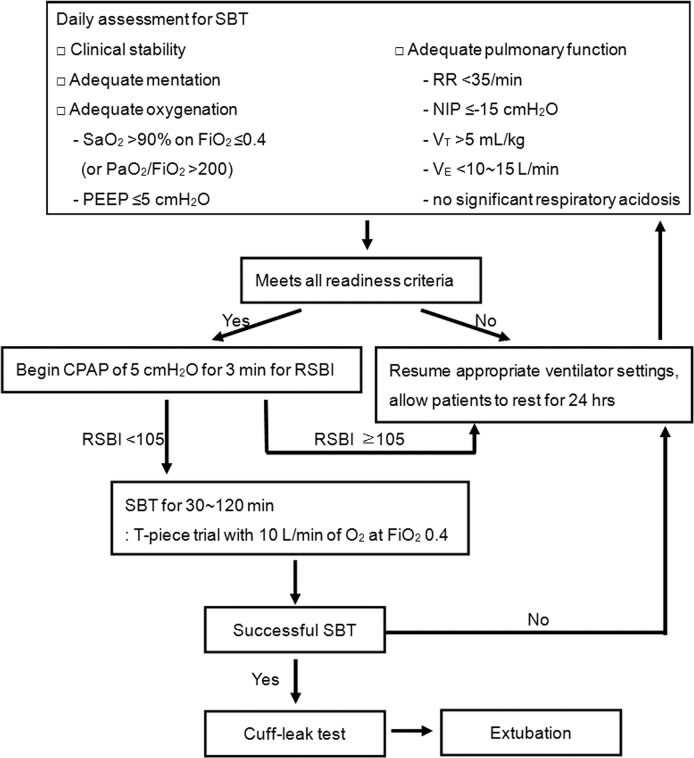
All consecutive patients admitted to the medical ICU and requiring mechanical ventilation (MV) for more than 24 hours were prospectively registered and screened for weaning readiness by a standardized weaning program between July 2010 and June 2013. Baseline characteristics and outcomes were compared across weaning classifications.
During the study period, a total of 680 patients were weaned according to the standardized weaning protocol. Of these, 457 (67%) were classified as simple weaning, 136 (20%) as difficult weaning, and 87 (13%) as prolonged weaning. Ventilator-free days within 28 days decreased significantly from simple to difficult to prolonged weaning groups (P < 0.001, test for trends). In addition, reintubation within 48 hours after extubation (P < 0.001) and need for tracheostomy during the weaning process (P < 0.001) increased significantly across weaning groups. Finally, ICU (P < 0.001), post-ICU (P = 0.001), and hospital (P < 0.001) mortalities significantly increased across weaning groups. In a multiple logistic regression model, prolonged weaning but not difficult weaning was still independently associated with ICU (adjusted OR 8.265, 95% CI 3.484-19.605, P < 0.001), and post-ICU (adjusted OR 3.180, 95% CI 1.349-7.497, P = 0.005), and hospital (adjusted OR 5.528, 95% CI 2.801-10.910, P < 0.001) mortalities.
Weaning classification based on the difficulty and duration of the weaning process may provide prognostic information for mechanically ventilated patients who undergo the weaning process.
尽管基于撤机过程的难度和持续时间的撤机分类已在不同类型的重症监护病房(ICU)中进行了评估,但对于内科ICU中三组患者的临床结局和有效性知之甚少。本研究的目的是在一个基于方案的撤机计划的内科ICU中评估撤机分类的临床相关性及其与医院死亡率的关联。
2010年7月至2013年6月期间,所有连续入住内科ICU且需要机械通气(MV)超过24小时的患者均进行前瞻性登记,并通过标准化撤机计划筛查撤机准备情况。比较不同撤机分类的基线特征和结局。
在研究期间,共有680例患者按照标准化撤机方案撤机。其中,457例(67%)被分类为简单撤机,136例(20%)为困难撤机,87例(13%)为延长撤机。从简单撤机组到困难撤机组再到延长撤机组,28天内无呼吸机天数显著减少(P<0.001,趋势检验)。此外,撤机后48小时内再次插管(P<0.001)和撤机过程中需要气管切开(P<0.001)在不同撤机组中显著增加。最后,不同撤机组的ICU死亡率(P<0.001)、ICU后死亡率(P=0.00)和医院死亡率(P<0.001)显著增加。在多因素逻辑回归模型中,延长撤机而非困难撤机仍与ICU死亡率(调整后的OR为8.265,95%CI为3.484-19.605,P<0.001)、ICU后死亡率(调整后的OR为3.180,95%CI为1.349-7.497,P=0.005)和医院死亡率(调整后的OR为5.528,95%CI为2.801-10.910,P<0.001)独立相关。
基于撤机过程的难度和持续时间的撤机分类可能为接受撤机过程的机械通气患者提供预后信息。