Porock Davina, Clissett Philip, Harwood Rowan H, Gladman John R F
Institute for Person-Centered Care , State University of New York at Buffalo , USA . ; School of Nursing, Midwifery and Physiotherapy , University of Nottingham , UK .
School of Nursing, Midwifery and Physiotherapy , University of Nottingham , UK .
Ageing Soc. 2015 Jan;35(1):37-63. doi: 10.1017/S0144686X13000561. Epub 2013 Sep 19.
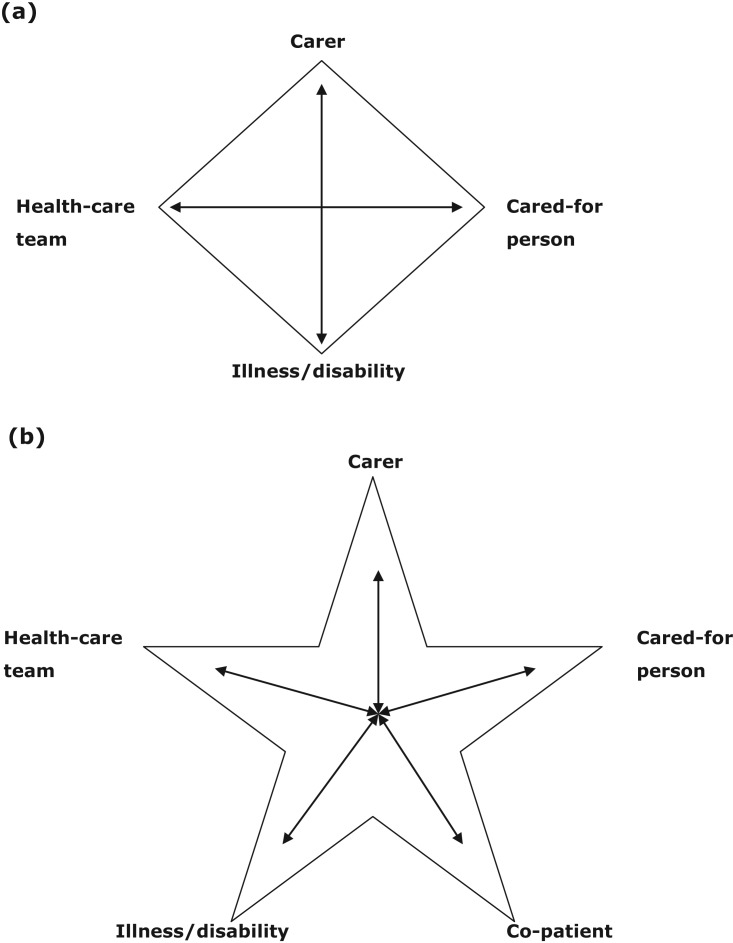
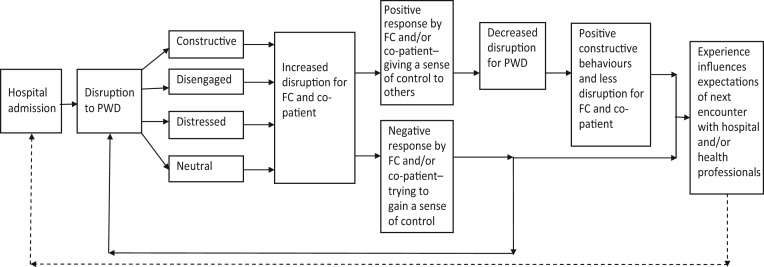
This qualitative study aimed to gain insight into the experience of hospitalisation from the perspectives of the older person with dementia, their family care-giver and other patients sharing the ward (co-patients). Non-participant observation of care on 11 acute hospital wards was supplemented by 39 semi-structured interviews with 35 family care-givers and four co-patients following discharge. Constant comparative analysis produced the core problem facing all those involved: disruption from normal routine meaning that the experience of hospitalisation was disrupted by the presence and behaviour of the person with dementia. Disruption adversely affected the person with dementia, triggering constructive, disengaged, distressed and neutral behaviours. Using Kitwood's model of person-centred care, these behaviours were interpreted as attempts by the person with dementia at gaining a sense of control over the unfamiliar environment and experience. Family care-givers' lives and experiences both inside and outside the hospital were disrupted by the hospitalisation. They too attempted to gain a sense of control over the experience and to give a sense of control to the patient, co-patients and staff. Co-patients experienced disruption from sharing space with the person with dementia and were left feeling vulnerable and sometimes afraid. They too attempted to gain a sense of control over their situation and give some control by helping the person with dementia, the family care-giver and the staff.
这项定性研究旨在从患有痴呆症的老年人、他们的家庭护理人员以及同病房的其他患者(同室患者)的角度,深入了解住院体验。对11个急性医院病房的护理进行非参与式观察,并在出院后对35名家庭护理人员和4名同室患者进行了39次半结构化访谈。持续比较分析得出了所有相关人员面临的核心问题:日常生活被打乱,这意味着痴呆症患者的存在和行为扰乱了住院体验。这种扰乱对痴呆症患者产生了不利影响,引发了建设性、脱离接触、痛苦和中立的行为。运用基特伍德的以人为本的护理模式,这些行为被解释为痴呆症患者试图在陌生的环境和体验中获得控制感。住院扰乱了家庭护理人员在医院内外的生活和经历。他们也试图在这种体验中获得控制感,并给予患者、同室患者和工作人员一种控制感。同室患者因与痴呆症患者共用空间而经历了生活被打乱的情况,感到脆弱,有时还会害怕。他们也试图对自己的处境获得控制感,并通过帮助痴呆症患者、家庭护理人员和工作人员来给予一定的控制权。