Ordóñez Jaime E, Orozco John Jairo
HEMO Group Carrera 25A N° 1A Sur-45, piso 5.Torre Médica El Tesoro Medellín, Medellín, Colombia.
CES University, Medellín, Colombia.
Cost Eff Resour Alloc. 2015 Apr 10;13:6. doi: 10.1186/s12962-015-0032-1. eCollection 2015.
Pneumococcal diseases in children under five years are common and preventable. In Colombia there are two pneumococcal conjugate vaccines (PCV) that have proved clinical efficacy. The aim was to estimate the cost-effectiveness of 13-valent PCV (PCV13) and 10-valent PCV (PCV10) in terms of prevention of Invasive Pneumococcal Diseases (IPD), radiologically-confirmed pneumonia, and their related mortality, as well as, acute otitis media (AOM) in a cohort of newborns in Colombia.
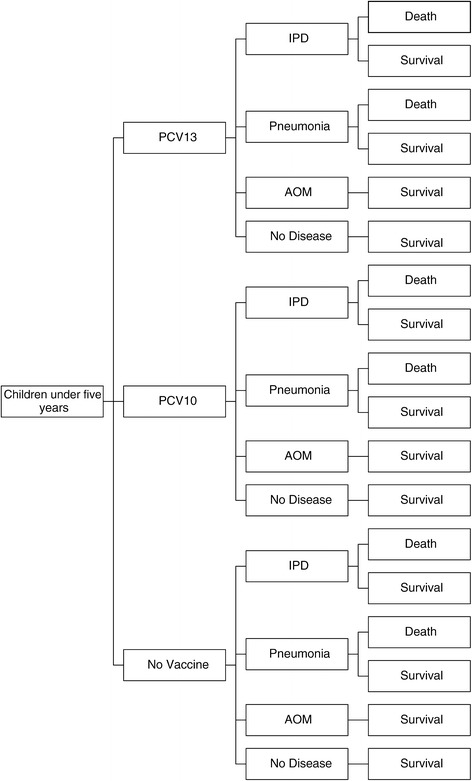
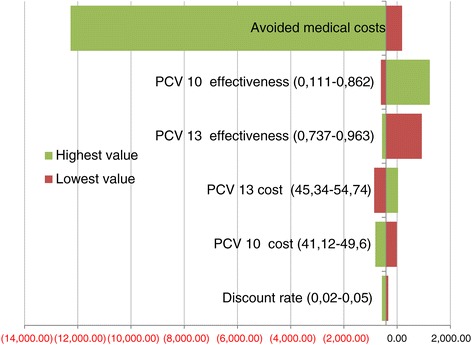
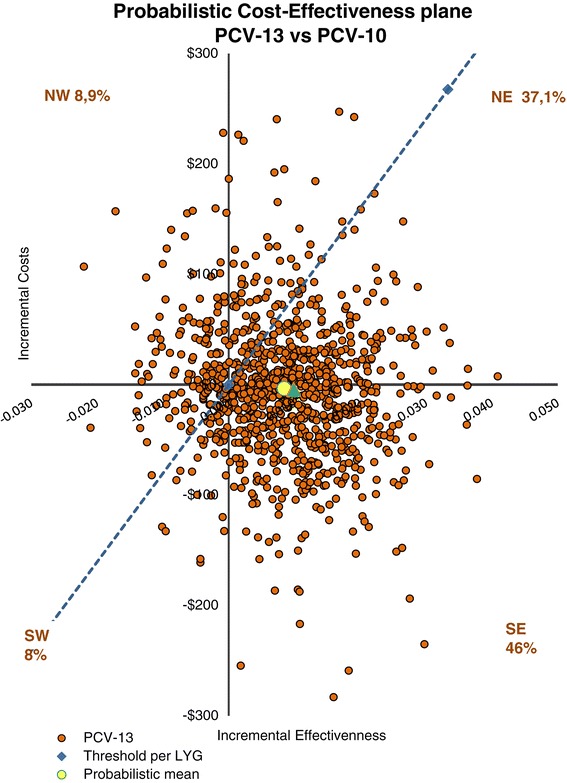
We developed an analytical decision tree model with national data including the distribution of pneumococcal serotypes in Colombia between 2009 and 2013. A simulation of vaccination of 90% of newborns in Colombia took place with a time horizon of 5 years. The analysis was done from the Colombian health system perspective. Vaccines efficacy parameters were measured as life-years gained (LYG) and avoided morbidity by pneumococcal diseases; they were determined by a systematic review of literature. A health insurance company provided the costs. A probabilistic and a univariate sensitivity analysis for epidemiological, efficacy and cost parameters were done.
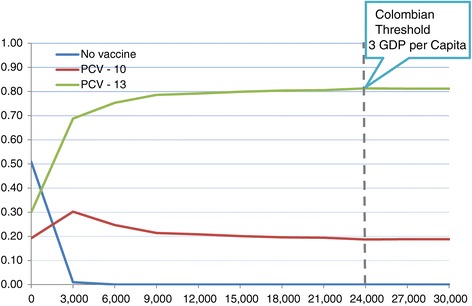
After 5 years projection, PCV13 would prevent 437 deaths due to pneumococcal infections versus 321 that would be prevented by PCV10, compared to no vaccination. PCV13 would generate 25 396 LYG, and PCV10 would generate 18 708 LYG. Medical costs avoided would be US$ 19 479 395 for PCV13 and US$ 13 703 271 for PCV10. Compared to no vaccination, PCV13 and PCV10 were cost-effective, with an incremental cost-effectiveness ratio (ICER) of US$ 489.26 and US$ 813.41 per additional LYG, respectively; besides, PCV13 was dominant over PCV10 due to lower costs and better outcomes.
PCV13 is a cost-saving strategy compared with PCV10, as part of a universal coverage vaccination program in Colombian children under one year. PCV13 is expected to lead to a greater decrement in infant mortality from pneumococcal diseases, and a higher cost saving by preventing more pneumococcal diseases compared with PCV10 in a 5 years projection.
五岁以下儿童的肺炎球菌疾病很常见且可预防。在哥伦比亚,有两种肺炎球菌结合疫苗(PCV)已证明具有临床疗效。目的是评估13价肺炎球菌结合疫苗(PCV13)和10价肺炎球菌结合疫苗(PCV10)在预防哥伦比亚一组新生儿的侵袭性肺炎球菌疾病(IPD)、放射学确诊的肺炎及其相关死亡率以及急性中耳炎(AOM)方面的成本效益。
我们利用包括2009年至2013年哥伦比亚肺炎球菌血清型分布在内的国家数据建立了一个分析决策树模型。对哥伦比亚90%的新生儿进行了为期5年的疫苗接种模拟。分析是从哥伦比亚卫生系统的角度进行的。疫苗效力参数以获得的生命年数(LYG)和肺炎球菌疾病避免的发病率来衡量;它们是通过对文献的系统综述确定的。一家健康保险公司提供了成本数据。对流行病学、效力和成本参数进行了概率和单变量敏感性分析。
经过5年的预测,与未接种疫苗相比,PCV13可预防437例因肺炎球菌感染导致的死亡,而PCV10可预防321例。PCV13将产生25396个LYG,PCV10将产生18708个LYG。PCV13避免的医疗成本为19479395美元,PCV10为13703271美元。与未接种疫苗相比,PCV13和PCV10具有成本效益,增量成本效益比(ICER)分别为每增加一个LYG489.26美元和813.41美元;此外,由于成本更低且效果更好,PCV13优于PCV10。
作为哥伦比亚一岁以下儿童普遍接种疫苗计划的一部分,与PCV10相比,PCV13是一种节省成本的策略。在5年的预测中,预计PCV13将使肺炎球菌疾病导致的婴儿死亡率有更大幅度的下降,并且通过预防更多的肺炎球菌疾病比PCV10节省更多成本。