Nymark Liv Solvår, Miller Alex, Vassall Anna
Department of Global Health, The Academic Medical Center (AMC), The University of Amsterdam, Meibergdreef 9, 1105 AZ, Amsterdam, The Netherlands.
Independent Researcher, London, UK.
Pharmacoecon Open. 2021 Dec;5(4):587-603. doi: 10.1007/s41669-021-00269-4. Epub 2021 May 4.
Our objective was to review economic evaluations of immunization and tuberculosis to determine the extent to which additional unintended consequences were taken into account in the analysis and to describe the methodological approaches used to estimate these, where possible.
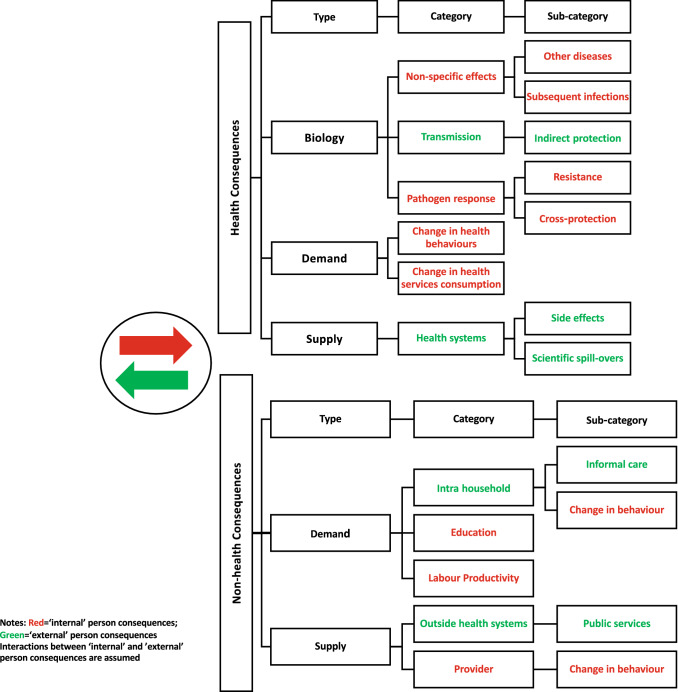
We sourced the vaccine economic evaluations from a previous systematic review by Nymark et al. (2009-2015) and searched PubMed/MEDLINE and Embase from 2015 to 2019 using the same search strategy. For tuberculosis economic evaluations, we extracted studies from 2009 to 2019 that were published in a previous review by Siapka et al. We followed Preferred Reporting Items for Systematic Reviews and Meta-Analyses (PRISMA) guidance. Studies were classified according to the categories and subcategories (e.g., herd immunity, non-specific effects, and labor productivity) defined in a framework identifying additional unintended consequences by Nymark and Vassall. Where possible, methods for estimating the additional unintended consequences categories and subcategories were described. We evaluated the reporting quality of included studies according to the Consolidated Health Economic Evaluation Reporting Standards (CHEERS) extraction guideline.
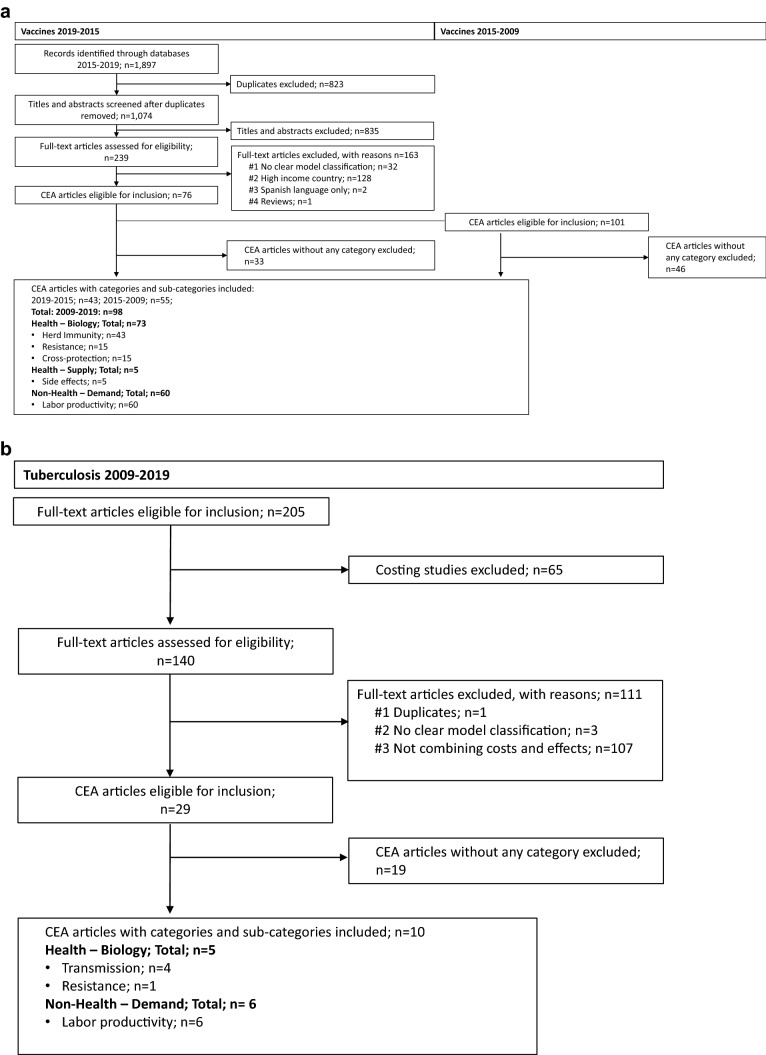
We identified 177 vaccine cost-effectiveness analyses (CEAs) between 2009 and 2019 that met the inclusion criteria. Of these, 98 included unintended consequences. Of the total 98 CEAs, overall health consequence categories were included 73 times; biological categories: herd immunity 43 times; pathogen response: resistance 15 times; and cross-protection 15 times. For health consequences pertaining to the supply-side (health systems) categories, side effects were included five times. On the nonhealth demand side (intrahousehold), labor productivity was included 60 times. We identified 29 tuberculosis CEAs from 2009 to 2019 that met the inclusion criteria. Of these, six articles included labor productivity, four included indirect transmission effects, and one included resistance. Between 2009 and 2019, only 34% of tuberculosis CEAs included additional unintended consequences, compared with 55% of vaccine CEAs.
The inclusion of additional unintended consequences in economic evaluations of immunization and tuberculosis continues to be limited. Additional unintended consequences of economic benefits, such as those examined in this review and especially those that occur outside the health system, offer valuable information to analysts. Further work on appropriate ways to value these additional unintended consequences is still warranted.
我们的目的是回顾免疫接种和结核病的经济评估,以确定在分析中考虑额外意外后果的程度,并尽可能描述用于估计这些后果的方法。
我们从Nymark等人(2009 - 2015年)之前的系统评价中获取疫苗经济评估资料,并使用相同的检索策略在2015年至2019年期间检索PubMed/MEDLINE和Embase。对于结核病经济评估,我们从Siapka等人之前的综述中提取2009年至2019年发表的研究。我们遵循系统评价和Meta分析的首选报告项目(PRISMA)指南。研究根据Nymark和Vassall确定额外意外后果的框架中定义的类别和子类别(例如群体免疫、非特异性效应和劳动生产率)进行分类。在可能的情况下,描述了估计额外意外后果类别和子类别的方法。我们根据综合卫生经济评估报告标准(CHEERS)提取指南评估纳入研究的报告质量。
我们确定了2009年至2019年期间符合纳入标准的177项疫苗成本效益分析(CEA)。其中,98项纳入了意外后果。在总共98项CEA中,总体健康后果类别被纳入73次;生物学类别:群体免疫43次;病原体反应:耐药性15次;交叉保护15次。对于与供应方(卫生系统)类别相关的健康后果,副作用被纳入5次。在非健康需求方(家庭内部),劳动生产率被纳入60次。我们确定了2009年至2019年期间符合纳入标准的29项结核病CEA。其中,6篇文章纳入了劳动生产率,4篇纳入了间接传播效应,1篇纳入了耐药性。在2009年至2019年期间,只有34%的结核病CEA纳入了额外的意外后果,而疫苗CEA的这一比例为55%。
在免疫接种和结核病的经济评估中纳入额外的意外后果仍然有限。经济收益的额外意外后果,如本综述中所研究的那些,尤其是那些发生在卫生系统之外的后果,为分析人员提供了有价值的信息。仍有必要进一步研究评估这些额外意外后果的适当方法。