Aggarwal Abhishek, Prinz-Wohlgenannt Maximilian, Gröschel Charlotte, Tennakoon Samawansha, Meshcheryakova Anastasia, Chang Wenhan, Brown Edward M, Mechtcheriakova Diana, Kállay Enikö
Department of Pathophysiology and Allergy Research, Medical University of Vienna, Währinger Gürtel 18-20, A-1090, Vienna, Austria.
Endocrine Research Unit, Department of Veteran Affairs Medical Center, University of California, San Francisco, CA, USA.
Mol Cancer. 2015 Mar 18;14:61. doi: 10.1186/s12943-015-0330-4.
The calcium sensing receptor (CaSR), a calcium-binding G protein-coupled receptor is expressed also in tissues not directly involved in calcium homeostasis like the colon. We have previously reported that CaSR expression is down-regulated in colorectal cancer (CRC) and that loss of CaSR provides growth advantage to transformed cells. However, detailed mechanisms underlying these processes are largely unknown.
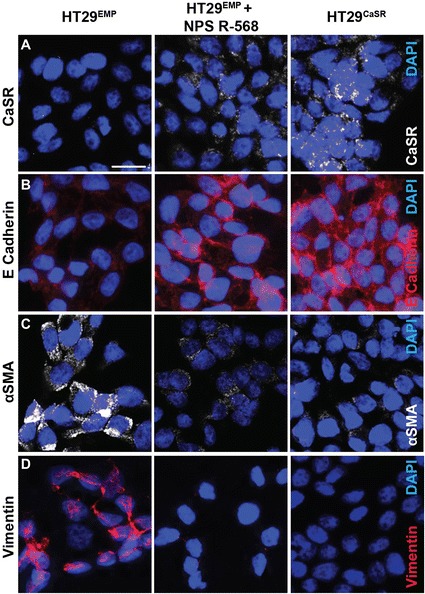
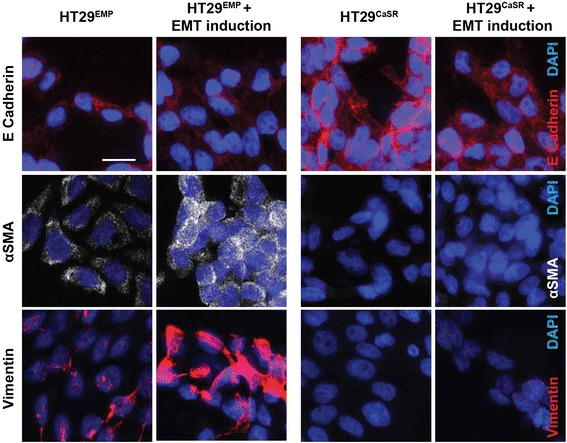
In a cohort of 111 CRC patients, we found significant inverse correlation between CaSR expression and markers of epithelial-to-mesenchymal transition (EMT), a process involved in tumor development in CRC. The colon of CaSR/PTH double-knockout, as well as the intestine-specific CaSR knockout mice showed significantly increased expression of markers involved in the EMT process. In vitro, stable expression of the CaSR (HT29(CaSR)) gave a more epithelial-like morphology to HT29 colon cancer cells with increased levels of E-Cadherin compared with control cells (HT29(EMP)). The HT29(CaSR) cells had reduced invasive potential, which was attributed to the inhibition of the Wnt/β-catenin pathway as measured by a decrease in nuclear translocation of β-catenin and transcriptional regulation of genes like GSK-3β and Cyclin D1. Expression of a spectrum of different mesenchymal markers was significantly down-regulated in HT29(CaSR) cells. The CaSR was able to block upregulation of mesenchymal markers even in an EMT-inducing environment. Moreover, overexpression of the CaSR led to down-regulation of stem cell-like phenotype.
The results from this study demonstrate that the CaSR inhibits epithelial-to-mesenchymal transition and the acquisition of a stem cell-like phenotype in the colon of mice lacking the CaSR as well as colorectal cancer cells, identifying the CaSR as a key molecule in preventing tumor progression. Our results support the rationale to develop new strategies either preventing CaSR loss or reversing its silencing.
钙敏感受体(CaSR)是一种钙结合G蛋白偶联受体,也在如结肠等并非直接参与钙稳态的组织中表达。我们之前报道过,CaSR表达在结直肠癌(CRC)中下调,且CaSR缺失为转化细胞提供生长优势。然而,这些过程背后的详细机制很大程度上尚不清楚。
在111名CRC患者队列中,我们发现CaSR表达与上皮-间质转化(EMT)标志物之间存在显著负相关,EMT是CRC肿瘤发生过程中的一个环节。CaSR/PTH双敲除小鼠的结肠以及肠道特异性CaSR敲除小鼠显示出EMT过程相关标志物的表达显著增加。在体外,CaSR的稳定表达(HT29(CaSR))使HT29结肠癌细胞呈现出更类似上皮的形态,与对照细胞(HT29(EMP))相比,E-钙黏蛋白水平增加。HT29(CaSR)细胞的侵袭潜能降低,这归因于Wnt/β-连环蛋白通路的抑制,表现为β-连环蛋白核转位减少以及GSK-3β和细胞周期蛋白D1等基因的转录调控。一系列不同间充质标志物的表达在HT29(CaSR)细胞中显著下调。即使在诱导EMT的环境中,CaSR也能够阻断间充质标志物的上调。此外,CaSR的过表达导致干细胞样表型的下调。
本研究结果表明,CaSR抑制小鼠结肠以及结直肠癌细胞中上皮-间质转化和干细胞样表型的获得,确定CaSR为预防肿瘤进展的关键分子。我们的结果支持开发预防CaSR缺失或逆转其沉默的新策略的理论依据。