Chen Haiyan, Wu Buyun, Gong Dehua, Liu Zhihong
National Clinical Research Center of Kidney Disease, Jinling Hospital, Nanjing University School of Medicine, Zhongshan East Road 305#, Nanjing, 210016, P. R. China.
Crit Care. 2015 Apr 2;19(1):135. doi: 10.1186/s13054-015-0871-3.
It is unclear whether the fluid status, as determined by bioimpedance vector analysis (BIVA) combined with serum N-terminal pro-B-type natriuretic peptides (NT-pro-BNP) measurement, is associated with treatment outcome among patients receiving continuous renal replacement therapy (CRRT). Our objective was to answer this question.
Patients who were in the intensive care units of a university teaching hospital and who required CRRT were screened for enrollment. For the enrolled patients, BIVA and serum NT-pro BNP measurement were performed just before the start of CRRT and 3 days afterward. According to the BIVA and NT-pro BNP measurement results, the patients were divided into four groups according to fluid status type: type 1, both normal; type 2, normal BIVA results and abnormal NT-pro BNP levels; type 3, abnormal BIVA results and normal NT-pro BNP levels; and type 4, both abnormal. The associations between fluid status and outcome were analyzed.
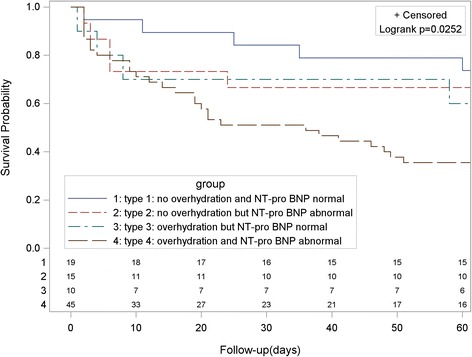
Eighty-nine patients were enrolled, 58 were males, and the mean age was 49.0 ± 17.2 years. The mean score of Acute Physiology and Chronic Health Evaluation II (APACHE II) was 18.8 ± 8.6. The fluid status before CRRT start was as follows: type 1, 21.3% (19 out of 89); type 2, 16.9% (15 out of 89); type 3, 11.2% (10 out of 89); and type 4, 50.6% (45 out of 89). There were significant differences between fluid status types before starting CRRT on baseline values for APACHE II scores, serum creatinine, hemoglobin, platelet count, urine volume, and incidences of oliguria and acute kidney injury (P <0.05). There were significant differences between patients with different fluid status before CRRT start on hospital mortality--type 1, 26.3% (5 out of 19); type 2, 33.3% (5 out of 15); type 3, 40% (4 out of 10); and type 4, 64.4% (29 out of 45) (P = 0.019)--as well as renal function recovery rates: type 1, 57.1% (4 out of 7); type 2, 67.7% (6 out of 9); type 3, 50% (3 out of 6); and type 4, 23.7% (9 out of 38) (P = 0.051).
Fluid status abnormalities were common among patients receiving CRRT. Different types of fluid status distinguished by BIVA combined with serum NT-pro BNP measurements corresponded to different clinical conditions and treatment outcomes, which implies a value of this method for evaluation of fluid status among patients receiving CRRT.
目前尚不清楚通过生物电阻抗矢量分析(BIVA)结合血清N末端B型利钠肽原(NT-pro-BNP)测定所确定的液体状态是否与接受连续性肾脏替代治疗(CRRT)的患者的治疗结果相关。我们的目的是回答这个问题。
筛选入住大学教学医院重症监护病房且需要CRRT的患者进行入组。对于入组患者,在CRRT开始前及之后3天进行BIVA和血清NT-pro BNP测定。根据BIVA和NT-pro BNP测定结果,根据液体状态类型将患者分为四组:1型,两者均正常;2型,BIVA结果正常但NT-pro BNP水平异常;3型,BIVA结果异常但NT-pro BNP水平正常;4型,两者均异常。分析液体状态与结果之间的关联。
共入组89例患者,其中男性58例,平均年龄为49.0±17.2岁。急性生理与慢性健康状况评分系统II(APACHE II)的平均评分为18.8±8.6。CRRT开始前的液体状态如下:1型,21.3%(89例中的19例);2型,16.9%(89例中的15例);3型,11.2%(89例中的10例);4型,50.6%(89例中的45例)。在CRRT开始前,不同液体状态类型在APACHE II评分、血清肌酐、血红蛋白、血小板计数、尿量以及少尿和急性肾损伤发生率的基线值方面存在显著差异(P<0.05)。CRRT开始前不同液体状态的患者在医院死亡率方面存在显著差异——1型,26.3%(19例中的5例);2型,33.3%(15例中的5例);3型,40%(10例中的4例);4型,64.4%(45例中的29例)(P = 0.019)——以及肾功能恢复率方面:1型,57.1%(7例中的4例);2型,67.7%(9例中的6例);3型,50%(6例中的3例);4型,23.7%(38例中的9例)(P = 0.051)。
接受CRRT的患者中液体状态异常很常见。通过BIVA结合血清NT-pro BNP测量区分的不同类型液体状态对应不同的临床情况和治疗结果,这意味着该方法在评估接受CRRT的患者液体状态方面具有价值。