Kusuma Pradiptajati, Cox Murray P, Pierron Denis, Razafindrazaka Harilanto, Brucato Nicolas, Tonasso Laure, Suryadi Helena Loa, Letellier Thierry, Sudoyo Herawati, Ricaut François-Xavier
Laboratoire d'Anthropologie Moléculaire et Imagérie de Synthèse UMR-5288, Université de Toulouse, Toulouse, France.
Genome Diversity and Diseases Laboratory, Eijkman Institute for Molecular Biology, Jakarta, Indonesia.
BMC Genomics. 2015 Mar 17;16(1):191. doi: 10.1186/s12864-015-1394-7.
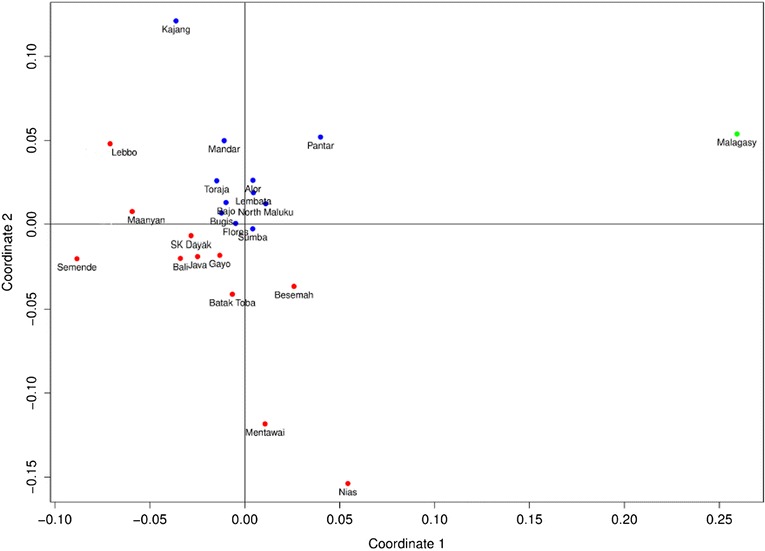
Linguistic, cultural and genetic characteristics of the Malagasy suggest that both Africans and Island Southeast Asians were involved in the colonization of Madagascar. Populations from the Indonesian archipelago played an especially important role because linguistic evidence suggests that the Malagasy language branches from the Southeast Barito language family of southern Borneo, Indonesia, with the closest language spoken today by the Ma'anyan. To test for a genetic link between Malagasy and these linguistically related Indonesian populations, we studied the Ma'anyan and other Indonesian ethnic groups (including the sea nomad Bajo) that, from their historical and linguistic contexts, may be modern descendants of the populations that helped enact the settlement of Madagascar.
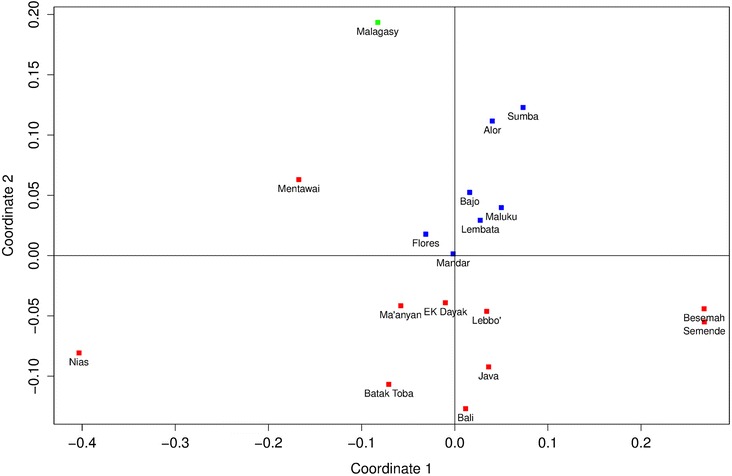
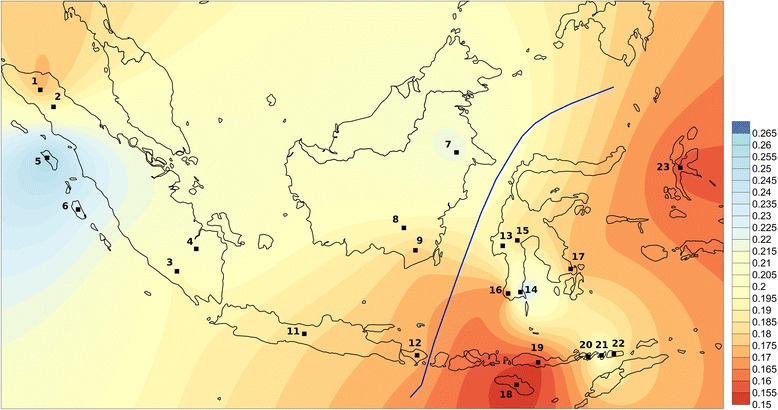
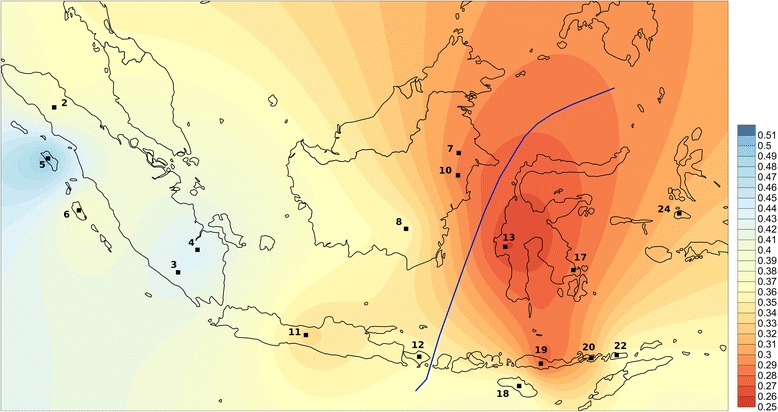
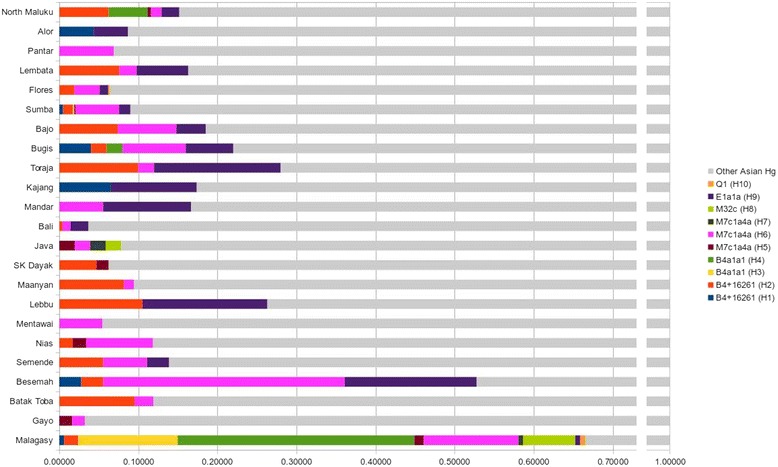
A combination of phylogeographic analysis of genetic distances, haplotype comparisons and inference of parental populations by linear optimization, using both maternal and paternal DNA lineages, suggests that Malagasy derive from multiple regional sources in Indonesia, with a focus on eastern Borneo, southern Sulawesi and the Lesser Sunda islands.
Settlement may have been mediated by ancient sea nomad movements because the linguistically closest population, Ma'anyan, has only subtle genetic connections to Malagasy, whereas genetic links with other sea nomads are more strongly supported. Our data hint at a more complex scenario for the Indonesian settlement of Madagascar than has previously been recognized.
马达加斯加人的语言、文化和遗传特征表明,非洲人和东南亚岛屿居民都参与了马达加斯加的殖民化过程。印度尼西亚群岛的人口发挥了特别重要的作用,因为语言证据表明,马达加斯加语源自印度尼西亚婆罗洲南部的东南巴里托语系,与现今马安扬人所讲的语言最为接近。为了检验马达加斯加人与这些语言相关的印度尼西亚人群之间的基因联系,我们研究了马安扬人和其他印度尼西亚族群(包括海上游牧民族巴焦人),从他们的历史和语言背景来看,这些族群可能是帮助马达加斯加实现定居的人群的现代后裔。
通过对遗传距离进行系统地理学分析、单倍型比较以及利用母系和父系DNA谱系通过线性优化推断亲本群体,结果表明马达加斯加人源自印度尼西亚的多个地区,主要集中在婆罗洲东部、苏拉威西岛南部和小巽他群岛。
定居可能是由古代海上游牧民族的迁徙介导的,因为在语言上最接近的群体马安扬人与马达加斯加人的基因联系很微弱,而与其他海上游牧民族的基因联系得到了更有力的支持。我们的数据表明,印度尼西亚人在马达加斯加的定居情况比之前所认识到的更为复杂。