Jóźwik Maciej, Okungbowa Osazee E, Lipska Alina, Jóźwik Marcin, Smoktunowicz Marzena, Semczuk Andrzej, Jóźwik Michał, Radziwon Piotr
Department of Gynecology and Gynecologic Oncology, Medical University of Białystok, Skłodowskiej 24 A, 15-276, Białystok, Poland.
Regional Center for Transfusion Medicine, Białystok, Poland.
BMC Cancer. 2015 Mar 15;15:129. doi: 10.1186/s12885-015-1136-x.
Of many specialized blood cells, monocytes are gaining increasing attention for their role in neoplastic disorders. The purpose of the present investigation was to determine the expression of selected peripheral blood monocyte surface antigens in cases of cervical, endometrial, and ovarian cancers. In addition, our aim was to validate the diagnostic value of two artificial coefficients recently proposed for the diagnosis of gynecologic malignancies: Neutrophil to Lymphocyte Ratio (NLR), and Multiplication of Neutrophil and Monocyte Counts (MNM).
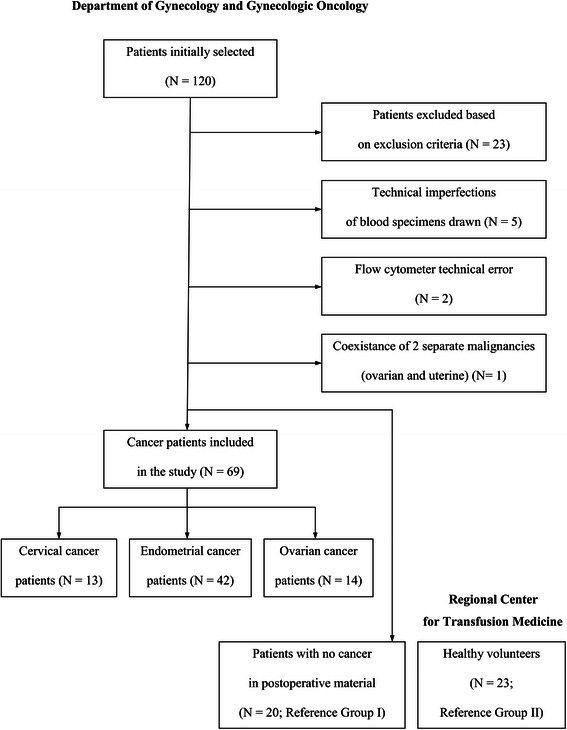
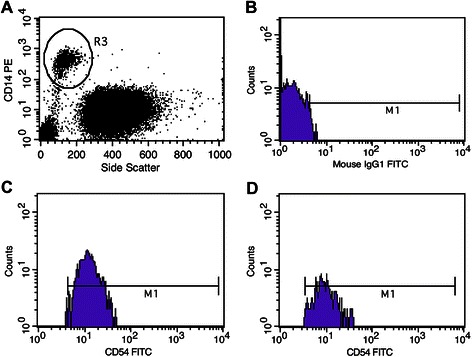
We studied 69 white Caucasian women with histopathologic confirmation of endometrial (N = 42), cervical (N = 13), and ovarian (N = 14) cancers. Reference Group I were women suspected of cancer but histologically nullified (N = 20), and Group II were healthy blood donors (N = 23). Expression of CD11a, CD11b, CD11c, CD16, CD54 (ICAM-1), CD62 L (L-selectin), CD64, and HLA-DR was measured with immunofluorescence in a flow cytometer.
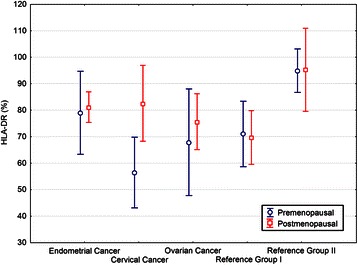
CD54 expression increased by ≥35.6% (p < 0.001) whilst HLA-DR decreased by ≥10.8% (p < 0.001) in all cancer subgroups and Group I as compared to blood donors. A correlation (p < 0.05) between CD54 and CD62 L was stronger in all cancers studied than in healthy subjects. There was no difference in the NLR values between any of these subgroups. Moreover, we observed an increase in MNM parameter in cases of cervical and endometrial cancer and in the Reference Group I.
In the studied gynecologic malignancies, CD54 expression on peripheral blood monocytes is enhanced, indicating a higher transmigrational potential present in such patients, and HLA-DR expression diminished, indicating a decreased readiness of the immune system to recognize foreign antigens. The more pronounced correlation for the expression of CD54 and CD62 L in cancer suggests that monocytes uptake from the bloodstream and their local adhesion increase the pool of tumor-associated macrophages. This study challenged the suggested credibility and usefulness of the artificial parameters of MNM and NLR for the differential diagnosis of gynecologic malignancies.
在众多特殊血细胞中,单核细胞因其在肿瘤性疾病中的作用而受到越来越多的关注。本研究的目的是确定宫颈癌、子宫内膜癌和卵巢癌患者外周血单核细胞表面抗原的表达情况。此外,我们的目的是验证最近提出的用于诊断妇科恶性肿瘤的两个人为系数的诊断价值:中性粒细胞与淋巴细胞比值(NLR)和中性粒细胞与单核细胞计数乘积(MNM)。
我们研究了69名经组织病理学确诊为子宫内膜癌(N = 42)、宫颈癌(N = 13)和卵巢癌(N = 14)的白人女性。第一对照组为疑似癌症但组织学检查排除癌症的女性(N = 20),第二组为健康献血者(N = 23)。使用流式细胞仪通过免疫荧光法检测CD11a、CD11b、CD11c、CD16、CD54(细胞间黏附分子-1)、CD62L(L-选择素)、CD64和HLA-DR的表达。
与献血者相比,所有癌症亚组和第一对照组中,CD54表达增加≥35.6%(p < 0.001),而HLA-DR表达降低≥10.8%(p < 0.001)。在所有研究癌症中,CD54与CD62L之间的相关性(p < 0.05)比健康受试者更强。这些亚组之间的NLR值没有差异。此外,我们观察到宫颈癌和子宫内膜癌患者以及第一对照组中的MNM参数增加。
在所研究的妇科恶性肿瘤中,外周血单核细胞上的CD54表达增强,表明此类患者具有更高的迁移潜能,而HLA-DR表达降低,表明免疫系统识别外来抗原的准备状态降低。癌症中CD54和CD62L表达的相关性更明显,这表明单核细胞从血液中的摄取及其局部黏附增加了肿瘤相关巨噬细胞的数量。本研究对MNM和NLR这两个人为参数在妇科恶性肿瘤鉴别诊断中的可信度和实用性提出了挑战。