Arévalo-Herrera Myriam, Lopez-Perez Mary, Medina Luz, Moreno Alberto, Gutierrez Juan B, Herrera Sócrates
Caucaseco Scientific Research Center, Cali, Colombia.
Faculty of Health, Universidad del Valle, Cali, Colombia.
Malar J. 2015 Apr 11;14:154. doi: 10.1186/s12936-015-0678-3.
Malaria transmission in Latin America is generally hypoendemic and unstable, with Plasmodium vivax as the most prevalent species. However, only a few studies have been carried out in areas with low and unstable transmission, whereas the clinical profile of malaria has been broadly described in hyperendemic areas. The pattern of clinical manifestations and laboratory findings in low to moderate endemic areas of Colombia is reported here.
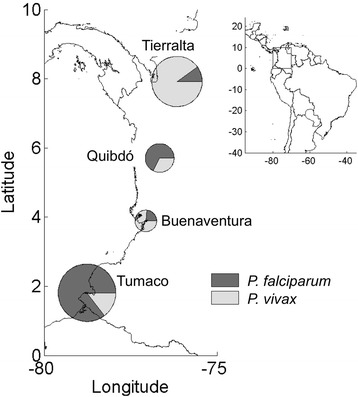
A passive surveillance study was conducted between 2011 and 2013 involving 1,328 patients with Plasmodium falciparum, P. vivax or mixed malaria infections attending malaria points-of-care of four malaria endemic-areas with distinct transmission intensities and parasite distribution. Trained physicians recorded clinical symptoms and signs as well as socio-demographic characteristics of study participants. Haematological, biochemical and urine tests were performed at the time of diagnosis.
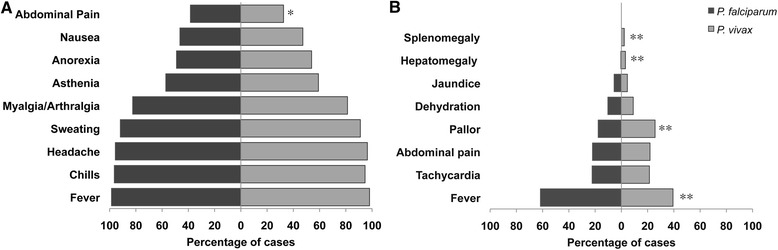
Out of 1,328 cases, 673 (50.7%) were caused by P. vivax; 650 (48.9%) were due to P. falciparum; and five (0.4%) patients had mixed infections (P. falciparum/P. vivax). Most patients (92.5%) presented with uncomplicated malaria characterized by fever, chills, headache, sweating, myalgia/arthralgia and parasitaemia ≤ 20,000 parasites/μL. Fever, tachycardia, pallor and abdominal pain on palpation were more frequent in P. falciparum patients, whereas mild hepatomegaly and splenomegaly were mostly observed with P. vivax. Non-severe anaemia (Hb 7.0-10.9 g/dL) was observed in 20% of the subjects, whereas severe anaemia (Hb < 7.0 g/dL) was present in four patients. Half of the patients presented thrombocytopaenia regardless of parasite species. Leukopaenia, neutrophilia and monocytosis were frequently observed in patients infected with P. falciparum. Mild-to-moderate biochemical alterations were present in ~25% of the patients, particularly abnormal bilirubin in those with P. falciparum and abnormal transaminases in P. vivax malaria patients. Proteinuria was present in ~50% of the patients regardless of parasite species, whereas haemoglobinuria was more common in P. vivax infections. Only 7.5% of the cases were classified as clinically severe malaria, caused by both P. vivax and P. falciparum.
The high prevalence of uncomplicated malaria associated with moderate parasitaemia suggests the importance of timely diagnosis and effective treatment and encourages new activities to further decrease complicated malaria cases and mortality.
拉丁美洲的疟疾传播通常为低流行且不稳定,间日疟原虫是最常见的疟原虫种类。然而,在低传播且不稳定的地区仅开展了少数研究,而疟疾的临床特征在高流行地区已有广泛描述。本文报告了哥伦比亚低至中度流行地区的临床表现和实验室检查结果模式。
2011年至2013年进行了一项被动监测研究,涉及1328例感染恶性疟原虫、间日疟原虫或混合感染的患者,这些患者前往四个疟疾流行强度和寄生虫分布不同的疟疾诊疗点就诊。经过培训的医生记录了研究参与者的临床症状和体征以及社会人口学特征。在诊断时进行了血液学、生化和尿液检查。
在1328例病例中,673例(50.7%)由间日疟原虫引起;650例(48.9%)由恶性疟原虫引起;5例(0.4%)患者为混合感染(恶性疟原虫/间日疟原虫)。大多数患者(92.5%)表现为非重症疟疾,其特征为发热、寒战、头痛、出汗、肌痛/关节痛以及寄生虫血症≤20,000个寄生虫/μL。恶性疟原虫患者发热、心动过速、面色苍白和触诊时腹痛更为常见,而间日疟原虫患者大多观察到轻度肝肿大和脾肿大。20%的受试者出现非重度贫血(血红蛋白7.0 - 10.9 g/dL),4例患者存在重度贫血(血红蛋白<7.0 g/dL)。无论感染何种寄生虫,一半的患者出现血小板减少。感染恶性疟原虫的患者经常出现白细胞减少、中性粒细胞增多和单核细胞增多。约25%的患者存在轻度至中度生化改变,特别是恶性疟原虫感染患者胆红素异常,间日疟原虫疟疾患者转氨酶异常。无论感染何种寄生虫,约50%的患者出现蛋白尿,而血红蛋白尿在间日疟原虫感染中更为常见。仅7.5%的病例被归类为临床重症疟疾,由间日疟原虫和恶性疟原虫共同引起。
与中度寄生虫血症相关的非重症疟疾的高患病率表明及时诊断和有效治疗的重要性,并鼓励开展新的活动以进一步减少复杂疟疾病例和死亡率。