David Érica Boarato, Guimarães Semíramis, de Oliveira Ana Paula, Goulart de Oliveira-Sequeira Teresa Cristina, Nogueira Bittencourt Gabriela, Moraes Nardi Ana Rita, Martins Ribolla Paulo Eduardo, Bueno Franco Regina Maura, Branco Nilson, Tosini Fabio, Bella Antonino, Pozio Edoardo, Cacciò Simone M
Parasitology Department, Institute of Bioscience, São Paulo State University (UNESP), Campus de Botucatu, Botucatu, São Paulo, PO Box: 510, CEP: 18618-970, Brazil.
Department of Animal Biology, Biology Institute, State University of Campinas, Rua Monteiro Lobato 255, Campinas, São Paulo, PO Box: 6109, CEP: 13083-970, Brazil.
Parasit Vectors. 2015 Feb 15;8:103. doi: 10.1186/s13071-015-0714-8.
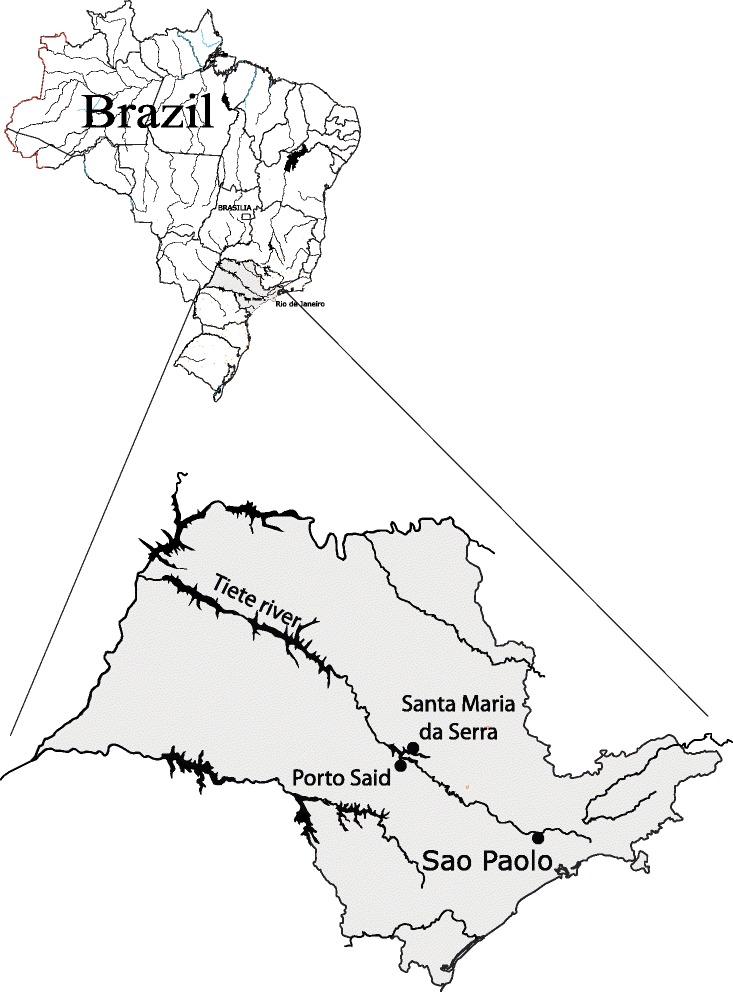
Several species of protozoa cause acute or chronic gastroenteritis in humans, worldwide. The burden of disease is particularly high among children living in developing areas of the world, where transmission is favored by lower hygienic standards and scarce availability of safe water. However, asymptomatic infection and polyparasitism are also commonly observed in poor settings. Here, we investigated the prevalence of intestinal protozoa in two small fishing villages, Porto Said (PS) and Santa Maria da Serra (SM), situated along the river Tietê in the State of São Paolo, Brazil. The villages lack basic public infrastructure and services, such as roads, public water supply, electricity and public health services.
Multiple fecal samples were collected from 88 individuals in PS and from 38 individuals in SM, who were asymptomatic at the time of sampling and had no recent history of diarrheal disease. To gain insights into potential transmission routes, 49 dog fecal samples (38 from PS and 11 from SM) and 28 river water samples were also collected. All samples were tested by microscopy and PCR was used to genotype Giardia duodenalis, Blastocystis sp., Dientamoeba fragilis and Cryptosporidium spp.
By molecular methods, the most common human parasite was Blastocystis sp. (prevalence, 45% in PS and 71% in SM), followed by D. fragilis (13.6% in PS, and 18.4% in SM) and G. duodenalis (18.2% in PS and 7.9% in SM); Cryptosporidium spp. were not detected. Sequence analysis revealed large genetic variation among Blastocystis samples, with subtypes (STs) 1 and 3 being predominant, and with the notable absence of ST4. Among G. duodenalis samples, assemblages A and B were detected in humans, whereas assemblages A, C and D were found in dogs. Finally, all D. fragilis samples from humans were genotype 1. A single dog was found infected with Cryptosporidium canis. River water samples were negative for the investigated parasites.
This study showed a high carriage of intestinal parasites in asymptomatic individuals from two poor Brazilian villages, and highlighted a large genetic variability of Blastocystis spp. and G. duodenalis.
在全球范围内,几种原生动物会导致人类急性或慢性肠胃炎。在世界发展中地区的儿童中,疾病负担尤为严重,那里较低的卫生标准和安全饮用水的匮乏有利于疾病传播。然而,在贫困地区也普遍观察到无症状感染和多重寄生虫感染。在此,我们调查了位于巴西圣保罗州蒂埃特河畔的两个小渔村波尔图塞德(PS)和圣玛丽亚达塞拉(SM)肠道原生动物的流行情况。这些村庄缺乏基本的公共基础设施和服务,如道路、公共供水、电力和公共卫生服务。
从PS村的88人和SM村的38人采集了多个粪便样本,这些人在采样时无症状且近期无腹泻病史。为深入了解潜在传播途径,还采集了49份狗粪便样本(38份来自PS村,11份来自SM村)和28份河水样本。所有样本均通过显微镜检查进行检测,并使用聚合酶链反应(PCR)对十二指肠贾第虫、芽囊原虫、脆弱双核阿米巴和隐孢子虫属进行基因分型。
通过分子方法,最常见的人体寄生虫是芽囊原虫(流行率:PS村为45%,SM村为71%),其次是脆弱双核阿米巴(PS村为13.6%,SM村为18.4%)和十二指肠贾第虫(PS村为18.2%,SM村为7.9%);未检测到隐孢子虫属。序列分析显示芽囊原虫样本间存在较大的基因变异,其中亚型1和3为主,且明显没有亚型4。在十二指肠贾第虫样本中,人体中检测到A和B种群,而狗中发现了A、C和D种群。最后,所有来自人类的脆弱双核阿米巴样本均为基因型1。发现一只狗感染了犬隐孢子虫。河水样本中所调查的寄生虫呈阴性。
本研究表明,巴西两个贫困村庄的无症状个体肠道寄生虫携带率很高,并突出了芽囊原虫属和十二指肠贾第虫的较大基因变异性。