Taddeo Adriano, Khodadadi Laleh, Voigt Caroline, Mumtaz Imtiaz M, Cheng Qingyu, Moser Katrin, Alexander Tobias, Manz Rudolf A, Radbruch Andreas, Hiepe Falk, Hoyer Bimba F
Department of Rheumatology and Clinical Immunology, Charité University Hospital Berlin, Charitéplatz 1, 10117, Berlin, Germany.
German Rheumatism Research Centre, a Leibniz Institute, Charitéplatz 1, 10117, Berlin, Germany.
Arthritis Res Ther. 2015 Mar 2;17(1):39. doi: 10.1186/s13075-015-0551-3.
Autoantibodies contribute significantly to the pathogenesis of systemic lupus erythematosus (SLE). Unfortunately, the long-lived plasma cells (LLPCs) secreting such autoantibodies are refractory to conventional immunosuppressive treatments. Although generated long before the disease becomes clinically apparent, it remains rather unclear whether LLPC generation continues in the established disease. Here, we analyzed the generation of LLPCs, including autoreactive LLPCs, in SLE-prone New Zealand Black/New Zealand White F1 (NZB/W F1) mice over their lifetime, and their regeneration after depletion.
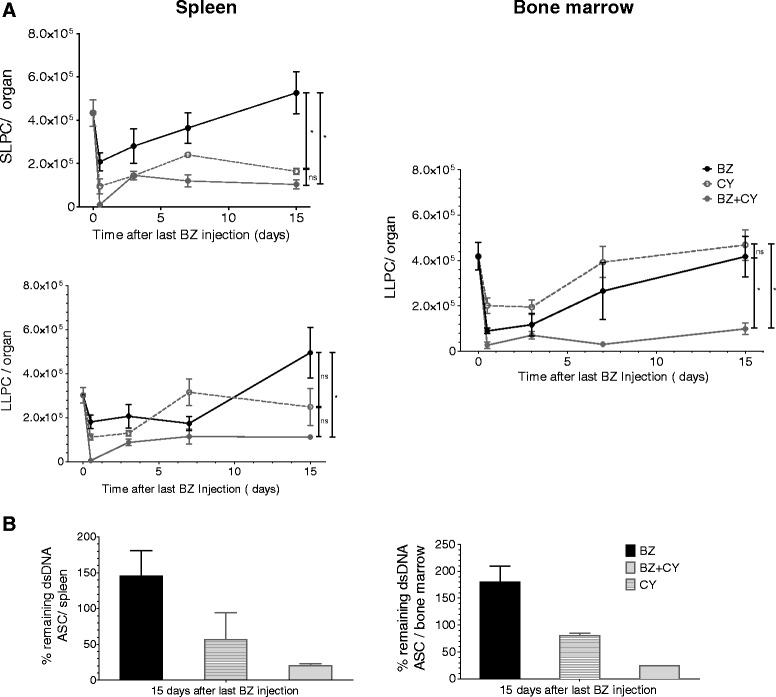
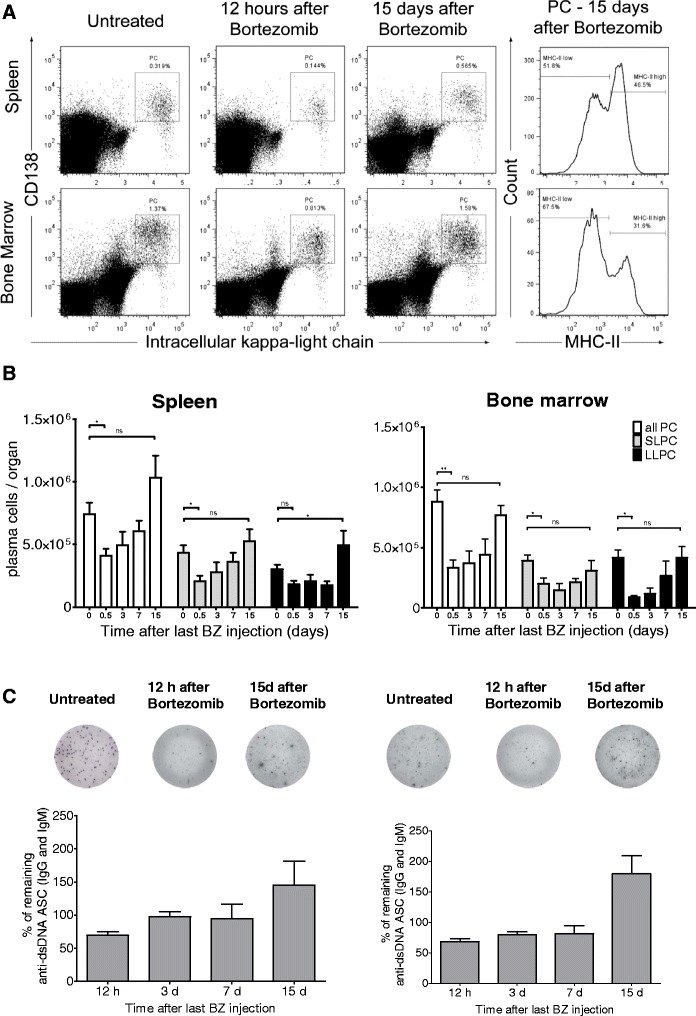
Bromodeoxyuridine pulse-chase experiments in mice of different ages were performed in order to analyze the generation of LLPCs during the development of SLE. LLPCs were enumerated by flow cytometry and autoreactive anti-double-stranded DNA (anti-dsDNA) plasma cells by enzyme-linked immunospot (ELISPOT). For analyzing the regeneration of LLPCs after depletion, mice were treated with bortezomib alone or in combination with cyclophosphamide and plasma cells were enumerated 12 hours, 3, 7, 11 and 15 days after the end of the bortezomib cycle.
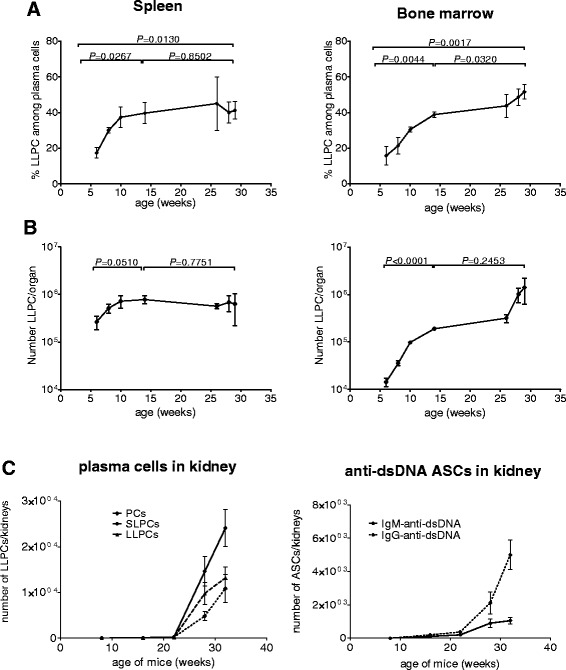
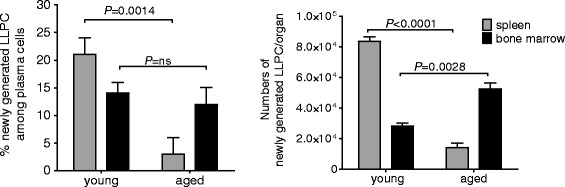
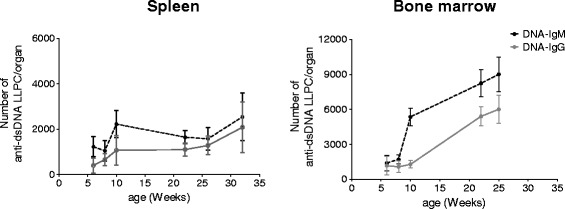
Autoreactive LLPCs are established in the spleen and bone marrow of SLE-prone mice very early in ontogeny, before week 4 and before the onset of symptoms. The generation of LLPCs then continues throughout life. LLPC counts in the spleen plateau by week 10, but continue to increase in the bone marrow and inflamed kidney. When LLPCs are depleted by the proteasome inhibitor bortezomib, their numbers regenerate within two weeks. Persistent depletion of LLPCs was achieved only by combining a cycle of bortezomib with maintenance therapy, for example cyclophosphamide, depleting the precursors of LLPCs or preventing their differentiation into LLPCs.
In SLE-prone NZB/W F1 mice, autoreactive LLPCs are generated throughout life. Their sustained therapeutic elimination requires both the depletion of LLPCs and the inhibition of their regeneration.
自身抗体在系统性红斑狼疮(SLE)的发病机制中起重要作用。不幸的是,分泌此类自身抗体的长寿浆细胞(LLPCs)对传统免疫抑制治疗具有抗性。尽管在疾病临床显现之前很久就已产生,但在已确诊的疾病中LLPCs是否持续产生仍相当不清楚。在此,我们分析了易患SLE的新西兰黑/新西兰白F1(NZB/W F1)小鼠一生中LLPCs(包括自身反应性LLPCs)的产生情况,以及它们在耗竭后的再生情况。
对不同年龄的小鼠进行溴脱氧尿苷脉冲追踪实验,以分析SLE发展过程中LLPCs的产生情况。通过流式细胞术计数LLPCs,通过酶联免疫斑点法(ELISPOT)计数自身反应性抗双链DNA(抗dsDNA)浆细胞。为了分析LLPCs耗竭后的再生情况,小鼠单独接受硼替佐米治疗或与环磷酰胺联合治疗,并在硼替佐米治疗周期结束后的12小时、3天、7天、11天和15天对浆细胞进行计数。
在易患SLE的小鼠中,自身反应性LLPCs在个体发育的早期,即第4周之前和症状出现之前,就在脾脏和骨髓中形成。然后LLPCs的产生在整个生命过程中持续。脾脏中的LLPC计数在第10周达到平稳,但在骨髓和发炎的肾脏中继续增加。当用蛋白酶体抑制剂硼替佐米耗尽LLPCs时,它们的数量在两周内再生。只有通过将一个周期的硼替佐米与维持治疗(例如环磷酰胺)相结合,耗尽LLPCs的前体或阻止它们分化为LLPCs,才能实现对LLPCs的持续消耗。
在易患SLE的NZB/W F1小鼠中,自身反应性LLPCs在整个生命过程中产生。对它们的持续治疗性清除既需要耗尽LLPCs,也需要抑制它们的再生。