Truini Andrea, Piroso Serena, Pasquale Erica, Notartomaso Serena, Di Stefano Giulia, Lattanzi Roberta, Battaglia Giuseppe, Nicoletti Ferdinando, Cruccu Giorgio
Department of Neurology and Psychiatry, University Sapienza, Rome, Italy.
Department of Neurology and Psychiatry, University Sapienza, I.R.C.C.S. Neuromed, Pozzilli, Italy.
Mol Pain. 2015 Mar 20;11:14. doi: 10.1186/s12990-015-0009-2.
Emerging research seeking novel analgesic drugs focuses on agents targeting group-II metabotropic glutamate receptors (mGlu2 and mGlu3 receptors). N-Acetylcysteine (NAC) enhances the endogenous activation of mGlu2/3 receptors by activating the glial glutamate:cystine membrane exchanger. Here, we examined whether NAC inhibits nociceptive responses in humans and animals. We tested the effect of oral NAC (1.2 g) on thermal-pain thresholds and laser-evoked potentials in 10 healthy volunteers, according to a crossover, double-blind, placebo-controlled design, and the effect of NAC (100 mg/kg, i.p.) on the tail-flick response evoked by radiant heat stimulation in mice.
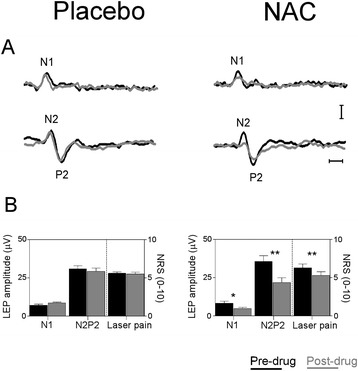
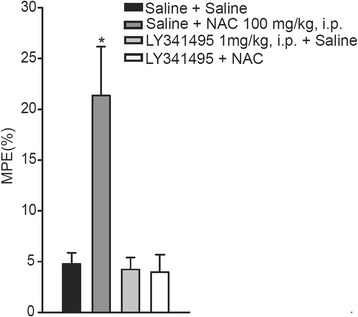
In healthy subjects, NAC treatment left thermal-pain thresholds unchanged, but significantly reduced pain ratings to laser stimuli and amplitudes of laser-evoked potentials. NAC induced significantly greater changes in these measures than placebo. In the tail-flick test, NAC strongly reduced the nocifensive reflex response to radiant heat. The action of NAC was abolished by the preferential mGlu2/3 receptor antagonist, LY341495 (1 mg/kg, i.p.).
Our findings show for the first time that NAC inhibits nociceptive transmission in humans, and does the same in mice by activating mGlu2/3 receptors. These data lay the groundwork for investigating the therapeutic potential of NAC in patients with chronic pain.
寻求新型镇痛药的新兴研究聚焦于靶向II型代谢型谷氨酸受体(mGlu2和mGlu3受体)的药物。N-乙酰半胱氨酸(NAC)通过激活胶质细胞谷氨酸:胱氨酸膜转运体增强mGlu2/3受体的内源性激活。在此,我们研究了NAC是否抑制人和动物的伤害性反应。我们根据交叉、双盲、安慰剂对照设计,测试了口服NAC(1.2克)对10名健康志愿者热痛阈值和激光诱发电位的影响,以及NAC(100毫克/千克,腹腔注射)对小鼠辐射热刺激诱发的甩尾反应的影响。
在健康受试者中,NAC治疗未改变热痛阈值,但显著降低了对激光刺激的疼痛评分和激光诱发电位的幅度。NAC在这些指标上引起的变化比安慰剂显著更大。在甩尾试验中,NAC强烈降低了对辐射热的伤害性反射反应。NAC的作用被优先的mGlu2/3受体拮抗剂LY341495(1毫克/千克,腹腔注射)消除。
我们的研究结果首次表明,NAC在人类中抑制伤害性传递,在小鼠中也通过激活mGlu2/3受体起到同样作用。这些数据为研究NAC在慢性疼痛患者中的治疗潜力奠定了基础。