Brzoska Edyta, Kowalski Kamil, Markowska-Zagrajek Agnieszka, Kowalewska Magdalena, Archacki Rafał, Plaskota Izabela, Stremińska Władysława, Jańczyk-Ilach Katarzyna, Ciemerych Maria A
Department of Cytology, Faculty of Biology, University of Warsaw, Miecznikowa 1, 02-096, Warsaw, Poland.
Department of Molecular and Translational Oncology, Maria Skłodowska-Curie Memorial Cancer Center and Institute of Oncology, Roentgena 5, 02-781, Warsaw, Poland.
Stem Cell Res Ther. 2015 Mar 24;6(1):46. doi: 10.1186/s13287-015-0041-1.
Understanding the mechanism of stem cell mobilization into injured skeletal muscles is a prerequisite step for the development of muscle disease therapies. Many of the currently studied stem cell types present myogenic potential; however, when introduced either into the blood stream or directly into the tissue, they are not able to efficiently engraft injured muscle. For this reason their use in therapy is still limited. Previously, we have shown that stromal-derived factor-1 (Sdf-1) caused the mobilization of endogenous (not transplanted) stem cells into injured skeletal muscle improving regeneration. Here, we demonstrate that the beneficial effect of Sdf-1 relies on the upregulation of the tetraspanin CD9 expression in stem cells.
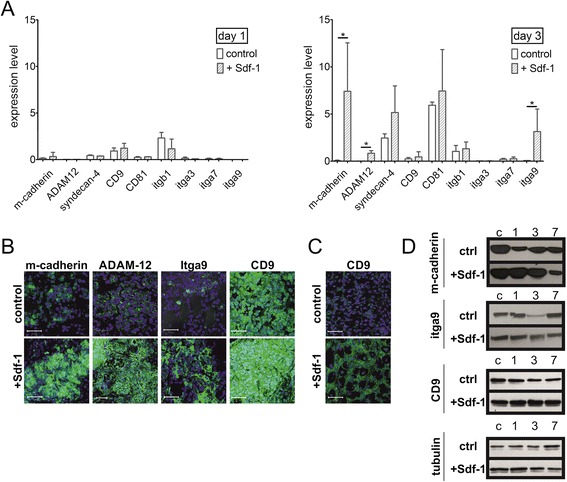
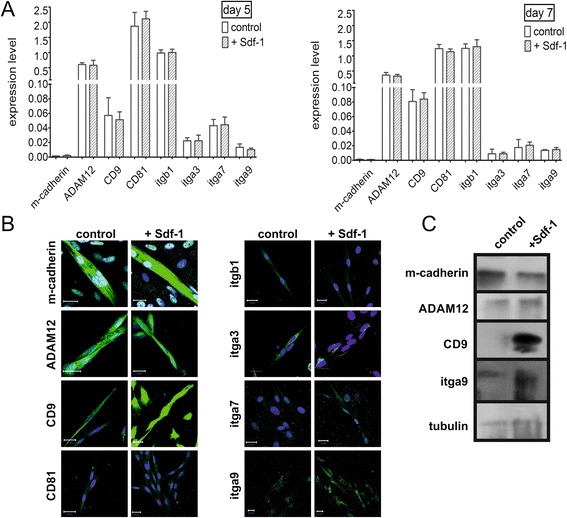
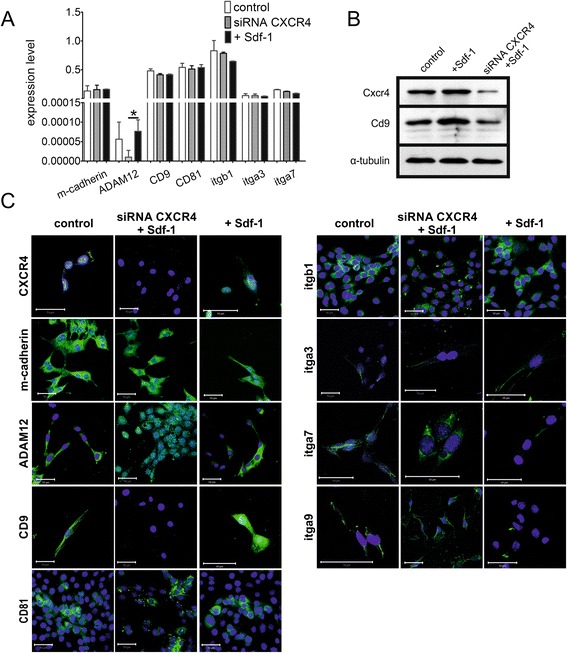
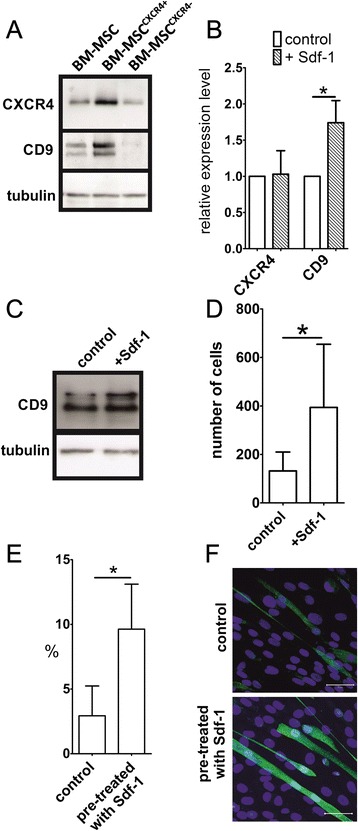
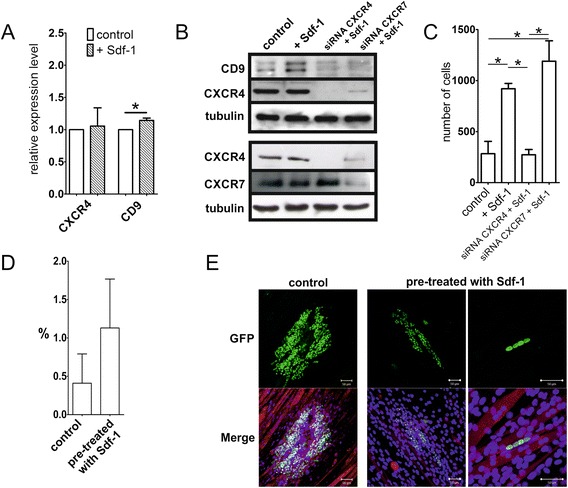
The expression pattern of adhesion proteins, including CD9, was analysed after Sdf-1 treatment during regeneration of rat skeletal muscles and mouse Pax7-/- skeletal muscles, that are characterized by the decreased number of satellite cells. Next, we examined the changes in CD9 level in satellite cells-derived myoblasts, bone marrow-derived mesenchymal stem cells, and embryonic stem cells after Sdf-1 treatment or silencing expression of CXCR4 and CXCR7. Finally, we examined the potential of stem cells to fuse with myoblasts after Sdf-1 treatment.
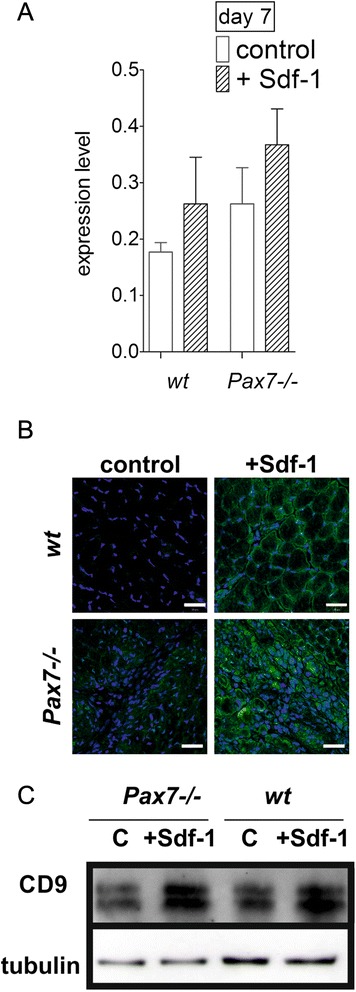
In vivo analyses of Pax7-/- mice strongly suggest that Sdf-1-mediates increase in CD9 levels also in mobilized stem cells. In the absence of CXCR4 receptor the effect of Sdf-1 on CD9 expression is blocked. Next, in vitro studies show that Sdf-1 increases the level of CD9 not only in satellite cell-derived myoblasts but also in bone marrow derived mesenchymal stem cells, as well as embryonic stem cells. Importantly, the Sdf-1 treated cells migrate and fuse with myoblasts more effectively.
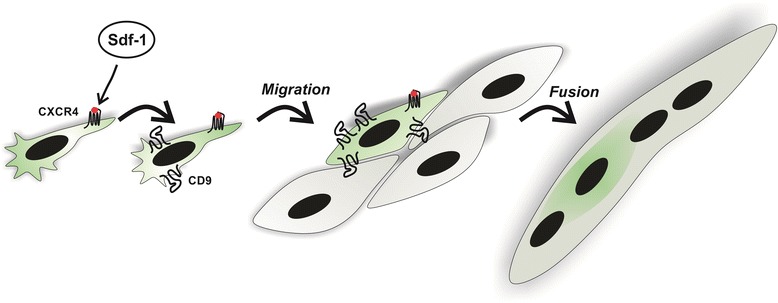
We suggest that Sdf-1 binding CXCR4 receptor improves skeletal muscle regeneration by upregulating expression of CD9 and thus, impacting at stem cells mobilization to the injured muscles.
了解干细胞动员至受损骨骼肌的机制是开发肌肉疾病治疗方法的前提步骤。目前研究的许多干细胞类型都具有成肌潜力;然而,当将它们引入血流或直接引入组织时,它们无法有效地植入受损肌肉。因此,它们在治疗中的应用仍然有限。此前,我们已经表明基质细胞衍生因子-1(Sdf-1)可促使内源性(未移植的)干细胞动员至受损骨骼肌,从而改善再生。在此,我们证明Sdf-1的有益作用依赖于干细胞中四跨膜蛋白CD9表达的上调。
在大鼠骨骼肌和小鼠Pax7-/-骨骼肌再生过程中,分析了Sdf-1处理后包括CD9在内的黏附蛋白的表达模式,这些骨骼肌的特征是卫星细胞数量减少。接下来,我们检测了Sdf-1处理或沉默CXCR4和CXCR7表达后,卫星细胞来源的成肌细胞、骨髓来源的间充质干细胞和胚胎干细胞中CD9水平的变化。最后,我们检测了Sdf-1处理后干细胞与成肌细胞融合的潜力。
对Pax7-/-小鼠的体内分析有力地表明,Sdf-1介导的动员干细胞中CD9水平也会增加。在没有CXCR4受体的情况下,Sdf-1对CD9表达的作用被阻断。接下来,体外研究表明,Sdf-1不仅能增加卫星细胞来源的成肌细胞中的CD9水平,还能增加骨髓来源的间充质干细胞以及胚胎干细胞中的CD9水平。重要的是,经Sdf-1处理的细胞迁移并与成肌细胞更有效地融合。
我们认为,Sdf-1与CXCR4受体结合可通过上调CD9的表达来改善骨骼肌再生,从而影响干细胞向受损肌肉的动员。