a Department of Cytology , Faculty of Biology, University of Warsaw , Warsaw , Poland.
b Department of Molecular and Translational Oncology , Maria Skłodowska-Curie Memorial Cancer Center and Institute of Oncology , Warsaw , Poland.
Cell Adh Migr. 2017 Jul 4;11(4):384-398. doi: 10.1080/19336918.2016.1227911. Epub 2016 Oct 13.
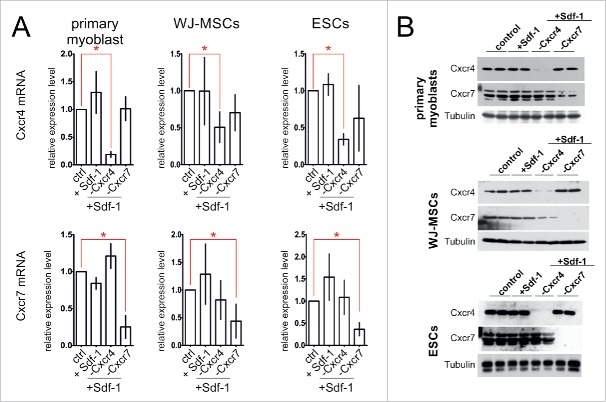
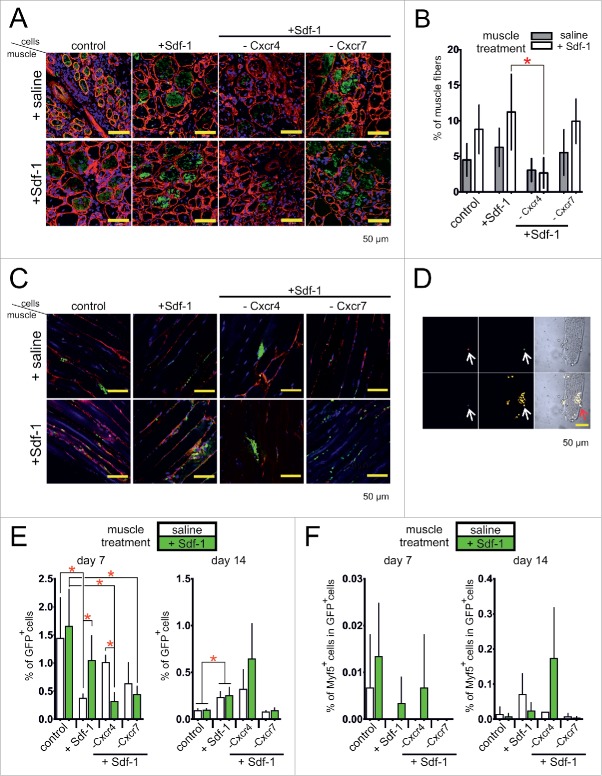
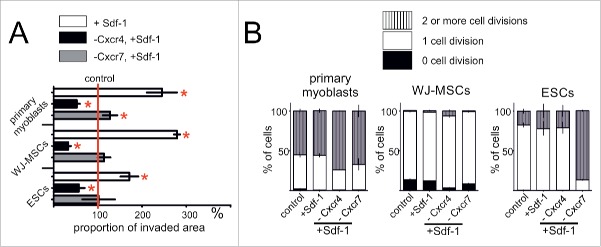
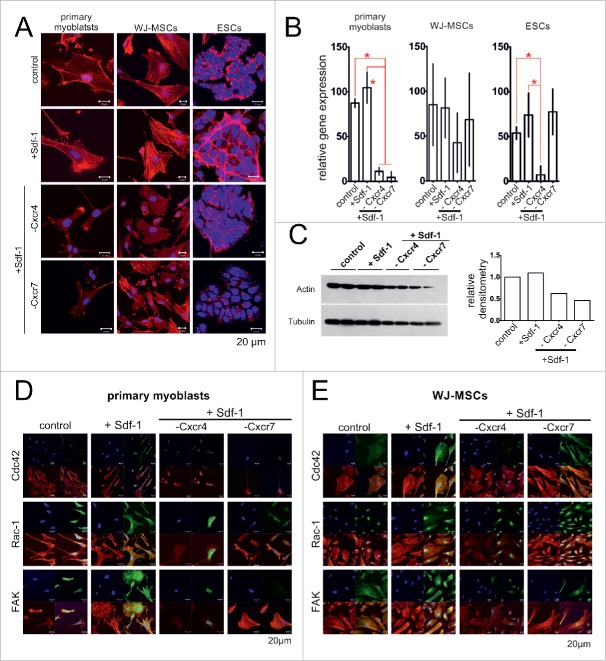
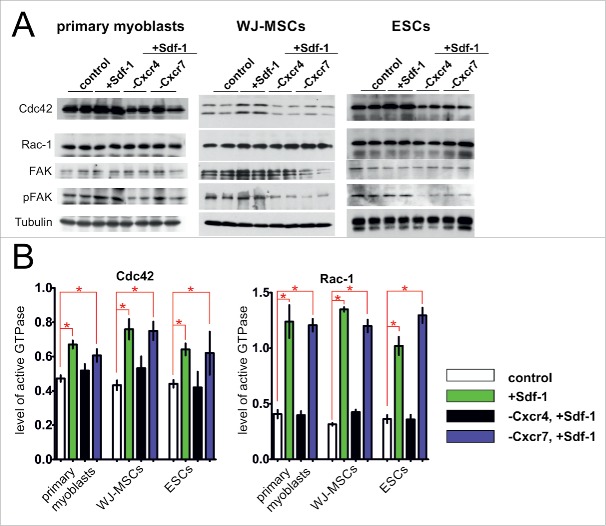
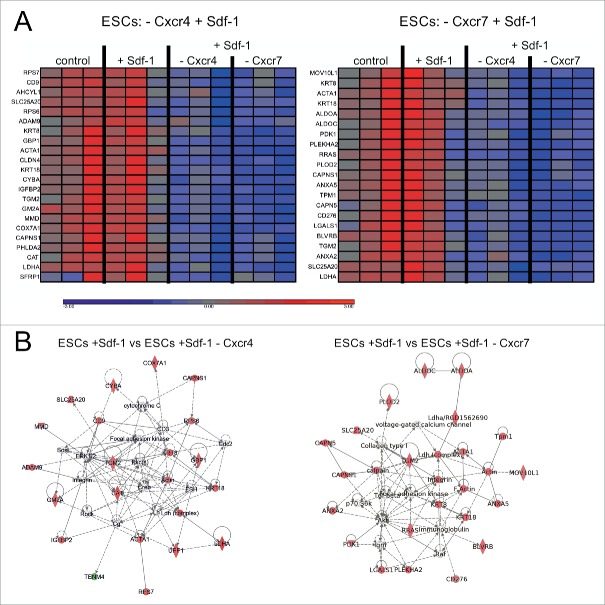
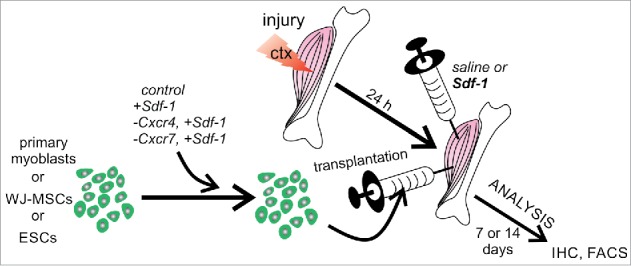
The skeletal muscle regeneration occurs due to the presence of tissue specific stem cells - satellite cells. These cells, localized between sarcolemma and basal lamina, are bound to muscle fibers and remain quiescent until their activation upon muscle injury. Due to pathological conditions, such as extensive injury or dystrophy, skeletal muscle regeneration is diminished. Among the therapies aiming to ameliorate skeletal muscle diseases are transplantations of the stem cells. In our previous studies we showed that Sdf-1 (stromal derived factor -1) increased migration of stem cells and their fusion with myoblasts in vitro. Importantly, we identified that Sdf-1 caused an increase in the expression of tetraspanin CD9 - adhesion protein involved in myoblasts fusion. In the current study we aimed to uncover the details of molecular mechanism of Sdf-1 action. We focused at the Sdf-1 receptors - Cxcr4 and Cxcr7, as well as signaling pathways induced by these molecules in primary myoblasts, as well as various stem cells - mesenchymal stem cells and embryonic stem cells, i.e. the cells of different migration and myogenic potential. We showed that Sdf-1 altered actin organization via FAK (focal adhesion kinase), Cdc42 (cell division control protein 42), and Rac-1 (Ras-Related C3 Botulinum Toxin Substrate 1). Moreover, we showed that Sdf-1 modified the transcription profile of genes encoding factors engaged in cells adhesion and migration. As the result, cells such as primary myoblasts or embryonic stem cells, became characterized by more effective migration when transplanted into regenerating muscle.
骨骼肌再生是由于组织特异性干细胞——卫星细胞的存在。这些细胞位于肌膜和基膜之间,与肌纤维结合并保持静止,直到肌肉损伤后被激活。由于病理条件,如广泛损伤或萎缩,骨骼肌再生能力减弱。在旨在改善骨骼肌疾病的治疗方法中,包括干细胞移植。在我们之前的研究中,我们表明 Sdf-1(基质衍生因子-1)增加了干细胞的迁移及其与成肌细胞的融合体外。重要的是,我们确定 Sdf-1 导致四跨膜蛋白 CD9 的表达增加-参与成肌细胞融合的粘附蛋白。在本研究中,我们旨在揭示 Sdf-1 作用的分子机制的细节。我们专注于 Sdf-1 受体——Cxcr4 和 Cxcr7,以及这些分子在原代成肌细胞以及各种干细胞-间充质干细胞和胚胎干细胞中诱导的信号通路,即具有不同迁移和成肌潜力的细胞。我们表明 Sdf-1 通过 FAK(粘着斑激酶)、Cdc42(细胞分裂控制蛋白 42)和 Rac-1(Ras-Related C3 Botulinum Toxin Substrate 1)改变肌动蛋白组织。此外,我们表明 Sdf-1 修饰了参与细胞黏附和迁移的基因的转录谱。结果,当移植到再生肌肉中时,原代成肌细胞或胚胎干细胞等细胞表现出更有效的迁移能力。