Malmström Marlene, Klefsgard Rosemarie, Ivarsson Bodil, Roman Maria, Johansson Jan
Clinical Sciences, Lund University, Lund, Sweden.
Department of surgery, Skane University Hospital, Lund, Sweden.
BMC Health Serv Res. 2015 Mar 12;15:96. doi: 10.1186/s12913-015-0747-x.
Oesophagectomy is a major procedure with known side effects and reduced postoperative quality of life (QOL). It has been shown that support of patients in their new life situation is often lacking. Knowledge about how QOL changes over time is fundamental for addressing patient needs and for determining the optimal timing of supportive care. The aim of this study was to identify QOL changes over time as well as factors that may impact patient QOL during the first year after oesophagectomy for cancer.
Patients operated on for adenocarcinoma or squamous cell cancer of the oesophagus were included in this study. Seventy-nine patients completed the European Organisation for Research and Treatment of Cancer QOL questionnaires (QLQ-C30 and QLQ-OES18) before and 2, 4, 6, 9, and 12 months after surgery. A general linear model with repeated measurement analysis of variance was used for statistical testing.
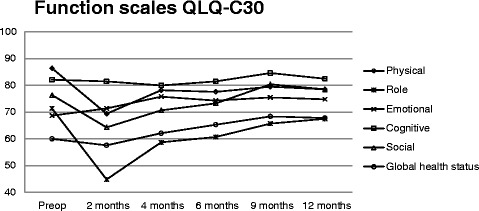
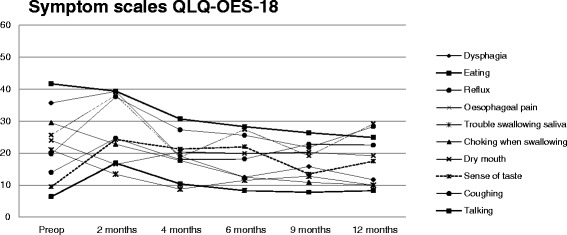
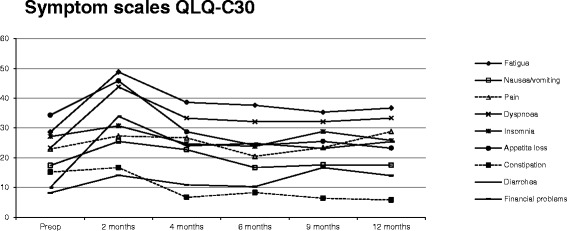
There was a significant QOL nadir at 2 months compared to 12 months after surgery (QLQ-C30 function scales p < 0.001, symptom scales p < 0.001, QLQ-OES18 scales p < 0.001). Treatment with proton-pump inhibitors was associated with enhanced QOL according to QLQ-C30 symptom scales (p = 0.003) and OES-18 scales (p = 0.015), but age, gender and American Society of Anaesthesiologists classification did not significantly impact QOL.
Patient QOL is severely hampered the first year after oesophagectomy for cancer, with a nadir at 2 months after surgery. Treatment with proton-pump inhibitors improved patient responses to symptom scales. Evidence of severely affected QOL after surgery indicates that these patients need support at an early stage after surgery. These results can be used by healthcare professionals to develop a postoperative supportive-care programme that is timed and better optimised to meet patient needs.
EudraCT database 2009-009997-28.
食管切除术是一项具有已知副作用且会降低术后生活质量(QOL)的大型手术。研究表明,患者在新的生活状况下往往缺乏支持。了解生活质量如何随时间变化是满足患者需求和确定支持性护理最佳时机的基础。本研究的目的是确定食管癌食管切除术后第一年生活质量的变化以及可能影响患者生活质量的因素。
本研究纳入了因食管腺癌或鳞状细胞癌接受手术的患者。79名患者在手术前以及术后2、4、6、9和12个月完成了欧洲癌症研究与治疗组织生活质量问卷(QLQ-C30和QLQ-OES18)。采用具有重复测量方差分析的一般线性模型进行统计检验。
与术后12个月相比,术后2个月时生活质量显著降至最低点(QLQ-C30功能量表p<0.001,症状量表p<0.001,QLQ-OES18量表p<0.001)。根据QLQ-C30症状量表(p = 0.003)和OES-18量表(p = 0.015),质子泵抑制剂治疗与生活质量提高相关,但年龄、性别和美国麻醉医师协会分级对生活质量无显著影响。
食管癌食管切除术后第一年患者的生活质量受到严重影响,术后2个月时降至最低点。质子泵抑制剂治疗改善了患者对症状量表的反应。术后生活质量严重受影响的证据表明,这些患者在术后早期需要支持。医护人员可利用这些结果制定一个术后支持性护理计划,该计划经过时间安排并得到更好优化,以满足患者需求。
欧洲药品管理局临床试验数据库2009-009997-28。