
RNA测序揭示了BET抑制剂JQ1介导的对脂多糖诱导的BV-2小胶质细胞激活的调节作用背后的不同机制。
RNA sequencing reveals distinct mechanisms underlying BET inhibitor JQ1-mediated modulation of the LPS-induced activation of BV-2 microglial cells.
作者信息
Jung Kyoung Hwa, Das Amitabh, Chai Jin Choul, Kim Sun Hwa, Morya Nishi, Park Kyoung Sun, Lee Young Seek, Chai Young Gyu
机构信息
Department of Molecular and Life Science, Hanyang University, 1271 Sa 3-dong, Ansan, Gyeonggi-do, 426-791, South Korea.
Department of Bionanotechnology, Hanyang University, 222 Wangsimni-ro, Seoul, 133-791, South Korea.
出版信息
J Neuroinflammation. 2015 Feb 24;12:36. doi: 10.1186/s12974-015-0260-5.
BACKGROUND
Microglial cells become rapidly activated through interaction with pathogens, and their persistent activation is associated with the production and secretion of various pro-inflammatory genes, cytokines, and chemokines, which may initiate or amplify neurodegenerative diseases. Bromodomain and extraterminal domain (BET) proteins are a group of epigenetic regulators that associate with acetylated histones and facilitate the transcription of target genes. A novel synthetic BET inhibitor, JQ1, was proven to exert immunosuppressive activities by inhibiting the expression of IL-6 and Tnf-α in macrophages. However, a genome-wide search for JQ1 molecular targets is largely unexplored in microglia.
METHODS
The present study was aimed at evaluating the anti-inflammatory function and underlying genes targeted by JQ1 in lipopolysaccharide (LPS)-stimulated BV-2 microglial cells using two transcriptomic techniques: global transcriptomic biological duplicate RNA sequencing and quantitative real-time PCR. Associated biological pathways and functional gene ontology were also evaluated.
RESULTS
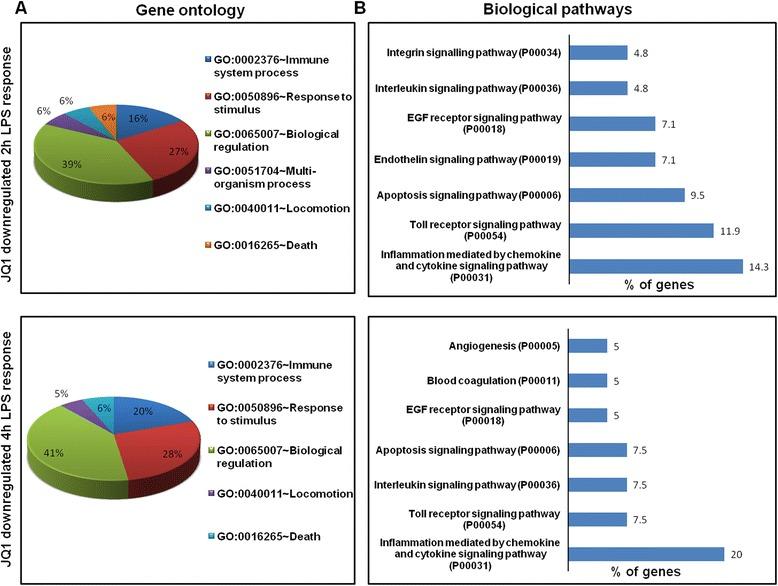
With a cutoff value of P ≤ 0.01 and fold change ≥1.5 log2, the expression level of 214 and 301 genes, including pro-inflammatory cytokine, chemokine, and transcription factors, was found to be upregulated in BV-2 cells stimulated with LPS for 2 and 4 h, respectively. Among these annotated genes, we found that JQ1 selectively reduced the expression of 78 and 118 genes (P ≤ 0.01, and fold change ≥ 1.5, respectively). Importantly, these inflammatory genes were not affected by JQ1 treatment alone. Furthermore, we confirmed that JQ1 reduced the expression of key inflammation- and immunity-related genes as well as cytokines/chemokines in the supernatants of LPS-treated primary microglial cells isolated from 3-day-old ICR mice. Utilizing functional group analysis, the genes affected by JQ1 were classified into four categories related to biological regulation, immune system processes, and response to stimuli. Moreover, the biological pathways and functional genomics obtained in this study may facilitate the suppression of different key inflammatory genes through JQ1-treated BV-2 microglial cells.
CONCLUSIONS
These unprecedented results suggest the BET inhibitor JQ1 as a candidate for the prevention or therapeutic treatment of inflammation-mediated neurodegenerative diseases.
背景
小胶质细胞通过与病原体相互作用而迅速被激活,其持续激活与多种促炎基因、细胞因子和趋化因子的产生及分泌有关,这些因子可能引发或加剧神经退行性疾病。溴结构域和额外末端结构域(BET)蛋白是一组表观遗传调节因子,它们与乙酰化组蛋白结合并促进靶基因的转录。一种新型合成BET抑制剂JQ1已被证明可通过抑制巨噬细胞中IL-6和Tnf-α的表达发挥免疫抑制活性。然而,在小胶质细胞中对JQ1分子靶点进行全基因组搜索的研究在很大程度上尚未开展。
方法
本研究旨在使用两种转录组技术——全转录组生物学重复RNA测序和定量实时PCR,评估JQ1在脂多糖(LPS)刺激的BV-2小胶质细胞中的抗炎功能及潜在靶向基因。还评估了相关的生物学途径和功能基因本体。
结果
以P≤0.01和变化倍数≥1.5 log2为截断值,发现在用LPS刺激2小时和4小时的BV-2细胞中,分别有214个和301个基因的表达水平上调,这些基因包括促炎细胞因子、趋化因子和转录因子。在这些注释基因中,我们发现JQ1分别选择性地降低了78个和118个基因的表达(P≤0.01,变化倍数分别≥1.5)。重要的是,这些炎症基因不受单独JQ1处理的影响。此外,我们证实JQ1降低了从3日龄ICR小鼠分离的LPS处理的原代小胶质细胞上清液中关键炎症和免疫相关基因以及细胞因子/趋化因子的表达。通过功能组分析,受JQ1影响的基因被分为与生物调节、免疫系统过程和对刺激的反应相关的四类。此外,本研究中获得的生物学途径和功能基因组学可能有助于通过JQ1处理的BV-2小胶质细胞抑制不同的关键炎症基因。
结论
这些前所未有的结果表明BET抑制剂JQ1可作为预防或治疗炎症介导的神经退行性疾病的候选药物。


 Zotero 插件