Hemmingsen Jette G, Rissler Jenny, Lykkesfeldt Jens, Sallsten Gerd, Kristiansen Jesper, Møller P Peter, Loft Steffen
Department of Public Health, Section of Environmental Health, Faculty of Health and Medical Sciences, University of Copenhagen, Øster Farimagsgade 5A, DK-1014, Copenhagen K, Denmark.
Division of Ergonomics and Aerosol Technology, Department of Design Sciences, Lund University, P.O. Box 118, SE-221 00, Lund, Sweden.
Part Fibre Toxicol. 2015 Mar 19;12:6. doi: 10.1186/s12989-015-0081-9.
Exposure to particulate matter (PM) is generally associated with elevated risk of cardiovascular morbidity and mortality. Elderly and obese subjects may be particularly susceptible, although short-term effects are poorly described.
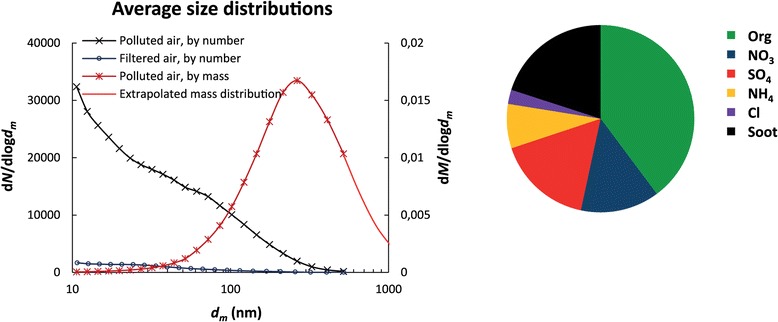
Sixty healthy subjects (25 males, 35 females, age 55 to 83 years, body mass index>25 kg/m2) were included in a cross-over study with 5 hours of exposure to particle- or sham-filtered air from a busy street using an exposure-chamber. The sham- versus particle-filtered air had average particle number concentrations of 23.000 versus ~1800/cm3 and PM2.5 levels of 24 versus 3 μg/m3, respectively. The PM contained similar fractions of elemental and black carbon (20-25%) in both exposure scenarios. Reactive hyperemia and nitroglycerin-induced vasodilation in finger arteries and heart rate variability (HRV) measured within 1 h after exposure were primary outcomes. Potential explanatory mechanistic variables included markers of oxidative stress (ascorbate/dehydroascorbate, nitric oxide-production cofactor tetrahydrobiopterin and its oxidation product dihydrobiopterin) and inflammation markers (C-reactive protein and leukocyte differential counts).
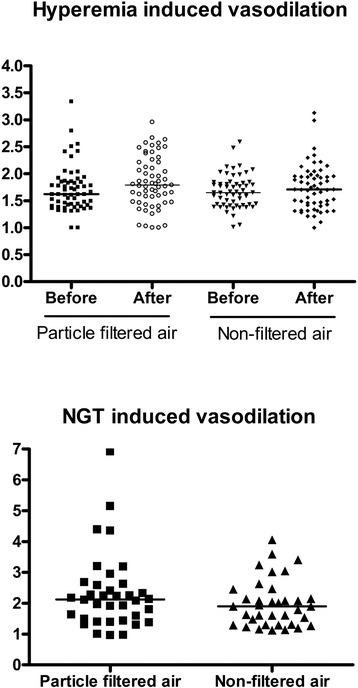
Nitroglycerin-induced vasodilation was reduced by 12% [95% confidence interval: -22%; -1.0%] following PM exposure, whereas hyperemia-induced vasodilation was reduced by 5% [95% confidence interval: -11.6%; 1.6%]. Moreover, HRV measurements showed that the high and low frequency domains were significantly decreased and increased, respectively. Redox and inflammatory status did not change significantly based on the above measures.
This study indicates that exposure to real-life levels of PM from urban street air impairs the vasomotor function and HRV in overweight middle-aged and elderly adults, although this could not be explained by changes in inflammation, oxidative stress or nitric oxide-cofactors.
接触颗粒物(PM)通常与心血管疾病发病率和死亡率升高有关。尽管对短期影响的描述较少,但老年人和肥胖者可能特别易感。
60名健康受试者(25名男性,35名女性,年龄55至83岁,体重指数>25kg/m²)被纳入一项交叉研究,使用暴露室让他们暴露于繁忙街道的颗粒物过滤空气或假过滤空气中5小时。假过滤空气与颗粒物过滤空气的平均颗粒数浓度分别约为23,000个/cm³和1800个/cm³,PM2.5水平分别为24μg/m³和3μg/m³。在两种暴露情况下,PM中元素碳和黑碳的比例相似(约20 - 25%)。暴露后1小时内测量的手指动脉反应性充血和硝酸甘油诱导的血管舒张以及心率变异性(HRV)是主要结局。潜在的解释性机制变量包括氧化应激标志物(抗坏血酸/脱氢抗坏血酸、一氧化氮产生辅助因子四氢生物蝶呤及其氧化产物二氢生物蝶呤)和炎症标志物(C反应蛋白和白细胞分类计数)。
暴露于PM后,硝酸甘油诱导的血管舒张降低了12% [95%置信区间:-22%;-1.0%],而充血诱导的血管舒张降低了5% [95%置信区间:-11.6%;1.6%]。此外,HRV测量显示高频域和低频域分别显著降低和升高。基于上述指标,氧化还原和炎症状态没有显著变化。
本研究表明,接触城市街道空气中实际水平的PM会损害超重中老年成年人的血管运动功能和HRV,尽管这无法通过炎症、氧化应激或一氧化氮辅助因子的变化来解释。