Oberweis Brandon S, Smilowitz Nathaniel R, Nukala Swetha, Rosenberg Andrew, Xu Jinfeng, Stuchin Steven, Iorio Richard, Errico Thomas, Radford Martha J, Berger Jeffrey S
Division of Cardiology, Department of Medicine, Columbia University Medical Center, New York, New York.
Division of Cardiology, Department of Medicine, New York University Langone Medical Center, New York, New York.
Am J Cardiol. 2015 Jun 15;115(12):1643-8. doi: 10.1016/j.amjcard.2015.03.003. Epub 2015 Mar 23.
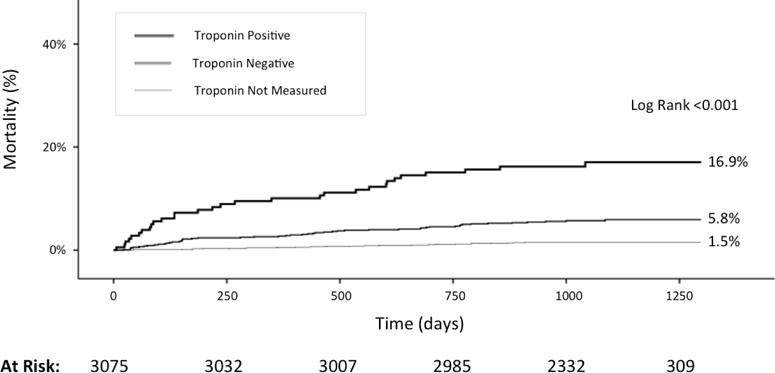
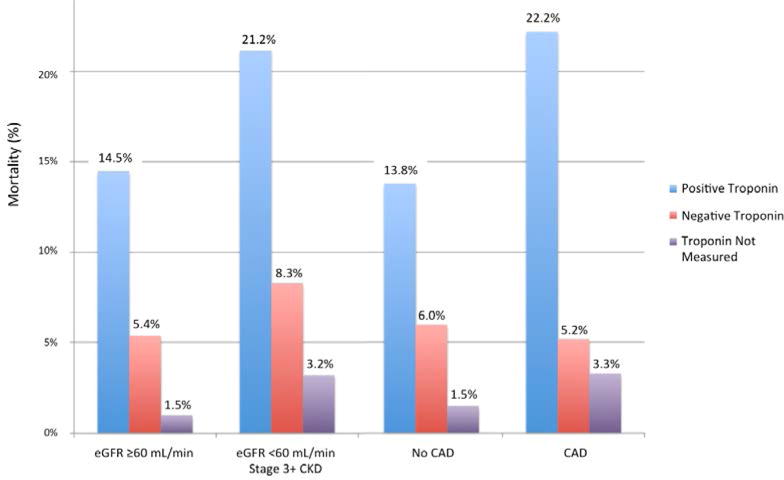
Myocardial necrosis in the perioperative period of noncardiac surgery is associated with short-term mortality, but long-term outcomes have not been characterized. We investigated the association between perioperative troponin elevation and long-term mortality in a retrospective study of consecutive subjects who underwent hip, knee, and spine surgery. Perioperative myocardial necrosis and International Classification of Disease, Ninth Revision-coded myocardial infarction (MI) were recorded. Long-term survival was assessed using the Social Security Death Index database. Logistic regression models were used to identify independent predictors of long-term mortality. A total of 3,050 subjects underwent surgery. Mean age was 60.8 years, and 59% were women. Postoperative troponin was measured in 1,055 subjects (34.6%). Myocardial necrosis occurred in 179 cases (5.9%), and MI was coded in 20 (0.7%). Over 9,015 patient-years of follow-up, 111 deaths (3.6%) occurred. Long-term mortality was 16.8% in subjects with myocardial necrosis and 5.8% with a troponin in the normal range. Perioperative troponin elevation (hazard ratio 2.33, 95% confidence interval 1.33 to 4.10) and coded postoperative MI (adjusted hazard ratio 3.51, 95% confidence interval 1.44 to 8.53) were significantly associated with long-term mortality after multivariable adjustment. After excluding patients with coronary artery disease and renal dysfunction, myocardial necrosis remained associated with long-term mortality. In conclusion, postoperative myocardial necrosis is common after orthopedic surgery. Myocardial necrosis is independently associated with long-term mortality at 3 years and may be used to identify patients at higher risk for events who may benefit from aggressive management of cardiovascular risk factors.
非心脏手术围术期的心肌坏死与短期死亡率相关,但长期预后尚未明确。我们在一项对连续接受髋、膝和脊柱手术患者的回顾性研究中,调查了围术期肌钙蛋白升高与长期死亡率之间的关联。记录围术期心肌坏死情况以及国际疾病分类第九版编码的心肌梗死(MI)。使用社会保障死亡指数数据库评估长期生存率。采用逻辑回归模型确定长期死亡率的独立预测因素。共有3050例患者接受手术。平均年龄为60.8岁,女性占59%。1055例患者(34.6%)术后检测了肌钙蛋白。179例(5.9%)发生心肌坏死,20例(0.7%)编码为MI。经过超过9015患者年的随访,发生111例死亡(3.6%)。心肌坏死患者的长期死亡率为16.8%,肌钙蛋白在正常范围的患者为5.8%。多变量调整后,围术期肌钙蛋白升高(风险比2.33,95%置信区间1.33至4.10)和术后编码的MI(调整后风险比3.51,95%置信区间1.44至8.53)与长期死亡率显著相关。排除冠状动脉疾病和肾功能不全患者后,心肌坏死仍与长期死亡率相关。总之,骨科手术后术后心肌坏死很常见。心肌坏死与3年长期死亡率独立相关,可用于识别可能从积极管理心血管危险因素中获益的高风险事件患者。