Paiz Leonardo Marcel, Baumgärtner Lucas, da Graça Weferson Júnio, Margarido Vladimir Pavan
Universidade Estadual do Oeste do Paraná,,Centro de Ciências Biológicas e da Saúde, CEP: 85819-110, Cascavel, PR, Brazil.
Universidade Estadual de Maringá, Departamento de Biologia Celular e Genética, CEP 87020-900, Maringá, Paraná, Brazil.
Comp Cytogenet. 2015 Feb 9;9(1):51-65. doi: 10.3897/CompCytogen.v9i1.9002. eCollection 2015.
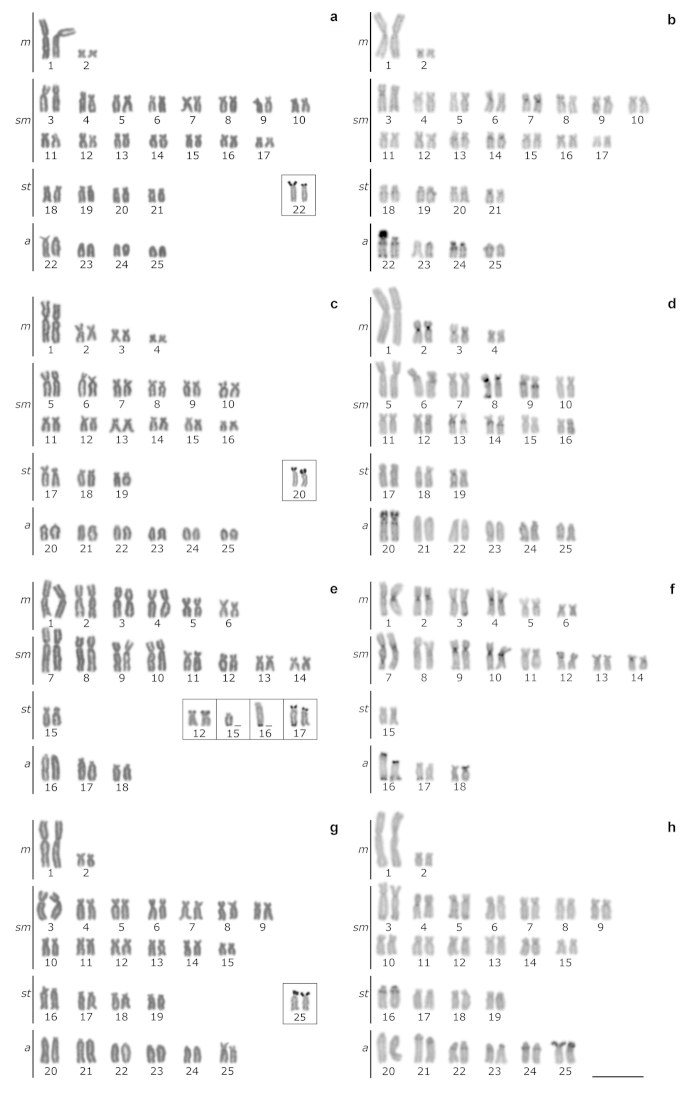
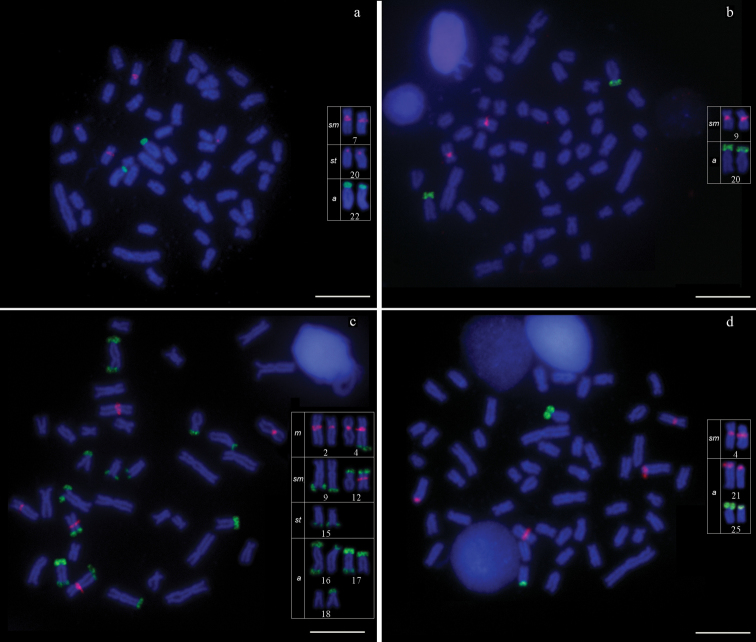
Karyotypes and chromosomal characteristics of both minor and major rDNAs in four fish species known popularly as "lambaris", namely Astyanaxabramis (Jenyns, 1842), Astyanaxasuncionensis Géry, 1972, Astyanaxcorrentinus (Holmberg, 1891) and Astyanax sp. collected from downstream of the Iguassu Falls (Middle Paraná River basin), preservation area of the Iguassu National Park, were analyzed by conventional and molecular protocols. Astyanaxabramis had diploid chromosome number 2n=50 (4m+30sm+8st+8a) and single AgNORs (pair 22), Astyanaxasuncionensis had 2n=50 (8m+24sm+6st+12a) and single AgNORs (pair 20), Astyanax sp. had 2n=50 (4m+26sm+8st+12a) and single AgNORs (pair 25), and Astyanaxcorrentinus had 2n=36 (12m+16sm+2st+6a) and multiple AgNORs (pairs 12, 15, 16, 17). FISH with 18S rDNA showed a single site for Astyanaxabramis, Astyanaxasuncionensis and Astyanax sp. and multiple for Astyanaxcorrentinus (14 sites). FISH with 5S rDNA showed single 5S-bearing loci chromosome pair only for Astyanaxasuncionensis and multiple for Astyanaxabramis (four sites), Astyanaxcorrentinus (five sites) and Astyanax sp. (four sites). Distinct distribution patterns of heterochromatin were observed for karyotypes of all species, with the exception of the first acrocentric chromosome pair characterized by centromeric, interstitial-proximal and telomeric blocks of heterochromatin on the long arm, which may represent homeology between karyotypes of Astyanaxabramis and Astyanaxasuncionensis. Our study showed species-specific characteristics which can serve in diagnosis and differentiation between Astyanaxabramis and Astyanaxasuncionensis, considered cryptic species, as well as strengthening the occurrence of a species of Astyanax not yet described taxonomically. In addition, the data obtained from first cytogenetic studies in Astyanaxcorrentinus suggest a high similarity with Astyanaxschubarti Britski, 1964, suggesting that these species may belong to the same morphological group and that can be phylogenetically related.
对俗称“兰巴里鱼”的四种鱼类(即詹氏丽脂鲤(Astyanax abramis,1842年詹尼斯命名)、阿松森丽脂鲤(Astyanax asuncionensis,1972年热里命名)、科伦蒂纳丽脂鲤(Astyanax correntinus,1891年霍尔姆贝格命名)以及采集自伊瓜苏瀑布下游(巴拉那河中游流域,伊瓜苏国家公园保护区)的丽脂鲤属未定种(Astyanax sp.))的核型和主要及次要核糖体DNA的染色体特征,采用传统和分子方法进行了分析。詹氏丽脂鲤的二倍体染色体数为2n = 50(4条中着丝粒染色体 + 30条亚中着丝粒染色体 + 8条近端着丝粒染色体 + 8条端着丝粒染色体),且有单个银染核仁组织区(位于第22对染色体);阿松森丽脂鲤的二倍体染色体数为2n = 50(8条中着丝粒染色体 + 24条亚中着丝粒染色体 + 6条近端着丝粒染色体 + 12条端着丝粒染色体),且有单个银染核仁组织区(位于第20对染色体);丽脂鲤属未定种的二倍体染色体数为2n = 50(4条中着丝粒染色体 + 26条亚中着丝粒染色体 + 8条近端着丝粒染色体 + 12条端着丝粒染色体),且有单个银染核仁组织区(位于第25对染色体);科伦蒂纳丽脂鲤的二倍体染色体数为2n = 36(12条中着丝粒染色体 + 16条亚中着丝粒染色体 + 2条近端着丝粒染色体 + 6条端着丝粒染色体),且有多个银染核仁组织区(位于第12、15、16、17对染色体)。用18S核糖体DNA进行荧光原位杂交显示,詹氏丽脂鲤、阿松森丽脂鲤和丽脂鲤属未定种有单个位点,而科伦蒂纳丽脂鲤有多个位点(14个位点)。用5S核糖体DNA进行荧光原位杂交显示,只有阿松森丽脂鲤的含5S核糖体DNA的位点位于单个染色体对,而詹氏丽脂鲤有多个位点(4个位点),科伦蒂纳丽脂鲤有多个位点(5个位点),丽脂鲤属未定种有多个位点(4个位点)。除了第一条近端着丝粒染色体对,在所有物种的核型中均观察到不同的异染色质分布模式,该近端着丝粒染色体对的长臂上有着丝粒、近中部和端粒异染色质块,这可能代表詹氏丽脂鲤和阿松森丽脂鲤核型之间的同源性。我们的研究显示了物种特异性特征,这些特征可用于诊断和区分被视为隐存种的詹氏丽脂鲤和阿松森丽脂鲤,同时也加强了尚未进行分类描述的丽脂鲤属一个物种的存在证据。此外,从对科伦蒂纳丽脂鲤的首次细胞遗传学研究中获得的数据表明,它与1964年布里茨基命名的舒氏丽脂鲤(Astyanax schubarti)高度相似,这表明这些物种可能属于同一形态组且在系统发育上相关。