Otto Gordon P, Hurtado-Oliveros Jorge, Chung Ha-Yeun, Knoll Kristin, Neumann Thomas, Müller Hans J, Herbsleb Marco, Kohl Matthias, Busch Martin, Sossdorf Maik, Claus Ralf A
Center for Sepsis Control and Care, Jena University Hospital, Jena, Germany; Clinic for Anesthesiology and Intensive Care, Jena University Hospital, Jena, Germany.
Center for Sepsis Control and Care, Jena University Hospital, Jena, Germany.
PLoS One. 2015 Apr 20;10(4):e0124429. doi: 10.1371/journal.pone.0124429. eCollection 2015.
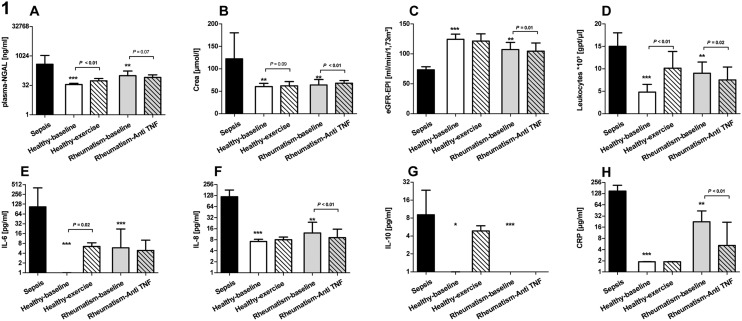
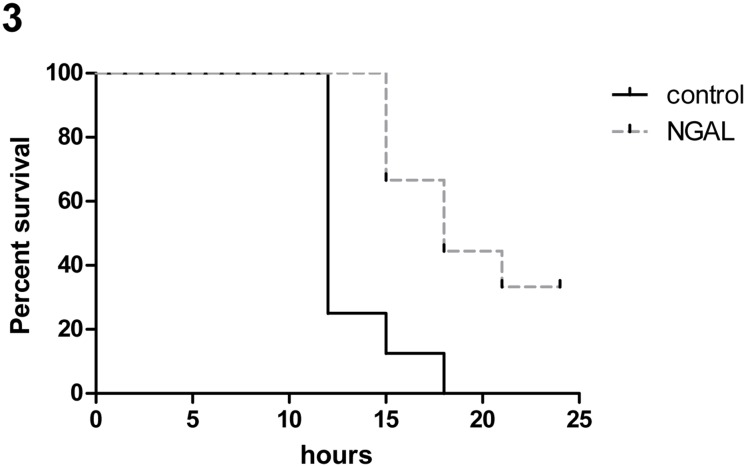
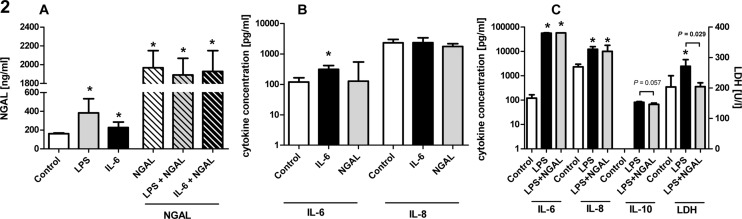
Acute kidney injury (AKI) during sepsis is common and underestimated. Plasma neutrophil gelatinase-associated lipocalin (plasma-NGAL) is discussed as new biomarker for AKI diagnosis, but during inflammation its function and diagnostic impact remain unclear. The association between plasma-NGAL and inflammatory markers in septic patients, but also in healthy controls and patients with chronic inflammation before and after either maximum exercise test or treatment with an anti-TNF therapy were investigated. In-vitro blood stimulations with IL-6, lipopolysaccharide, NGAL or its combinations were performed to investigate cause-effect-relationship. Plasma-NGAL levels were stronger associated with inflammation markers including IL-6 (Sepsis: r = 0.785 P < 0.001; chronic inflammation after anti-TNF: r = 0.558 P < 0.001), IL-8 (Sepsis: r = 0.714 P<0.004; healthy controls after exercise r = 0.786 P < 0.028; chronic inflammation before anti-TNF: r = 0.429 P < 0.041) and IL-10 (healthy controls before exercise: r = 0.791 P < 0.028) than with kidney injury or function. Correlation to kidney injury or function was found only in septic patients (for creatinine: r = 0.906 P < 0.001; for eGFR: r = -0.686 P = 0.005) and in patients with rheumatic disease after anti-TNF therapy (for creatinine: r = 0.466 P < 0.025). In stimulation assays with IL-6 and lipopolysaccharide plasma-NGAL was increased. Co-stimulation of lipopolysaccharide with plasma-NGAL decreased cellular injury (P < 0.05) and in trend IL-10 levels (P = 0.057). Septic mice demonstrated a significantly improved survival rate after NGAL treatment (P < 0.01). Plasma-NGAL seams to be strongly involved in inflammation. For clinical relevance, it might not only be useful for AKI detection during severe inflammation - indeed it has to be interpreted carefully within this setting - but additionally might offer therapeutic potential.
脓毒症期间的急性肾损伤(AKI)很常见且易被低估。血浆中性粒细胞明胶酶相关脂质运载蛋白(血浆-NGAL)被视为AKI诊断的新生物标志物,但在炎症期间其功能和诊断意义仍不明确。研究了脓毒症患者、健康对照者以及接受抗TNF治疗前后的慢性炎症患者血浆-NGAL与炎症标志物之间的关联。还进行了用白细胞介素-6(IL-6)、脂多糖、NGAL或其组合进行的体外血液刺激实验,以研究因果关系。血浆-NGAL水平与包括IL-6(脓毒症:r = 0.785,P < 0.001;抗TNF治疗后的慢性炎症:r = 0.558,P < 0.001)、IL-8(脓毒症:r = 0.714,P < 0.004;运动后的健康对照者:r = 0.786,P < 0.028;抗TNF治疗前的慢性炎症:r = 0.429,P < 0.041)和IL-10(运动前的健康对照者:r = 0.791,P < 0.028)在内的炎症标志物的相关性,比与肾损伤或肾功能的相关性更强。仅在脓毒症患者(肌酐:r = 0.906,P < 0.001;估算肾小球滤过率:r = -0.686,P = 0.005)和抗TNF治疗后的风湿性疾病患者(肌酐:r = 0.466,P < 0.025)中发现了与肾损伤或肾功能的相关性。在IL-6和脂多糖刺激实验中,血浆-NGAL水平升高。脂多糖与血浆-NGAL共同刺激可降低细胞损伤(P < 0.05),且IL-10水平有降低趋势(P = 0.057)。脓毒症小鼠在接受NGAL治疗后存活率显著提高(P < 0.01)。血浆-NGAL似乎与炎症密切相关。就临床相关性而言,它可能不仅对严重炎症期间的AKI检测有用——实际上在这种情况下必须谨慎解读——而且还可能具有治疗潜力。