
猪科动物中Toll样受体(TLRs)的适应性进化
Adaptive Evolution of Toll-Like Receptors (TLRs) in the Family Suidae.
作者信息
Darfour-Oduro Kwame A, Megens Hendrik-Jan, Roca Alfred L, Groenen Martien A M, Schook Lawrence B
机构信息
Department of Animal Sciences, University of Illinois, Urbana-Champaign, Illinois, United States of America.
Animal Breeding and Genomics Centre, Wageningen University, Wageningen, The Netherlands.
出版信息
PLoS One. 2015 Apr 20;10(4):e0124069. doi: 10.1371/journal.pone.0124069. eCollection 2015.
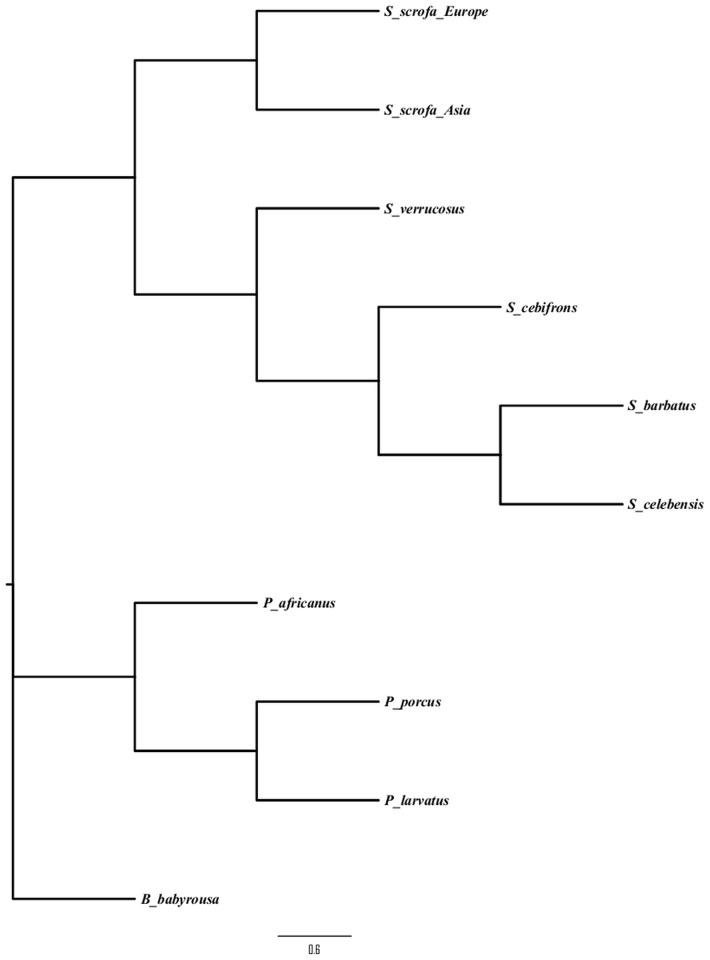
Members of the family Suidae have diverged over extended evolutionary periods in diverse environments, suggesting that adaptation in response to endemic infectious agents may have occurred. Toll-like receptors (TLRs) comprise a multigene family that acts as the first line of defense against infectious microbes at the host-environment interface. We hypothesized that across the Suidae, positive selection mediated by infectious agents has contributed to the evolution of TLR diversity. Thus, we analyzed Sus scrofa, Sus barbatus, Sus verrucosus, Sus celebensis, Sus scebifrons, Babyrousa babyrussa, Potamochoerus larvatus, Potamochoerus porcus and Phacochoerus africanus genomes. Specifically, analyses were performed to identify evidence of positive selection using Maximum likelihood (ML) methods within a phylogenetic framework for bacterial and viral sensing Suidae TLR extracellular domains. Our analyses did not reveal evidence of positive selection for TLR3 and TLR7, suggesting strong functional conservation among these two genes for members of the Suidae. Positive selection was inferred for Suidae TLR1, TLR2, TLR6 and TLR8 evolution. ML methods identified amino acid sites of the bacterial sensing TLR1, TLR2, TLR6 and the viral sensing TLR8 to be under persistent positive selection. Some of these sites are in close proximity to functionally relevant sites, further strengthening the case for pathogen mediated selection for these sites. The branch leading to the genus Sus demonstrated evidence of episodic positive selection for TLR1, indicating selection mediated by infectious agents encountered within the specific geographic origin of the Sus. These results indicate that species of the Suidae have positively selected residues within functional domains of TLRs reflective of prior infections. Thus, TLR genes represent candidates for experimental validation to determine their functional role in antibacterial and antiviral activity within members of the Suidae.
猪科动物在不同环境中经历了漫长的进化分歧,这表明可能已经发生了针对地方性感染因子的适应性变化。Toll样受体(TLR)是一个多基因家族,在宿主与环境的界面上作为抵御感染性微生物的第一道防线。我们假设,在整个猪科动物中,由感染因子介导的正选择促进了TLR多样性的进化。因此,我们分析了野猪、须猪、疣猪、西里伯斯野猪、菲律宾野猪、鹿豚、非洲河猪、非洲野猪和非洲疣猪的基因组。具体而言,在系统发育框架内,使用最大似然(ML)方法对猪科动物TLR细胞外结构域进行细菌和病毒感知分析,以确定正选择的证据。我们的分析没有发现TLR3和TLR7存在正选择的证据,这表明这两个基因在猪科动物成员中具有很强的功能保守性。推断猪科动物TLR1、TLR2、TLR6和TLR8的进化存在正选择。ML方法确定,细菌感知TLR1、TLR2、TLR6和病毒感知TLR8的氨基酸位点处于持续的正选择之下。其中一些位点靠近功能相关位点,进一步支持了这些位点由病原体介导选择的观点。通向猪属的分支显示出TLR1存在间歇性正选择的证据,表明在猪属的特定地理起源中遇到的感染因子介导了选择。这些结果表明,猪科动物的物种在TLR功能域内对反映先前感染的残基进行了正选择。因此,TLR基因是实验验证的候选对象,以确定它们在猪科动物成员的抗菌和抗病毒活性中的功能作用。


 Zotero 插件