Zhu Yi-Ping, Wan Fang-Ning, Shen Yi-Jun, Wang Hong-Kai, Zhang Gui-Ming, Ye Ding-Wei
Department of Urology, Fudan University Shanghai Cancer Center, Fudan University, Shanghai, China.
Department of Oncology, Shanghai Medical College, Fudan University, Shanghai, China.
Oncotarget. 2015 Jun 10;6(16):14488-96. doi: 10.18632/oncotarget.3697.
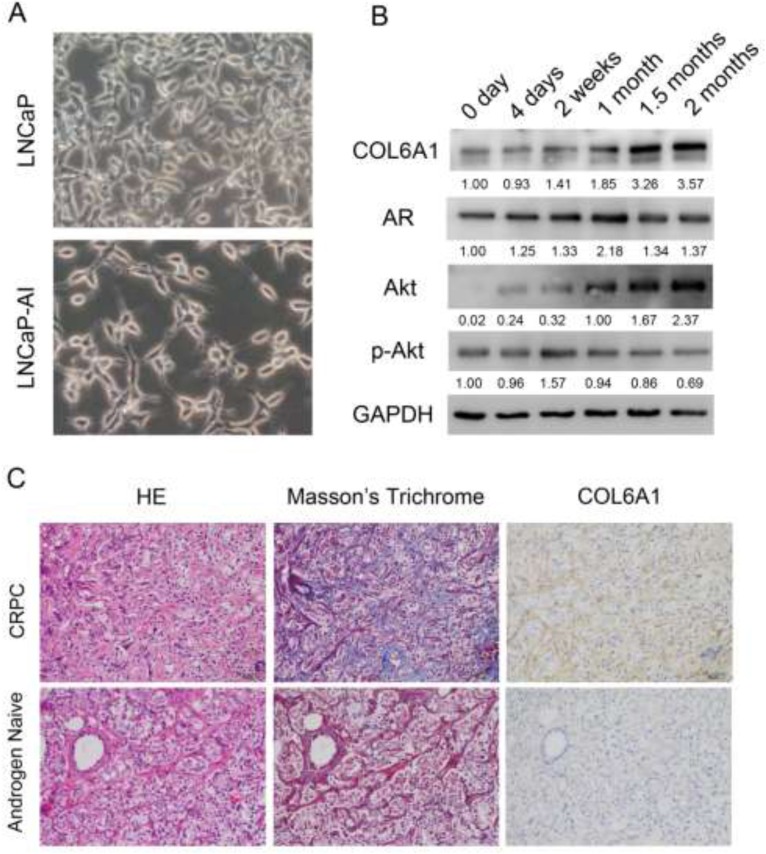
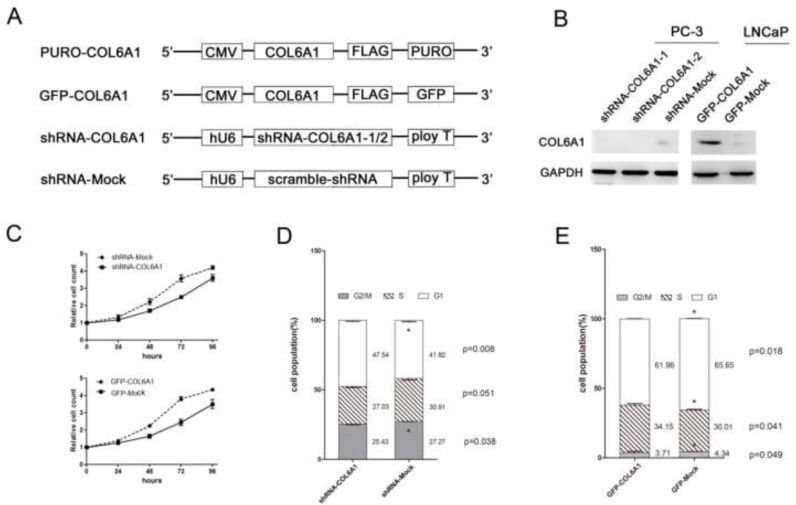
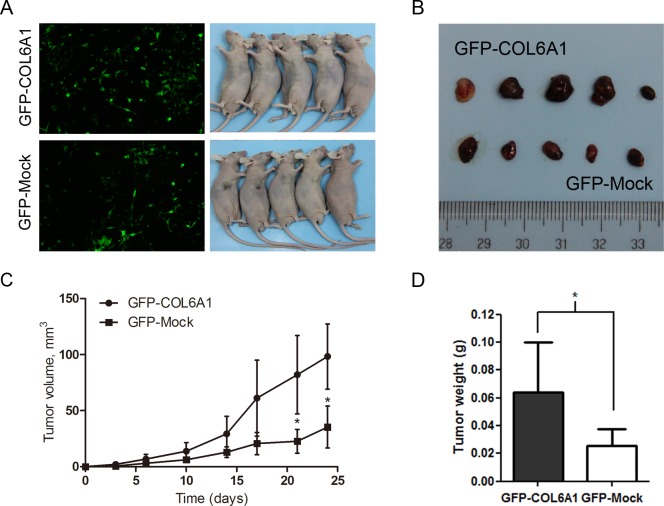
Castration-resistant prostate cancer (CRPC) remains the most critical challenge in the clinical management of prostate cancer (PCa). Reactive stromal changes in PCa are likely involved in the emergence of CRPC. In the present study, we identified a novel oncogene termed COL6A1 which was upregulated in the reactive stroma of CRPC. We established an androgen-independent LNCaP (LNCaP-AI) cell line in steroid-reduced (SR) medium within 2 months. We examined COL6A1 expression with western blot during the LNCaP-AI induction, and studied the function of COL6A1 in vitro and in vivo. Immunohistochemical staining of COL6A1 was performed in ten pairs of androgen-sensitive PCa and CRPC samples. We demonstrated that COL6A1 expression was markedly increased in LNCaP-AI cells and CRPC tissues compared with LNCaP cells and paired androgen-sensitive PCa specimens. In vitro, COL6A1 knockdown resulted in G1-S cell cycle arrest and descended vitality. Overexpression of COL6A1 was associated with accelerated S phase entry and elevated vitality in prostate cancer cells. COL6A1 also promoted tumorigenesis of LNCaP cells in vivo. Taken together, these data suggest an important role of COL6A1 in the molecular etiology of castration-resistant prostate cancer, and support the potential use of COL6A1 in CRPC therapy.
去势抵抗性前列腺癌(CRPC)仍然是前列腺癌(PCa)临床管理中最关键的挑战。PCa中的反应性基质变化可能与CRPC的出现有关。在本研究中,我们鉴定了一种名为COL6A1的新型癌基因,其在CRPC的反应性基质中上调。我们在2个月内在类固醇减少(SR)培养基中建立了雄激素非依赖性LNCaP(LNCaP-AI)细胞系。我们在LNCaP-AI诱导过程中用蛋白质印迹法检测COL6A1表达,并在体外和体内研究COL6A1的功能。对十对雄激素敏感的PCa和CRPC样本进行了COL6A1的免疫组织化学染色。我们证明,与LNCaP细胞和配对的雄激素敏感PCa标本相比,LNCaP-AI细胞和CRPC组织中COL6A1表达明显增加。在体外,COL6A1敲低导致G1-S细胞周期停滞并降低活力。COL6A1的过表达与前列腺癌细胞中S期进入加速和活力升高有关。COL6A1还在体内促进LNCaP细胞的肿瘤发生。综上所述,这些数据表明COL6A1在去势抵抗性前列腺癌的分子病因学中起重要作用,并支持COL6A1在CRPC治疗中的潜在应用。