Ye Changrong, Tenorio Fatima A, Argayoso May A, Laza Marcelino A, Koh Hee-Jong, Redoña Edilberto D, Jagadish Krishna S V, Gregorio Glenn B
International Rice Research Institute, DAPO Box 7777, Metro Manila, 1301, Philippines.
Seoul National University, Seoul, 151-921, South Korea.
BMC Genet. 2015 Apr 22;16:41. doi: 10.1186/s12863-015-0199-7.
Climate change is affecting rice production in many countries. Developing new rice varieties with heat tolerance is an essential way to sustain rice production in future global warming. We have previously reported four quantitative trait loci (QTLs) responsible for rice spikelet fertility under high temperature at flowering stage from an IR64/N22 population. To further explore additional QTL from other varieties, two bi-parental F2 populations and one three-way F2 population derived from heat tolerant variety Giza178 were used for indentifying and confirming QTLs for heat tolerance at flowering stage.
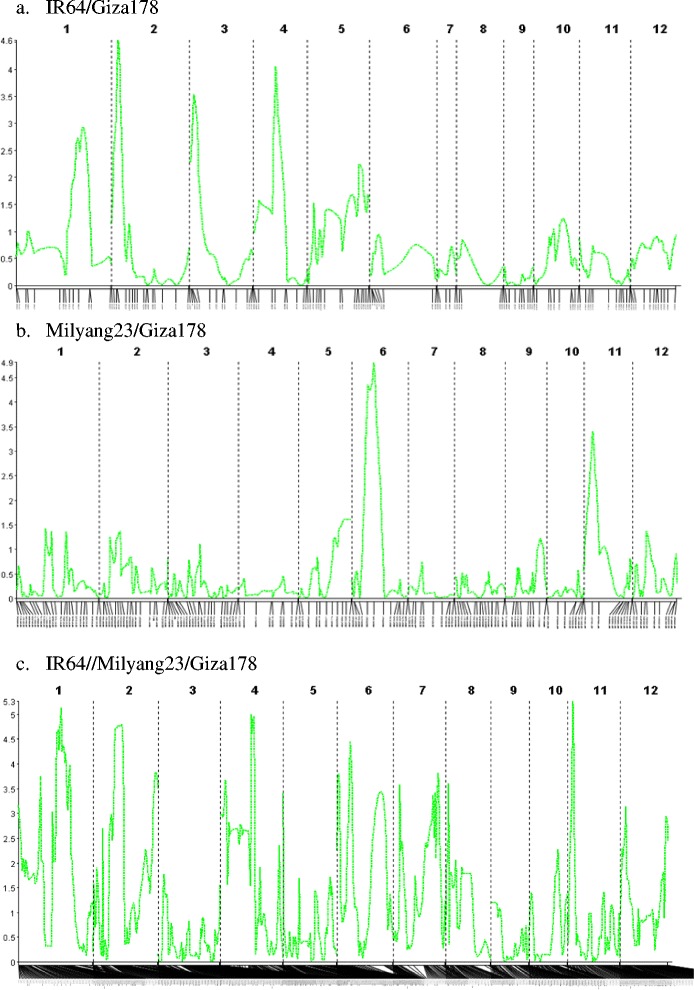
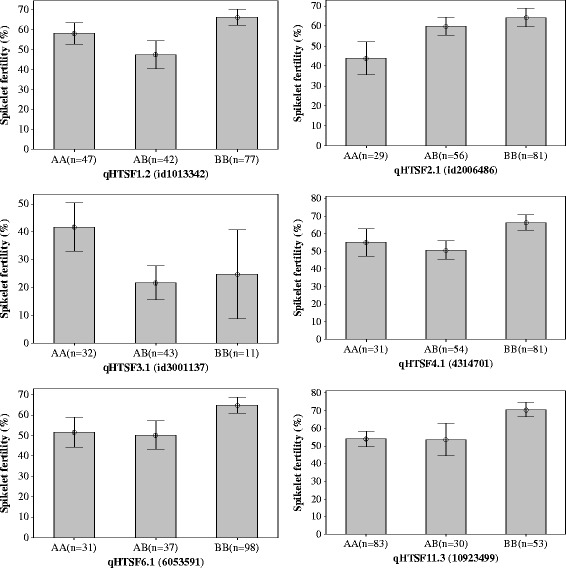
Four QTLs (qHTSF1.2, qHTSF2.1, qHTSF3.1 and qHTSF4.1) were identified in the IR64/Giza178 population, and two other QTLs (qHTSF6.1 and qHTSF11.2) were identified in the Milyang23/Giza178 population. To confirm the identified QTLs, another three-way-cross population derived from IR64//Milyang23/Giza178 was genotyped using 6K SNP chips. Five QTLs were identified in the three-way-cross population, and three of those QTLs (qHTSF1.2, qHTSF4.1 and qHTSF6.1) were overlapped with the QTLs identified in the bi-parental populations. The tolerance alleles of these QTLs were from the tolerant parent Giza178 except for qHTSF3.1. The QTL on chromosome 4 (qHTSF4.1) is the same QTL previously identified in the IR64/N22 population.
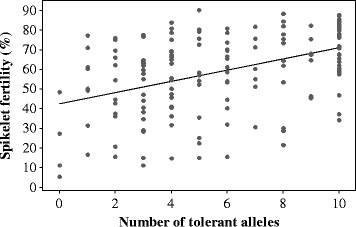
The results from different populations suggest that heat tolerance in rice at flowering stage is controlled by several QTLs with small effects and stronger heat tolerance could be attained through pyramiding validated heat tolerance QTLs. QTL qHTSF4.1 was consistently detected across different genetic backgrounds and could be an important source for enhancing heat tolerance in rice at flowering stage. Polymorphic SNP markers in these QTL regions can be used for future fine mapping and developing SNP chips for marker-assisted breeding.
气候变化正在影响许多国家的水稻生产。培育耐热的水稻新品种是在未来全球变暖情况下维持水稻生产的关键途径。我们之前报道过从IR64/N22群体中鉴定出4个在开花期高温下影响水稻小穗育性的数量性状基因座(QTL)。为了从其他品种中进一步挖掘更多QTL,利用两个双亲亲本F2群体和一个来自耐热品种吉萨178的三交F2群体来鉴定和确认开花期耐热QTL。
在IR64/吉萨178群体中鉴定出4个QTL(qHTSF1.2、qHTSF2.1、qHTSF3.1和qHTSF4.1),在密阳23/吉萨178群体中鉴定出另外2个QTL(qHTSF6.1和qHTSF11.2)。为了验证所鉴定的QTL,利用6K SNP芯片对另一个由IR64//密阳23/吉萨178衍生的三交群体进行基因分型。在三交群体中鉴定出5个QTL其中3个QTL(qHTSF1.2、qHTSF4.1和qHTSF6.1)与在双亲亲本群体中鉴定出的QTL重叠。除qHTSF3.1外,这些QTL的耐热等位基因均来自耐热亲本吉萨178。位于第4染色体上的QTL(qHTSF4.1)与之前在IR64/N22群体中鉴定出的QTL相同。
不同群体的结果表明,水稻开花期的耐热性由多个效应较小的QTL控制,通过聚合已验证的耐热QTL可获得更强的耐热性。QTL qHTSF4.1在不同遗传背景下均能稳定检测到,可能是提高水稻开花期耐热性的重要来源。这些QTL区域的多态性SNP标记可用于未来的精细定位和开发用于分子标记辅助育种的SNP芯片。