Mons Ute, Müezzinler Aysel, Gellert Carolin, Schöttker Ben, Abnet Christian C, Bobak Martin, de Groot Lisette, Freedman Neal D, Jansen Eugène, Kee Frank, Kromhout Daan, Kuulasmaa Kari, Laatikainen Tiina, O'Doherty Mark G, Bueno-de-Mesquita Bas, Orfanos Philippos, Peters Annette, van der Schouw Yvonne T, Wilsgaard Tom, Wolk Alicja, Trichopoulou Antonia, Boffetta Paolo, Brenner Hermann
Division of Clinical Epidemiology and Aging Research, German Cancer Research Center (DKFZ), Heidelberg, Germany
Division of Clinical Epidemiology and Aging Research, German Cancer Research Center (DKFZ), Heidelberg, Germany Network Aging Research (NAR), University of Heidelberg, Heidelberg, Germany.
BMJ. 2015 Apr 20;350:h1551. doi: 10.1136/bmj.h1551.
To investigate the impact of smoking and smoking cessation on cardiovascular mortality, acute coronary events, and stroke events in people aged 60 and older, and to calculate and report risk advancement periods for cardiovascular mortality in addition to traditional epidemiological relative risk measures.
Individual participant meta-analysis using data from 25 cohorts participating in the CHANCES consortium. Data were harmonised, analysed separately employing Cox proportional hazard regression models, and combined by meta-analysis.
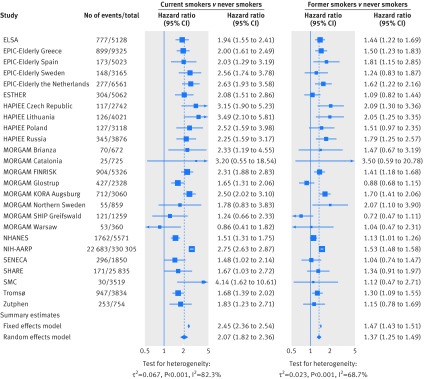
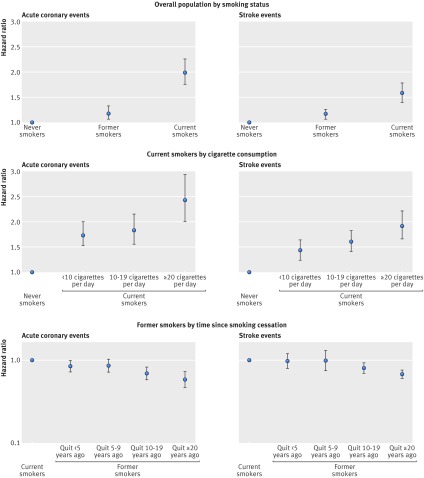
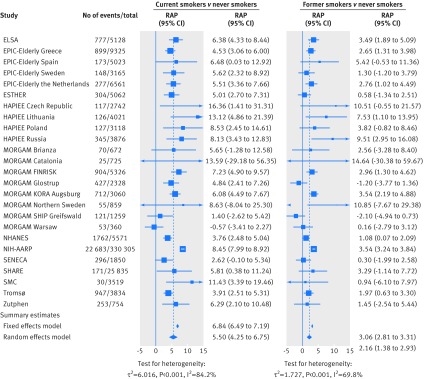
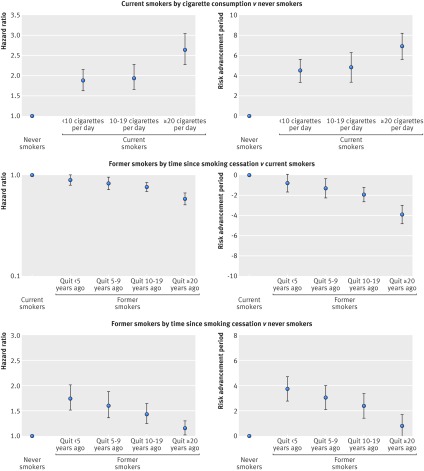
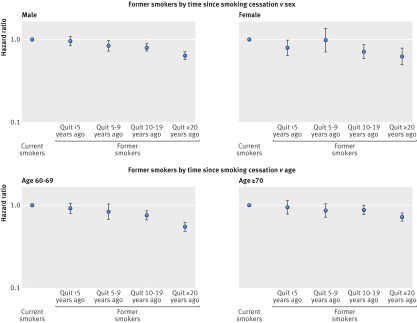
Overall, 503,905 participants aged 60 and older were included in this study, of whom 37,952 died from cardiovascular disease. Random effects meta-analysis of the association of smoking status with cardiovascular mortality yielded a summary hazard ratio of 2.07 (95% CI 1.82 to 2.36) for current smokers and 1.37 (1.25 to 1.49) for former smokers compared with never smokers. Corresponding summary estimates for risk advancement periods were 5.50 years (4.25 to 6.75) for current smokers and 2.16 years (1.38 to 2.39) for former smokers. The excess risk in smokers increased with cigarette consumption in a dose-response manner, and decreased continuously with time since smoking cessation in former smokers. Relative risk estimates for acute coronary events and for stroke events were somewhat lower than for cardiovascular mortality, but patterns were similar.
Our study corroborates and expands evidence from previous studies in showing that smoking is a strong independent risk factor of cardiovascular events and mortality even at older age, advancing cardiovascular mortality by more than five years, and demonstrating that smoking cessation in these age groups is still beneficial in reducing the excess risk.
研究吸烟及戒烟对60岁及以上人群心血管疾病死亡率、急性冠脉事件和中风事件的影响,并除传统流行病学相对风险指标外,计算并报告心血管疾病死亡率的风险提前期。
采用来自参与CHANCES联盟的25个队列的数据进行个体参与者荟萃分析。数据进行了统一处理,分别采用Cox比例风险回归模型进行分析,并通过荟萃分析进行合并。
总体而言,本研究纳入了503,905名60岁及以上的参与者,其中37,952人死于心血管疾病。对吸烟状况与心血管疾病死亡率之间关联的随机效应荟萃分析显示,与从不吸烟者相比,当前吸烟者的汇总风险比为2.07(95%置信区间1.82至2.36),既往吸烟者为1.37(1.25至1.49)。当前吸烟者和既往吸烟者风险提前期的相应汇总估计分别为5.50年(4.25至6.75)和2.16年(1.38至2.39)。吸烟者的额外风险随香烟消费量呈剂量反应关系增加,既往吸烟者自戒烟后随时间持续下降。急性冠脉事件和中风事件的相对风险估计略低于心血管疾病死亡率,但模式相似。
我们的研究证实并扩展了先前研究的证据,表明即使在老年,吸烟仍是心血管事件和死亡率的强独立风险因素,使心血管疾病死亡率提前超过五年,并表明在这些年龄组戒烟仍有利于降低额外风险。