Andris Clio, Lee David, Hamilton Marcus J, Martino Mauro, Gunning Christian E, Selden John Armistead
Department of Geography, The Pennsylvania State University, University Park, Pennsylvania, United States of America.
Department of Urban Studies and Planning, Massachusetts Institute of Technology, Cambridge, Massachusetts, United States of America; Senseable City Lab, Massachusetts Institute of Technology, Cambridge, Massachusetts, United States of America.
PLoS One. 2015 Apr 21;10(4):e0123507. doi: 10.1371/journal.pone.0123507. eCollection 2015.
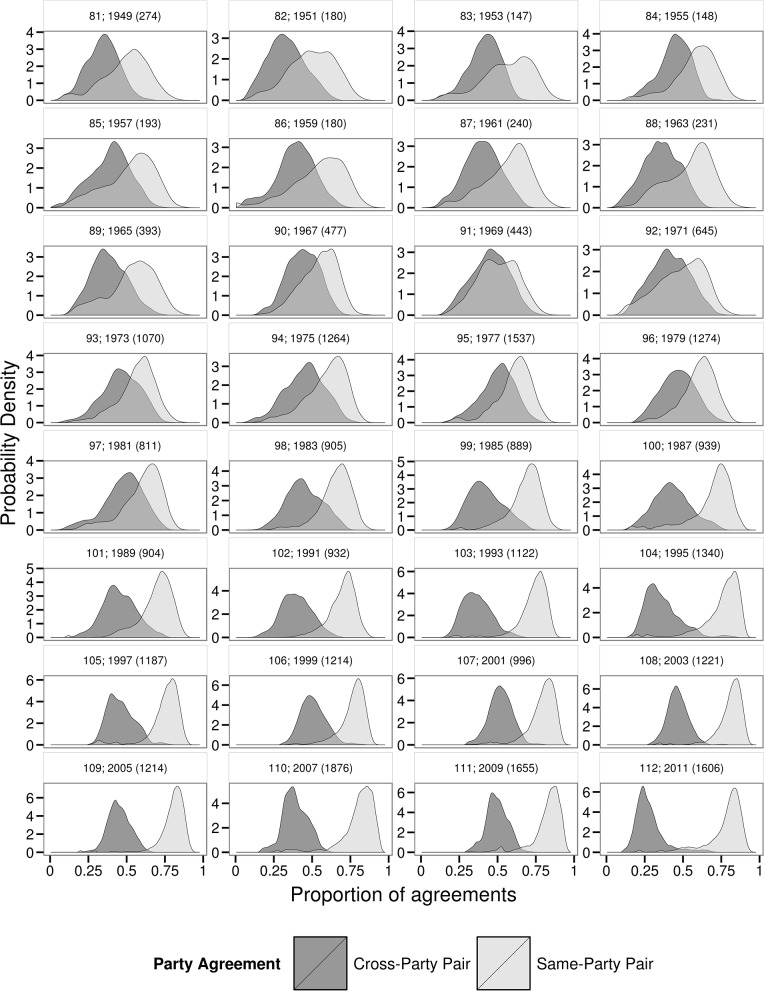
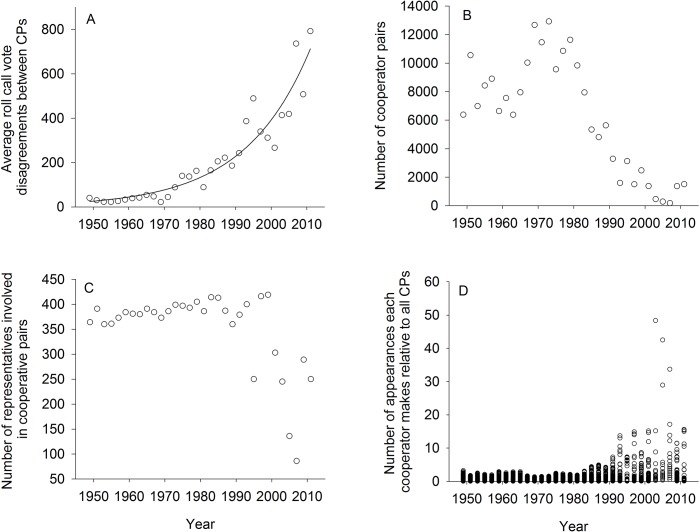
It is widely reported that partisanship in the United States Congress is at an historic high. Given that individuals are persuaded to follow party lines while having the opportunity and incentives to collaborate with members of the opposite party, our goal is to measure the extent to which legislators tend to form ideological relationships with members of the opposite party. We quantify the level of cooperation, or lack thereof, between Democrat and Republican Party members in the U.S. House of Representatives from 1949-2012. We define a network of over 5 million pairs of representatives, and compare the mutual agreement rates on legislative decisions between two distinct types of pairs: those from the same party and those formed of members from different parties. We find that despite short-term fluctuations, partisanship or non-cooperation in the U.S. Congress has been increasing exponentially for over 60 years with no sign of abating or reversing. Yet, a group of representatives continue to cooperate across party lines despite growing partisanship.
据广泛报道,美国国会中的党派偏见处于历史高位。鉴于个人在有机会且有动机与对立党派成员合作时仍被说服遵循党派路线,我们的目标是衡量立法者与对立党派成员形成意识形态关系的程度。我们量化了1949年至2012年美国众议院民主党和共和党成员之间的合作水平(或缺乏合作的程度)。我们定义了一个由超过500万对代表组成的网络,并比较了两种不同类型的代表对在立法决策上的相互一致率:来自同一党派的代表对和由来自不同党派的成员组成的代表对。我们发现,尽管存在短期波动,但美国国会中的党派偏见或不合作在60多年来一直在呈指数级增长,且没有减弱或逆转的迹象。然而,尽管党派偏见日益严重,仍有一群代表继续跨党派合作。