Hacein-Bey Abina Salima, Gaspar H Bobby, Blondeau Johanna, Caccavelli Laure, Charrier Sabine, Buckland Karen, Picard Capucine, Six Emmanuelle, Himoudi Nourredine, Gilmour Kimberly, McNicol Anne-Marie, Hara Havinder, Xu-Bayford Jinhua, Rivat Christine, Touzot Fabien, Mavilio Fulvio, Lim Annick, Treluyer Jean-Marc, Héritier Sébastien, Lefrère Francois, Magalon Jeremy, Pengue-Koyi Isabelle, Honnet Géraldine, Blanche Stéphane, Sherman Eric A, Male Frances, Berry Charles, Malani Nirav, Bushman Frederic D, Fischer Alain, Thrasher Adrian J, Galy Anne, Cavazzana Marina
Biotherapy Department, Necker Children's Hospital, Assistance Publique-Hôpitaux de Paris, Paris, France2Biotherapy Clinical Investigation Center, Groupe Hospitalier Universitaire Ouest, Assistance Publique-Hôpitaux de Paris, INSERM, Paris, France3Unité de.
Section of Molecular and Cellular Immunology, University College London Institute of Child Health, London, England6Department of Clinical Immunology, Hospital National Health Service Foundation Trust, London, England.
JAMA. 2015 Apr 21;313(15):1550-63. doi: 10.1001/jama.2015.3253.
Wiskott-Aldrich syndrome is a rare primary immunodeficiency associated with severe microthrombocytopenia. Partially HLA antigen-matched allogeneic hematopoietic stem cell (HSC) transplantation is often curative but is associated with significant comorbidity.
To assess the outcomes and safety of autologous HSC gene therapy in Wiskott-Aldrich syndrome.
DESIGN, SETTING, AND PARTICIPANTS: Gene-corrected autologous HSCs were infused in 7 consecutive patients with severe Wiskott-Aldrich syndrome lacking HLA antigen-matched related or unrelated HSC donors (age range, 0.8-15.5 years; mean, 7 years) following myeloablative conditioning. Patients were enrolled in France and England and treated between December 2010 and January 2014. Follow-up of patients in this intermediate analysis ranged from 9 to 42 months.
A single infusion of gene-modified CD34+ cells with an advanced lentiviral vector.
Primary outcomes were improvement at 24 months in eczema, frequency and severity of infections, bleeding tendency, and autoimmunity and reduction in disease-related days of hospitalization. Secondary outcomes were improvement in immunological and hematological characteristics and evidence of safety through vector integration analysis.
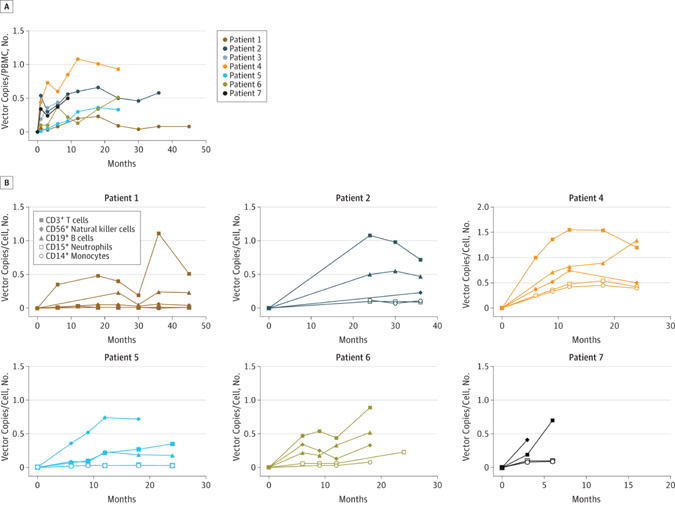
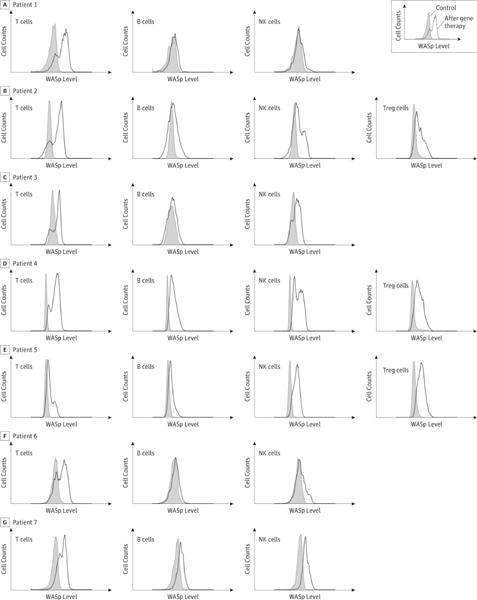
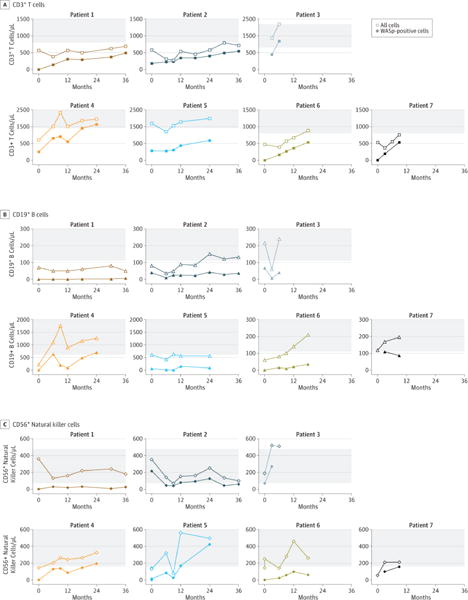
Six of the 7 patients were alive at the time of last follow-up (mean and median follow-up, 28 months and 27 months, respectively) and showed sustained clinical benefit. One patient died 7 months after treatment of preexisting drug-resistant herpes virus infection. Eczema and susceptibility to infections resolved in all 6 patients. Autoimmunity improved in 5 of 5 patients. No severe bleeding episodes were recorded after treatment, and at last follow-up, all 6 surviving patients were free of blood product support and thrombopoietic agonists. Hospitalization days were reduced from a median of 25 days during the 2 years before treatment to a median of 0 days during the 2 years after treatment. All 6 surviving patients exhibited high-level, stable engraftment of functionally corrected lymphoid cells. The degree of myeloid cell engraftment and of platelet reconstitution correlated with the dose of gene-corrected cells administered. No evidence of vector-related toxicity was observed clinically or by molecular analysis.
This study demonstrated the feasibility of the use of gene therapy in patients with Wiskott-Aldrich syndrome. Controlled trials with larger numbers of patients are necessary to assess long-term outcomes and safety.
威斯科特-奥尔德里奇综合征是一种罕见的原发性免疫缺陷病,伴有严重的小血小板减少症。部分人类白细胞抗原(HLA)抗原匹配的异基因造血干细胞(HSC)移植通常可治愈该病,但会伴有显著的合并症。
评估自体HSC基因治疗威斯科特-奥尔德里奇综合征的疗效和安全性。
设计、背景和参与者:在清髓预处理后,将基因校正的自体HSC输注给7例患有严重威斯科特-奥尔德里奇综合征且缺乏HLA抗原匹配的相关或无关HSC供者的连续患者(年龄范围为0.8至15.5岁;平均年龄7岁)。患者在法国和英国入组,并于2010年12月至2014年1月接受治疗。本次中期分析中患者的随访时间为9至42个月。
单次输注携带先进慢病毒载体的基因修饰CD34+细胞。
主要结局为24个月时湿疹、感染频率和严重程度、出血倾向及自身免疫性的改善,以及与疾病相关的住院天数减少。次要结局为免疫和血液学特征的改善,以及通过载体整合分析证明的安全性。
在最后一次随访时,7例患者中有6例存活(平均随访时间和中位随访时间分别为28个月和27个月),并显示出持续的临床获益。1例患者在治疗既往耐药的疱疹病毒感染7个月后死亡。所有6例患者的湿疹和感染易感性均得到缓解。5例患者中有5例自身免疫性有所改善。治疗后未记录到严重出血事件,在最后一次随访时,所有6例存活患者均无需血液制品支持和促血小板生成激动剂。住院天数从治疗前2年的中位25天降至治疗后2年的中位0天。所有6例存活患者均表现出功能校正的淋巴细胞高水平、稳定的植入。髓系细胞植入程度和血小板重建与给予的基因校正细胞剂量相关。临床或分子分析均未观察到载体相关毒性的证据。
本研究证明了基因治疗用于威斯科特-奥尔德里奇综合征患者的可行性。需要进行更多患者的对照试验来评估长期结局和安全性。