Morel Baptiste, Rouffet David M, Saboul Damien, Rota Samuel, Clémençon Michel, Hautier Christophe A
Center of Research and Innovation on Sport, University of Lyon 1, Villeurbanne, France.
Institute of Sport, Exercise and Active Living, Victoria University, Melbourne, Australia.
PLoS One. 2015 Apr 22;10(4):e0119719. doi: 10.1371/journal.pone.0119719. eCollection 2015.
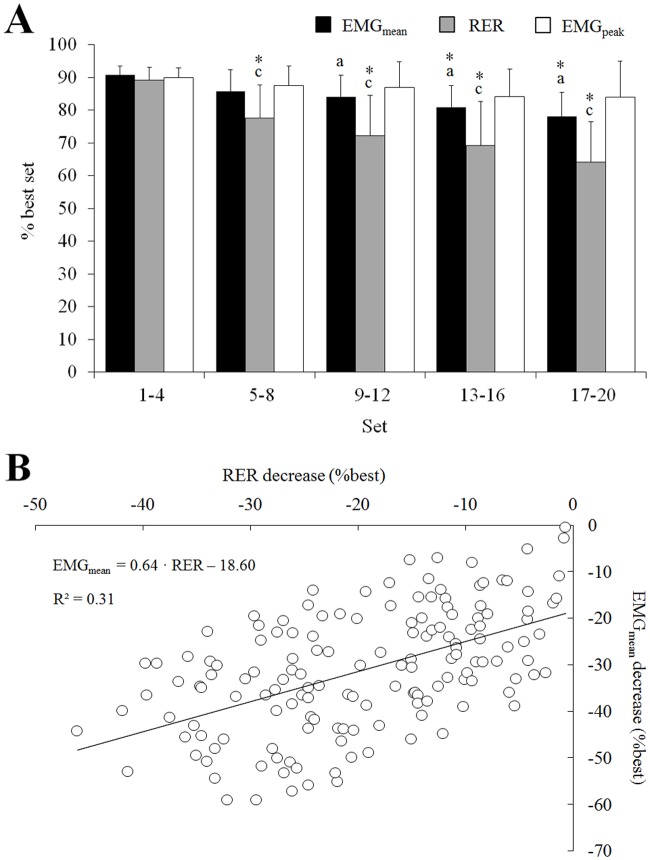
Rapid force production is critical to improve performance and prevent injuries. However, changes in rate of force/torque development caused by the repetition of maximal contractions have received little attention. The aim of this study was to determine the relative influence of rate of torque development (RTD) and peak torque (T(peak)) on the overall performance (i.e. mean torque, T(mean)) decrease during repeated maximal contractions and to investigate the contribution of contractile and neural mechanisms to the alteration of the various mechanical variables. Eleven well-trained men performed 20 sets of 6-s isokinetic maximal knee extensions at 240° · s(-1), beginning every 30 seconds. RTD, T(peak) and T(mean) as well as the Rate of EMG Rise (RER), peak EMG (EMG(peak)) and mean EMG (EMG(mean)) of the vastus lateralis were monitored for each contraction. A wavelet transform was also performed on raw EMG signal for instant mean frequency (if(mean)) calculation. A neuromuscular testing procedure was carried out before and immediately after the fatiguing protocol including evoked RTD (eRTD) and maximal evoked torque (eT(peak)) induced by high frequency doublet (100 Hz). T(mean) decrease was correlated to RTD and T(peak) decrease (R(²) = 0.62; p<0.001; respectively β=0.62 and β=0.19). RER, eRTD and initial if(mean) (0-225 ms) decreased after 20 sets (respectively -21.1 ± 14.1, -25 ± 13%, and ~20%). RTD decrease was correlated to RER decrease (R(²) = 0.36; p<0.05). The eT(peak) decreased significantly after 20 sets (24 ± 5%; p<0.05) contrary to EMG(peak) (-3.2 ± 19.5 %; p=0.71). Our results show that reductions of RTD explained part of the alterations of the overall performance during repeated moderate velocity maximal exercise. The reductions of RTD were associated to an impairment of the ability of the central nervous system to maximally activate the muscle in the first milliseconds of the contraction.
快速发力对于提高运动表现和预防损伤至关重要。然而,最大收缩重复引起的力量/扭矩发展速率的变化却很少受到关注。本研究的目的是确定扭矩发展速率(RTD)和峰值扭矩(T(peak))对重复最大收缩期间整体表现(即平均扭矩,T(mean))下降的相对影响,并研究收缩和神经机制对各种力学变量变化的贡献。11名训练有素的男性以240°·s(-1)的速度进行20组6秒的等速最大膝关节伸展,每组间隔30秒。每次收缩时监测RTD、T(peak)和T(mean),以及股外侧肌的肌电图上升速率(RER)、肌电图峰值(EMG(peak))和肌电图平均值(EMG(mean))。还对原始肌电图信号进行小波变换以计算即时平均频率(if(mean))。在疲劳方案之前和之后立即进行神经肌肉测试程序,包括高频双脉冲(频率100Hz)诱发的RTD(eRTD)和最大诱发扭矩(eT(peak))。T(mean)下降与RTD和T(peak)下降相关(R(²)=0.62;p<0.001;β分别为0.62和0.19)。20组后RER、eRTD和初始if(mean)(0 - 225毫秒)下降(分别下降-21.1±14.1、-25±13%和约20%)。RTD下降与RER下降相关(R(²)=0.36;p<0.05)。与肌电图峰值(-3.2±19.5%;p = 0.71)相反,20组后eT(peak)显著下降(24±5%;p<0.05)。我们的结果表明,RTD的降低解释了重复中等速度最大运动期间整体表现变化的部分原因。RTD的降低与中枢神经系统在收缩最初几毫秒内最大程度激活肌肉的能力受损有关。