von Rhein Daniel, Cools Roshan, Zwiers Marcel P, van der Schaaf Marieke, Franke Barbara, Luman Marjolein, Oosterlaan Jaap, Heslenfeld Dirk J, Hoekstra Pieter J, Hartman Catharina A, Faraone Stephen V, van Rooij Daan, van Dongen Eelco V, Lojowska Maria, Mennes Maarten, Buitelaar Jan
Radboud University Medical Center, Radboud University Nijmegen, Donders Institute for Brain, Cognition and Behaviour, Centre for Cognitive Neuroimaging, Nijmegen, the Netherlands.
Radboud University Medical Center, Radboud University Nijmegen, Donders Institute for Brain, Cognition and Behaviour, Centre for Cognitive Neuroimaging, Nijmegen, the Netherlands.
J Am Acad Child Adolesc Psychiatry. 2015 May;54(5):394-402. doi: 10.1016/j.jaac.2015.02.012. Epub 2015 Mar 2.
Attention-deficit/hyperactivity disorder (ADHD) is a heritable neuropsychiatric disorder associated with abnormal reward processing. Limited and inconsistent data exist about the neural mechanisms underlying this abnormality. Furthermore, it is not known whether reward processing is abnormal in unaffected siblings of participants with ADHD.
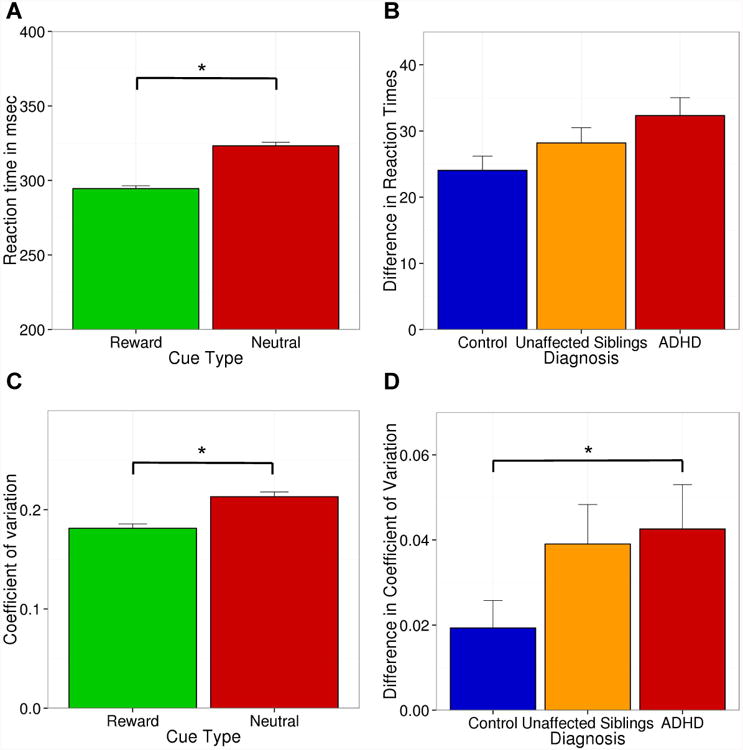
We used event-related functional magnetic resonance imaging (fMRI) to investigate brain responses during reward anticipation and receipt with an adapted monetary incentive delay task in a large sample of adolescents and young adults with ADHD (n = 150), their unaffected siblings (n = 92), and control participants (n = 108), all of the same age.
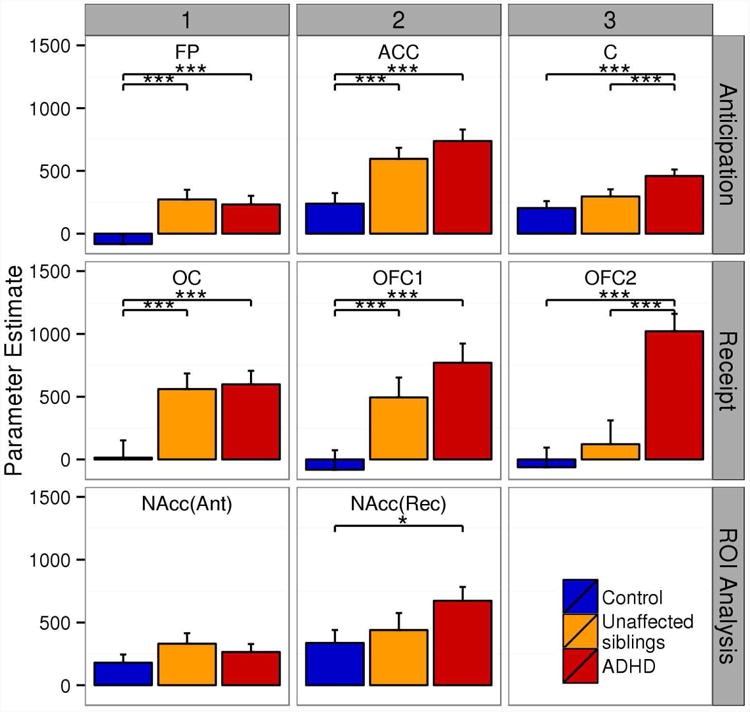
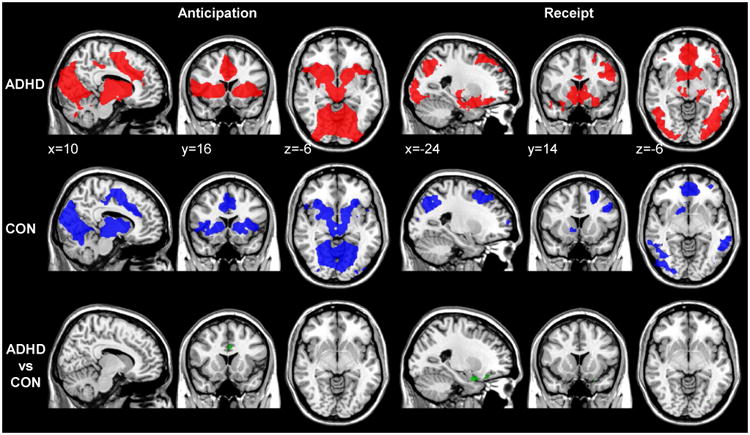
Participants with ADHD showed, relative to control participants, increased responses in the anterior cingulate, anterior frontal cortex, and cerebellum during reward anticipation, and in the orbitofrontal, occipital cortex and ventral striatum. Responses of unaffected siblings were increased in these regions as well, except for the cerebellum during anticipation and ventral striatum during receipt.
ADHD in adolescents and young adults is associated with enhanced neural responses in frontostriatal circuitry to anticipation and receipt of reward. The findings support models emphasizing aberrant reward processing in ADHD, and suggest that processing of reward is subject to familial influences. Future studies using standard monetary incentive delay task parameters are needed to replicate our findings.
注意缺陷多动障碍(ADHD)是一种与奖赏处理异常相关的遗传性神经精神障碍。关于这种异常背后的神经机制的数据有限且不一致。此外,尚不清楚ADHD患者未受影响的兄弟姐妹的奖赏处理是否异常。
我们使用事件相关功能磁共振成像(fMRI),通过一项经过改编的金钱激励延迟任务,在一大群年龄相同的患有ADHD的青少年和年轻人(n = 150)、他们未受影响的兄弟姐妹(n = 92)以及对照参与者(n = 108)中,研究奖赏预期和获得过程中的大脑反应。
与对照参与者相比,患有ADHD的参与者在奖赏预期期间,前扣带回、前额叶皮层和小脑以及眶额、枕叶皮层和腹侧纹状体的反应增强。未受影响的兄弟姐妹在这些区域的反应也增强,预期期间小脑和获得期间腹侧纹状体除外。
青少年和年轻人的ADHD与额纹状体回路对奖赏预期和获得的神经反应增强有关。这些发现支持了强调ADHD中异常奖赏处理的模型,并表明奖赏处理受家族影响。需要使用标准金钱激励延迟任务参数的未来研究来复制我们的发现。