David Yael, Vila-Perelló Miquel, Verma Shivam, Muir Tom W
Department of Chemistry, Princeton University, Frick Laboratory, Princeton, New Jersey 08544, USA.
Nat Chem. 2015 May;7(5):394-402. doi: 10.1038/nchem.2224. Epub 2015 Apr 6.
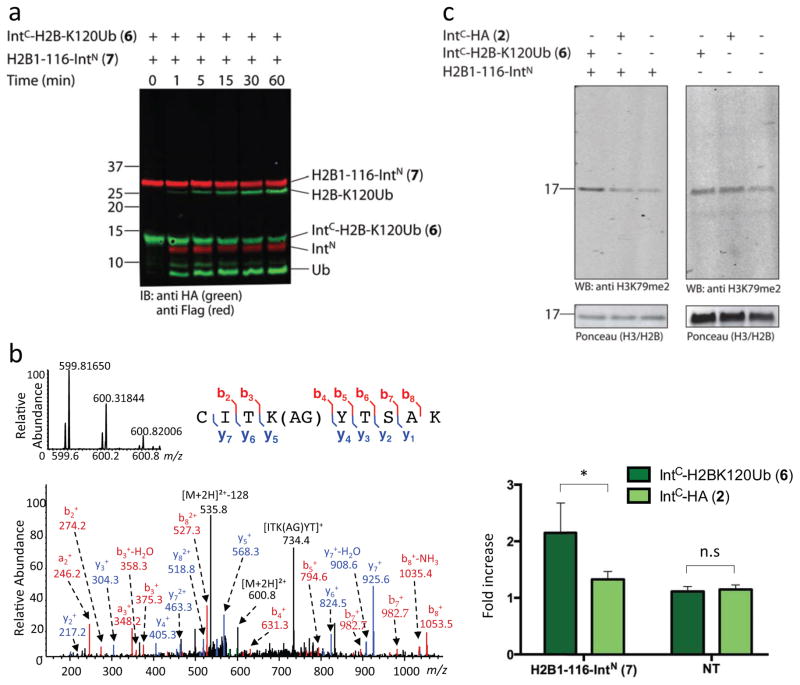
Post-translational modification of the histone proteins in chromatin plays a central role in the epigenetic control of DNA-templated processes in eukaryotic cells. Developing methods that enable the structure of histones to be manipulated is, therefore, essential to understand the biochemical mechanisms that underlie genomic regulation. Here we present a synthetic biology method to engineer histones that bear site-specific modifications on cellular chromatin using protein trans-splicing (PTS). We genetically fused the N-terminal fragment of ultrafast split intein to the C terminus of histone H2B, which, on reaction with a complementary synthetic C intein, generated labelled histone. Using this approach, we incorporated various non-native chemical modifications into chromatin in vivo with temporal control. Furthermore, the time and concentration dependence of PTS performed in nucleo enabled us to examine differences in the accessibility of the euchromatin and heterochromatin regions of the epigenome. Finally, we used PTS to semisynthesize a native histone modification, H2BK120 ubiquitination, in isolated nuclei and showed that this can trigger downstream epigenetic crosstalk of H3K79 methylation.
染色质中组蛋白的翻译后修饰在真核细胞中DNA模板化过程的表观遗传控制中起着核心作用。因此,开发能够操纵组蛋白结构的方法对于理解基因组调控背后的生化机制至关重要。在这里,我们提出了一种合成生物学方法,利用蛋白质反式剪接(PTS)对细胞染色质上具有位点特异性修饰的组蛋白进行工程改造。我们将超快分裂内含肽的N端片段与组蛋白H2B的C端进行基因融合,该片段与互补的合成C内含肽反应后,生成标记的组蛋白。使用这种方法,我们在体内以时间控制的方式将各种非天然化学修饰引入染色质。此外,在细胞核中进行的PTS的时间和浓度依赖性使我们能够研究表观基因组常染色质和异染色质区域可及性的差异。最后,我们使用PTS在分离的细胞核中半合成天然组蛋白修饰H2BK120泛素化,并表明这可以触发H3K79甲基化的下游表观遗传串扰。