Jeganathan Ajitha, Razi Aida, Thurlow Brett, Ortega Joaquin
Department of Biochemistry and Biomedical Sciences, M.G. DeGroote Institute for Infectious Diseases Research, McMaster University, Hamilton, Ontario, Canada L8S 4K1.
RNA. 2015 Jun;21(6):1203-16. doi: 10.1261/rna.049171.114. Epub 2015 Apr 22.
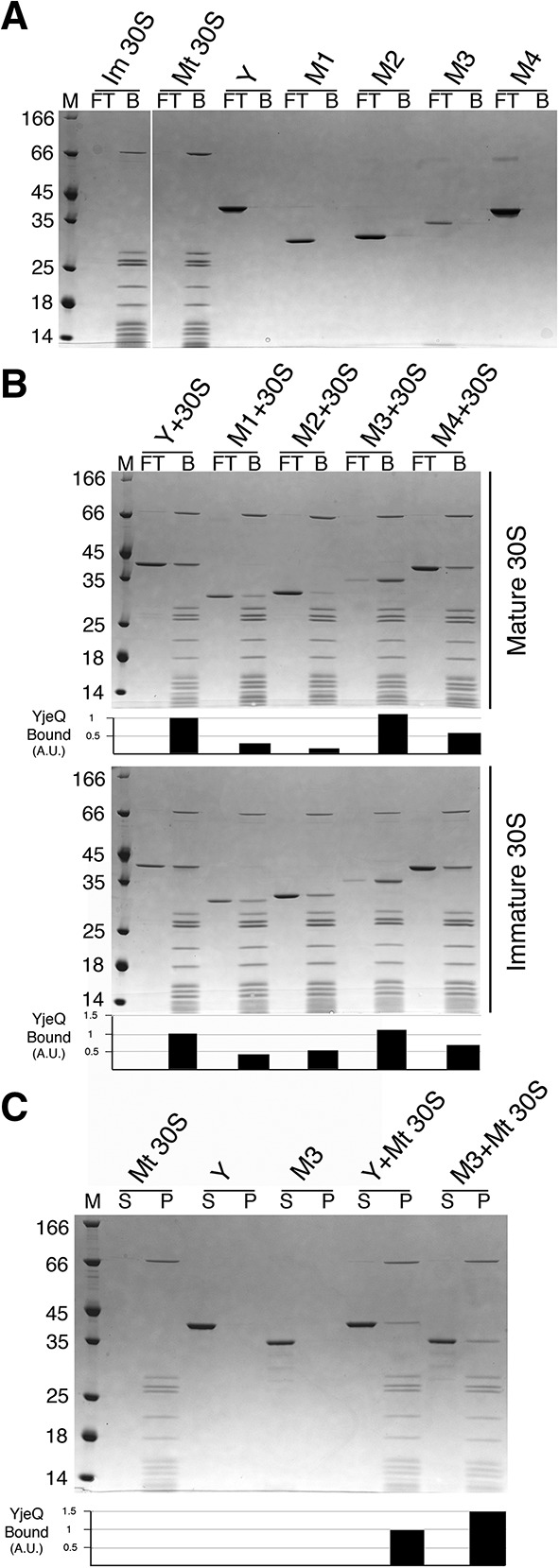
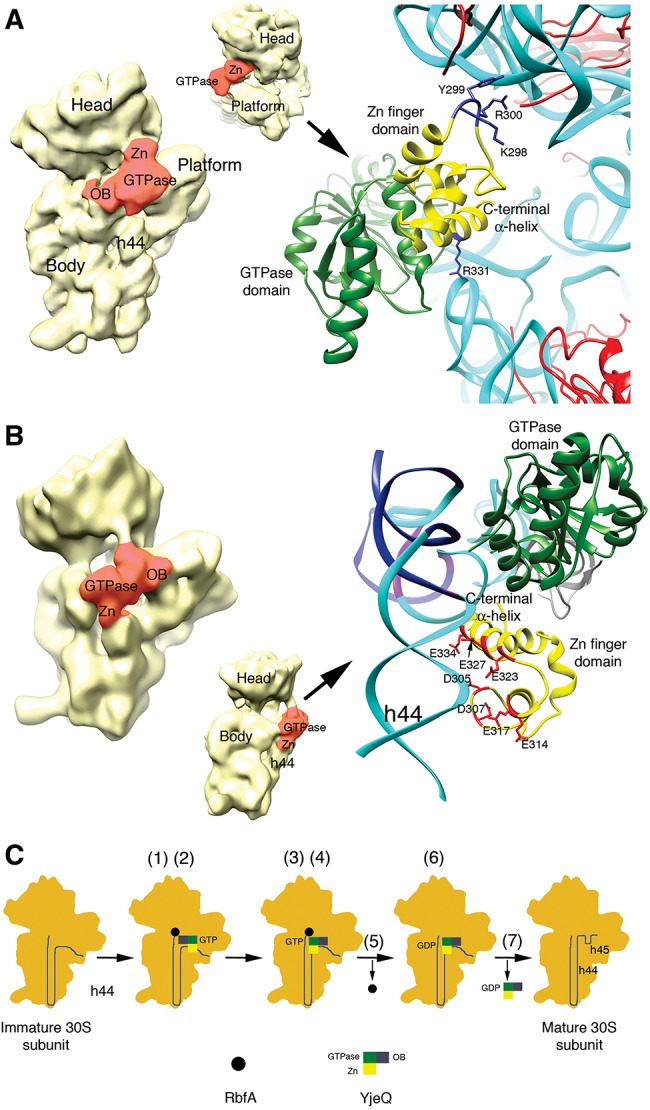
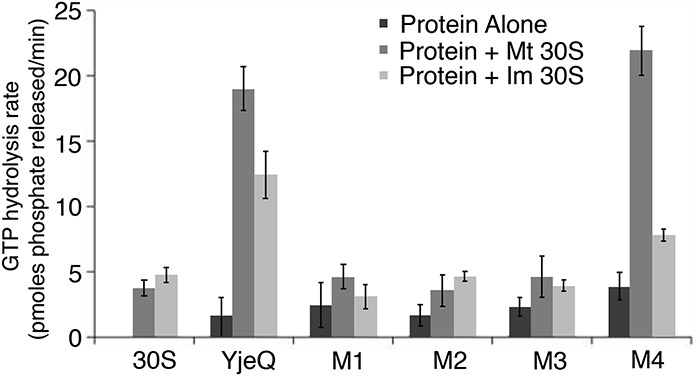
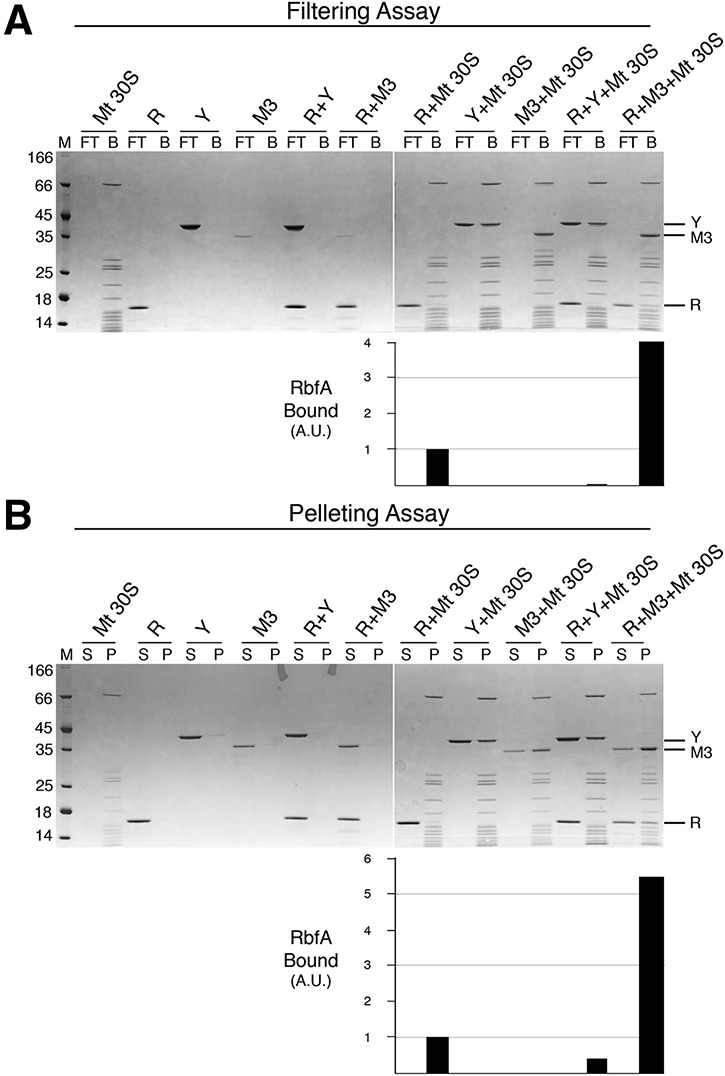
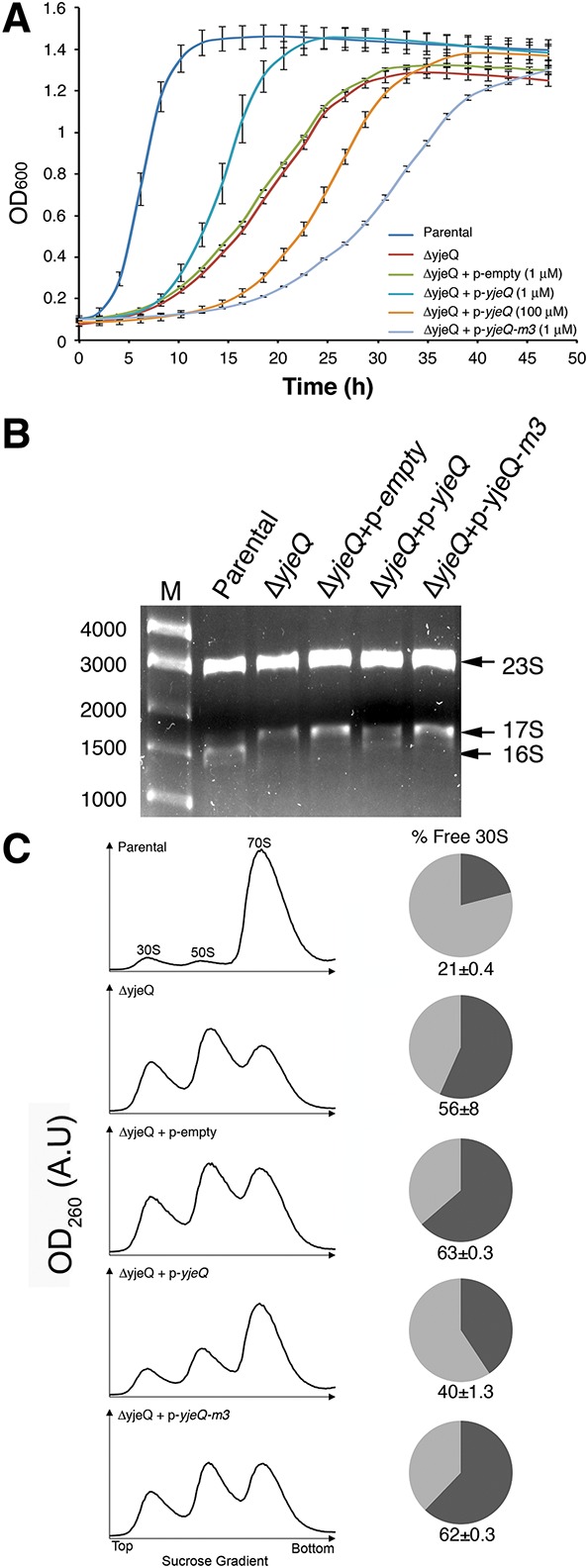
YjeQ (also called RsgA) and RbfA proteins in Escherichia coli bind to immature 30S ribosome subunits at late stages of assembly to assist folding of the decoding center. A key step for the subunit to enter the pool of actively translating ribosomes is the release of these factors. YjeQ promotes dissociation of RbfA during the final stages of maturation; however, the mechanism implementing this functional interplay has not been elucidated. YjeQ features an amino-terminal oligonucleotide/oligosaccharide binding domain, a central GTPase module and a carboxy-terminal zinc-finger domain. We found that the zinc-finger domain is comprised of two functional motifs: the region coordinating the zinc ion and a carboxy-terminal α-helix. The first motif is essential for the anchoring of YjeQ to the 30S subunit and the carboxy-terminal α-helix facilitates the removal of RbfA once the 30S subunit reaches the mature state. Furthermore, the ability of the mature 30S subunit to stimulate YjeQ GTPase activity also depends on the carboxy-terminal α-helix. Our data are consistent with a model in which YjeQ uses this carboxy-terminal α-helix as a sensor to gauge the conformation of helix 44, an essential motif of the decoding center. According to this model, the mature conformation of helix 44 is sensed by the carboxy-terminal α-helix, which in turn stimulates the YjeQ GTPase activity. Hydrolysis of GTP is believed to assist the release of YjeQ from the mature 30S subunit through a still uncharacterized mechanism. These results identify the structural determinants in YjeQ that implement the functional interplay with RbfA.
大肠杆菌中的YjeQ(也称为RsgA)和RbfA蛋白在组装后期与未成熟的30S核糖体亚基结合,以协助解码中心的折叠。亚基进入活跃翻译核糖体池的关键步骤是这些因子的释放。YjeQ在成熟的最后阶段促进RbfA的解离;然而,实现这种功能相互作用的机制尚未阐明。YjeQ具有一个氨基末端寡核苷酸/寡糖结合结构域、一个中央GTPase模块和一个羧基末端锌指结构域。我们发现锌指结构域由两个功能基序组成:协调锌离子的区域和羧基末端α螺旋。第一个基序对于YjeQ锚定到30S亚基至关重要,而羧基末端α螺旋在30S亚基达到成熟状态后有助于去除RbfA。此外,成熟的30S亚基刺激YjeQ GTPase活性的能力也取决于羧基末端α螺旋。我们的数据与一个模型一致,在该模型中,YjeQ使用这个羧基末端α螺旋作为传感器来衡量解码中心的关键基序——螺旋44的构象。根据这个模型,螺旋44的成熟构象被羧基末端α螺旋感知,这反过来又刺激YjeQ GTPase活性。据信,GTP的水解通过一种尚未明确的机制协助YjeQ从成熟的30S亚基上释放。这些结果确定了YjeQ中与RbfA实现功能相互作用的结构决定因素。