Walker Brian A, Wardell Christopher P, Murison Alex, Boyle Eileen M, Begum Dil B, Dahir Nasrin M, Proszek Paula Z, Melchor Lorenzo, Pawlyn Charlotte, Kaiser Martin F, Johnson David C, Qiang Ya-Wei, Jones John R, Cairns David A, Gregory Walter M, Owen Roger G, Cook Gordon, Drayson Mark T, Jackson Graham H, Davies Faith E, Morgan Gareth J
Division of Molecular Pathology, The Institute of Cancer Research, London SM2 5NG, UK.
Myeloma Institute, University of Arkansas for Medical Sciences, Little Rock, Arkansas 72205, USA.
Nat Commun. 2015 Apr 23;6:6997. doi: 10.1038/ncomms7997.
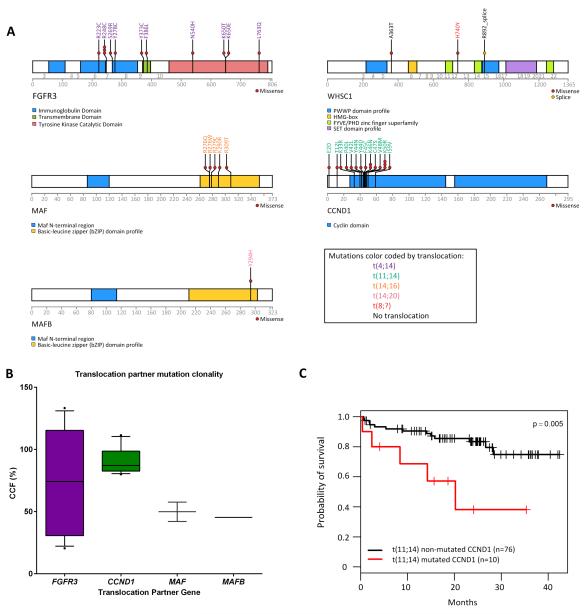
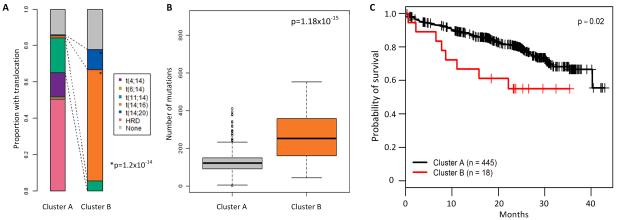
We have sequenced 463 presenting cases of myeloma entered into the UK Myeloma XI study using whole exome sequencing. Here we identify mutations induced as a consequence of misdirected AID in the partner oncogenes of IGH translocations, which are activating and associated with impaired clinical outcome. An APOBEC mutational signature is seen in 3.8% of cases and is linked to the translocation-mediated deregulation of MAF and MAFB, a known poor prognostic factor. Patients with this signature have an increased mutational load and a poor prognosis. Loss of MAF or MAFB expression results in decreased APOBEC3B and APOBEC4 expression, indicating a transcriptional control mechanism. Kataegis, a further mutational pattern associated with APOBEC deregulation, is seen at the sites of the MYC translocation. The APOBEC mutational signature seen in myeloma is, therefore, associated with poor prognosis primary and secondary translocations and the molecular mechanisms involved in generating them.
我们使用全外显子测序对进入英国骨髓瘤XI研究的463例初诊骨髓瘤病例进行了测序。在此,我们鉴定出IGH易位的伙伴癌基因中因AID错误靶向而诱导产生的突变,这些突变具有激活作用且与不良临床结局相关。在3.8%的病例中观察到APOBEC突变特征,且其与易位介导的MAF和MAFB失调有关,MAF和MAFB是已知的不良预后因素。具有这种特征的患者突变负荷增加且预后不良。MAF或MAFB表达缺失导致APOBEC3B和APOBEC4表达降低,提示存在转录调控机制。在MYC易位位点观察到另一种与APOBEC失调相关的突变模式——kataegis。因此,骨髓瘤中观察到的APOBEC突变特征与原发性和继发性易位的不良预后以及产生这些易位的分子机制相关。