Weber Christopher, Büchner Sarah M, Schnierle Barbara S
Department of Virology, Paul-Ehrlich-Institut, Langen, Germany.
PLoS Negl Trop Dis. 2015 Apr 23;9(4):e0003684. doi: 10.1371/journal.pntd.0003684. eCollection 2015 Apr.
The mosquito-borne Chikungunya virus (CHIKV) causes high fever and severe joint pain in humans. It is expected to spread in the future to Europe and has recently reached the USA due to globalization, climate change and vector switch. Despite this, little is known about the virus life cycle and, so far, there is no specific treatment or vaccination against Chikungunya infections. We aimed here to identify small antigenic determinants of the CHIKV E2 protein able to induce neutralizing immune responses.
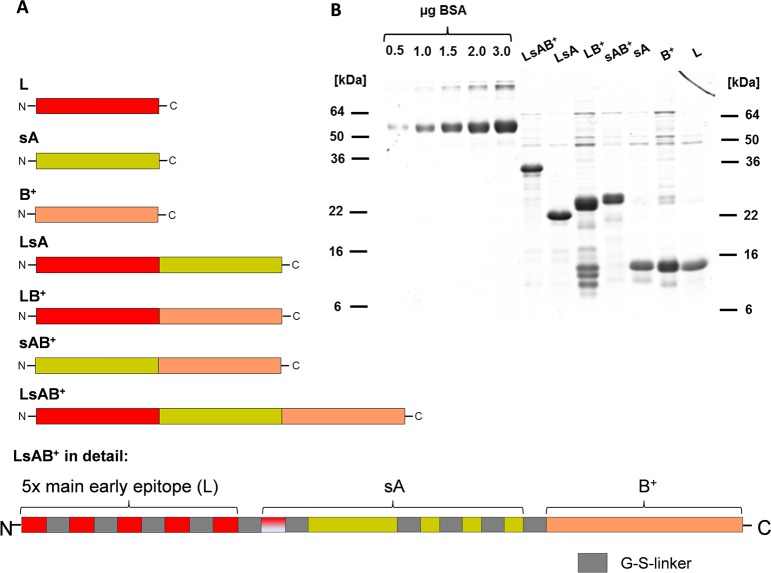
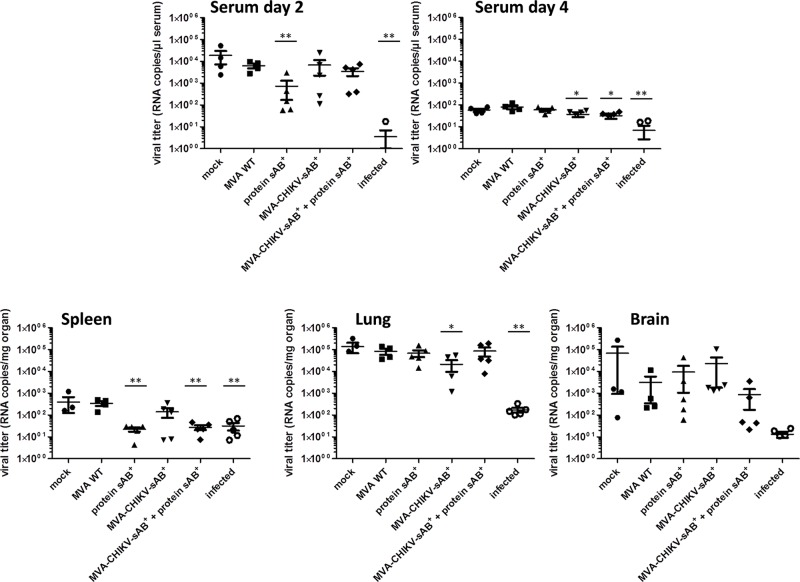
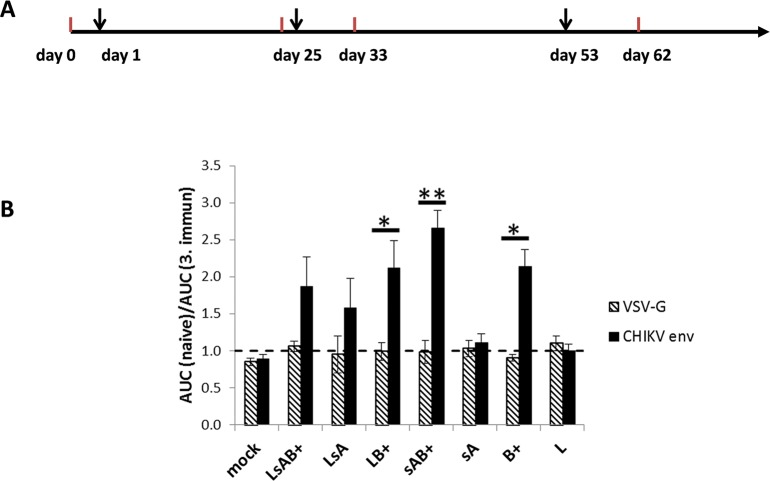
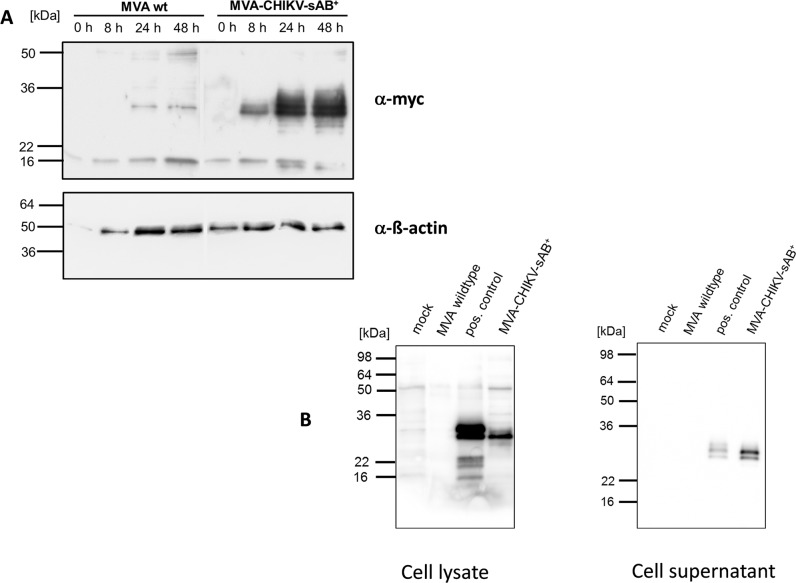
METHODOLOGY/PRINCIPAL FINDINGS: E2 enables attachment of the virus to target cells and a humoral immune response against E2 should protect from CHIKV infections. Seven recombinant proteins derived from E2 and consisting of linear and/or structural antigens were created, and were expressed in and purified from E. coli. BALB/c mice were vaccinated with these recombinant proteins and the mouse sera were screened for neutralizing antibodies. Whereas a linear N-terminally exposed peptide (L) and surface-exposed parts of the E2 domain A (sA) alone did not induce neutralizing antibodies, a construct containing domain B and a part of the β-ribbon (called B+) was sufficient to induce neutralizing antibodies. Furthermore, domain sA fused to B+ (sAB+) induced the highest amount of neutralizing antibodies. Therefore, the construct sAB+ was used to generate a recombinant modified vaccinia virus Ankara (MVA), MVA-CHIKV-sAB+. Mice were vaccinated with MVA-CHIKV-sAB+ and/or the recombinant protein sAB+ and were subsequently challenged with wild-type CHIKV. Whereas four vaccinations with MVA-CHIKV-sAB+ were not sufficient to protect mice from a CHIKV infection, protein vaccination with sAB+ markedly reduced the viral titers of vaccinated mice.
CONCLUSIONS/SIGNIFICANCE: The recombinant protein sAB+ contains important structural antigens for a neutralizing antibody response in mice and its formulation with appropriate adjuvants might lead to a future CHIKV vaccine.
蚊媒传播的基孔肯雅病毒(CHIKV)可导致人类高热和严重关节疼痛。由于全球化、气候变化和媒介转换,预计该病毒未来会在欧洲传播,且最近已传入美国。尽管如此,人们对该病毒的生命周期知之甚少,到目前为止,尚无针对基孔肯雅病毒感染的特异性治疗方法或疫苗。我们的目的是鉴定能够诱导中和免疫反应的基孔肯雅病毒E2蛋白的小抗原决定簇。
方法/主要发现:E2可使病毒附着于靶细胞,针对E2的体液免疫反应应能预防基孔肯雅病毒感染。我们制备了7种源自E2的重组蛋白,它们由线性和/或结构抗原组成,并在大肠杆菌中表达和纯化。用这些重组蛋白对BALB/c小鼠进行免疫接种,并筛选小鼠血清中的中和抗体。单独的线性N端暴露肽(L)和E2结构域A的表面暴露部分(sA)不能诱导中和抗体,而包含结构域B和一部分β-折叠带(称为B+)的构建体足以诱导中和抗体。此外,与B+融合的结构域sA(sAB+)诱导产生的中和抗体量最高。因此,构建体sAB+被用于制备重组改良安卡拉痘苗病毒(MVA),即MVA-CHIKV-sAB+。用MVA-CHIKV-sAB+和/或重组蛋白sAB+对小鼠进行免疫接种,随后用野生型基孔肯雅病毒攻击小鼠。虽然用MVA-CHIKV-sAB+进行4次免疫接种不足以保护小鼠免受基孔肯雅病毒感染,但用sAB+进行蛋白免疫接种可显著降低接种小鼠的病毒滴度。
结论/意义:重组蛋白sAB+包含对小鼠中和抗体反应重要的结构抗原,其与合适佐剂的配方可能会带来未来的基孔肯雅病毒疫苗。