McEvoy Jo, While Geoffrey M, Jones Susan M, Wapstra Erik
School of Biological Sciences, University of Tasmania, Hobart, Tasmania, Australia.
School of Biological Sciences, University of Tasmania, Hobart, Tasmania, Australia; Edward Grey Institute, Department of Zoology, University of Oxford, Oxford, United Kingdom.
PLoS One. 2015 Apr 23;10(4):e0125015. doi: 10.1371/journal.pone.0125015. eCollection 2015.
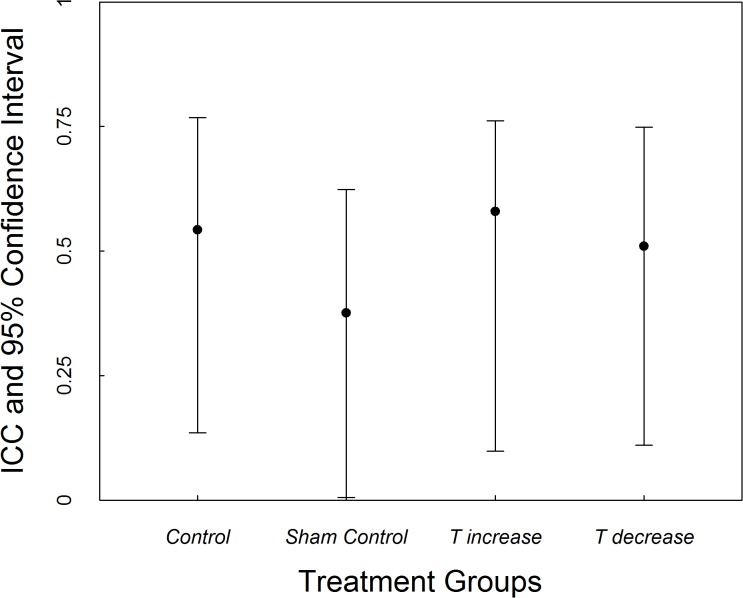
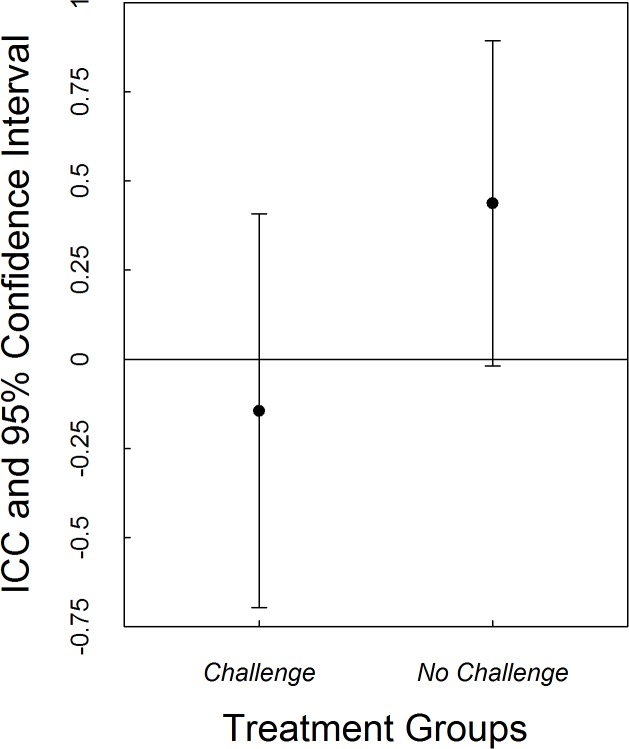
Hormones have been suggested as a key proximate mechanism that organize and maintain consistent individual differences in behavioural traits such as aggression. The steroid hormone testosterone in particular has an important activational role in mediating short-term aggressive responses to social and environmental stimuli within many vertebrate systems. We conducted two complementary experiments designed to investigate the activational relationship between testosterone and aggression in male Egernia whitii, a social lizard species. First, we investigated whether a conspecific aggressive challenge induced a testosterone response and second, we artificially manipulated testosterone concentrations to examine whether this changed aggression levels. We found that at the mean level, plasma T concentration did not appear to be influenced by an aggression challenge. However, there was a slight indication that receiving a challenge may influence intra-individual consistency of plasma T concentrations, with individuals not receiving an aggression challenge maintaining consistency in their circulating testosterone concentrations, while those individuals that received a challenge did not. Manipulating circulating testosterone concentrations had no influence on either mean-level or individual-level aggression. Combined with our previous work, our study adds increasing evidence that the relationship between testosterone and aggression is not straightforward, and promotes the investigation of alternative hormonal pathways and differences in neuro-synthesis and neuroendocrine pathways to account for species variable testosterone - aggression links.
激素被认为是一种关键的近端机制,它组织并维持诸如攻击性等行为特征中个体差异的一致性。尤其是类固醇激素睾酮,在许多脊椎动物系统中介导对社会和环境刺激的短期攻击反应方面具有重要的激活作用。我们进行了两项互补实验,旨在研究雄性白氏柔蜥(一种群居蜥蜴物种)中睾酮与攻击性之间的激活关系。首先,我们研究了同种攻击性挑战是否会引发睾酮反应;其次,我们人工操纵睾酮浓度,以检查这是否会改变攻击水平。我们发现,在平均水平上,血浆睾酮浓度似乎不受攻击挑战的影响。然而,有一个细微迹象表明,接受挑战可能会影响血浆睾酮浓度的个体内一致性,未接受攻击挑战的个体其循环睾酮浓度保持一致,而接受挑战的个体则不然。操纵循环睾酮浓度对平均水平或个体水平的攻击性均无影响。结合我们之前的研究工作,我们的研究进一步证明了睾酮与攻击性之间的关系并非简单直接,并促使人们对替代激素途径以及神经合成和神经内分泌途径的差异进行研究,以解释物种间不同的睾酮 - 攻击性联系。