Vychytilova-Faltejskova Petra, Kiss Igor, Klusova Sona, Hlavsa Jan, Prochazka Vladimir, Kala Zdenek, Mazanec Jan, Hausnerova Jitka, Kren Leos, Hermanova Marketa, Lenz Jiri, Karasek Petr, Vyzula Rostislav, Slaby Ondrej
Molecular Oncology II - Solid Cancers, Molecular Medicine, Central European Institute of Technology, Masaryk University, Brno, Czech Republic.
Department of Comprehensive Cancer Care, Masaryk Memorial Cancer Institute, Zluty kopec 7, Brno, Czech Republic.
Diagn Pathol. 2015 Apr 24;10:38. doi: 10.1186/s13000-015-0272-6.
Pancreatic ductal adenocarcinoma is an aggressive malignancy with late presentation, metastatic potential and very poor prognosis. Therefore, there is an urgent need for novel diagnostic and prognostic biomarkers. MicroRNAs are small non-coding RNAs that post-transcriptionally regulate gene expression. Altered expression of microRNAs has been reported in wide range of malignancies, including pancreatic ductal adenocarcinoma. The aim of this study was to analyze the expression of selected microRNAs in normal pancreas, chronic pancreatitis and pancreatic ductal adenocarcinoma tissues and evaluate their diagnostic and prognostic potential.
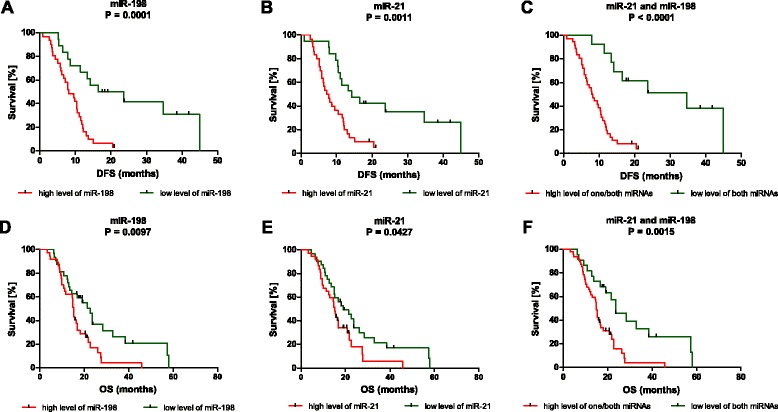
Using quantitative real-time PCR, expression levels of 4 microRNAs were examined in 74 tumor tissues, 18 tissues of chronic pancreatitis and 9 adjacent normal tissues and correlated with clinicopathological features of patients. Expression levels of miR-21, miR-34a and miR-198 were significantly higher, whereas levels of miR-217 were significantly lower in pancreatic ductal adenocarcinomas compared to healthy tissues and tissues of chronic pancreatitis. Moreover, increased expression of miR-21 and miR-198 was significantly associated with shorter disease free survival and overall survival.
Our data suggest that altered expression of examined microRNAs is related to neoplastic transformation and progression of the disease and these microRNAs could serve as diagnostic and prognostic biomarkers for pancreatic ductal adenocarcinoma.
The virtual slide(s) for this article can be found here: http://www.diagnosticpathology.diagnomx.eu/vs/1373952531543898.
胰腺导管腺癌是一种侵袭性恶性肿瘤,就诊时往往较晚,具有转移潜能且预后极差。因此,迫切需要新型的诊断和预后生物标志物。微小RNA是一类小的非编码RNA,可在转录后水平调节基因表达。据报道,在包括胰腺导管腺癌在内的多种恶性肿瘤中,微小RNA的表达均发生改变。本研究旨在分析特定微小RNA在正常胰腺、慢性胰腺炎和胰腺导管腺癌组织中的表达情况,并评估其诊断和预后潜力。
采用定量实时聚合酶链反应,检测了74例肿瘤组织、18例慢性胰腺炎组织和9例相邻正常组织中4种微小RNA的表达水平,并将其与患者的临床病理特征进行关联分析。与健康组织和慢性胰腺炎组织相比,胰腺导管腺癌中miR-21、miR-34a和miR-198的表达水平显著升高,而miR-217的水平显著降低。此外,miR-21和miR-198表达的增加与无病生存期和总生存期的缩短显著相关。
我们的数据表明,所检测的微小RNA表达改变与肿瘤转化和疾病进展相关,这些微小RNA可作为胰腺导管腺癌的诊断和预后生物标志物。
本文的虚拟切片可在此处找到:http://www.diagnosticpathology.diagnomx.eu/vs/1373952531543898。