Fettiplace Michael R, Pichurko Adrian, Ripper Richard, Lin Bocheng, Kowal Katarzyna, Lis Kinga, Schwartz David, Feinstein Douglas L, Rubinstein Israel, Weinberg Guy
Department of Anesthesiology, University of Illinois College of Medicine, Chicago, IL.
Research & Development Service, Jesse Brown Veterans' Affairs Medical Center, Chicago, IL.
Acad Emerg Med. 2015 May;22(5):508-17. doi: 10.1111/acem.12657. Epub 2015 Apr 23.
Cocaine intoxication leads to over 500,000 emergency department visits annually in the United States and ethanol cointoxication occurs in 34% of those cases. Cardiotoxicity is an ominous complication of cocaine and cocaethylene overdose for which no specific antidote exists. Because infusion of lipid emulsion (Intralipid) can treat lipophilic local anesthetic toxicity and cocaine is an amphipathic local anesthetic, the authors tested whether lipid emulsion could attenuate cocaine cardiotoxicity in vivo. The effects of lipid emulsion were compared with the metabolically inert sulfobutylether-β-cyclodextrin (SBE-β-CD; Captisol) in an isolated heart model of cocaine and cocaethylene toxicity to determine if capture alone could exert similar benefit as lipid emulsion, which exhibits multimodal effects. The authors then tested if cocaine and cocaethylene, like bupivacaine, inhibit lipid-based metabolism in isolated cardiac mitochondria.
For whole animal experiments, Sprague-Dawley rats were anesthetized, instrumented, and pretreated with lipid emulsion followed by a continuous infusion of cocaine to assess time of onset of cocaine toxicity. For ex vivo experiments, rat hearts were placed onto a nonrecirculating Langendorff system perfused with Krebs-Henseleit solution. Heart rate, left ventricle maximum developed pressure (LVdevP), left ventricle diastolic pressure, maximum rate of contraction (+dP/dtmax), maximum rate of relaxation (-dP/dtmax), rate-pressure product (RPP = heart rate × LVdevP), and line pressure were monitored continuously during the experiment. A dose response to cocaine (10, 30, 50, and 100 μmol/L) and cocaethylene (10, 30, and 50 μmol/L) was generated in the absence or presence of either 0.25% lipid emulsion or SBE-β-CD. Substrate-specific rates of oxygen consumption were measured in interfibrillar cardiac mitochondria in the presence of cocaine, cocaethylene, ecgonine, and benzoylecgonine.
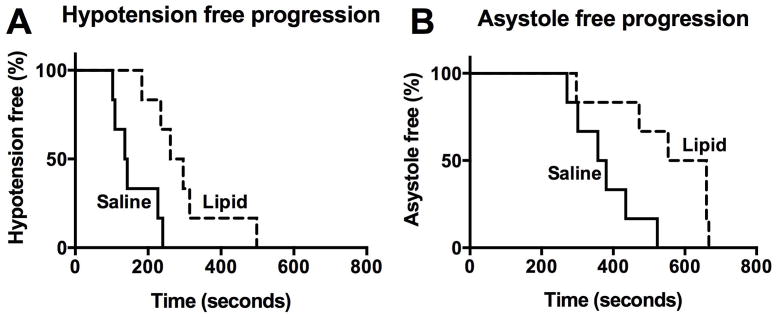
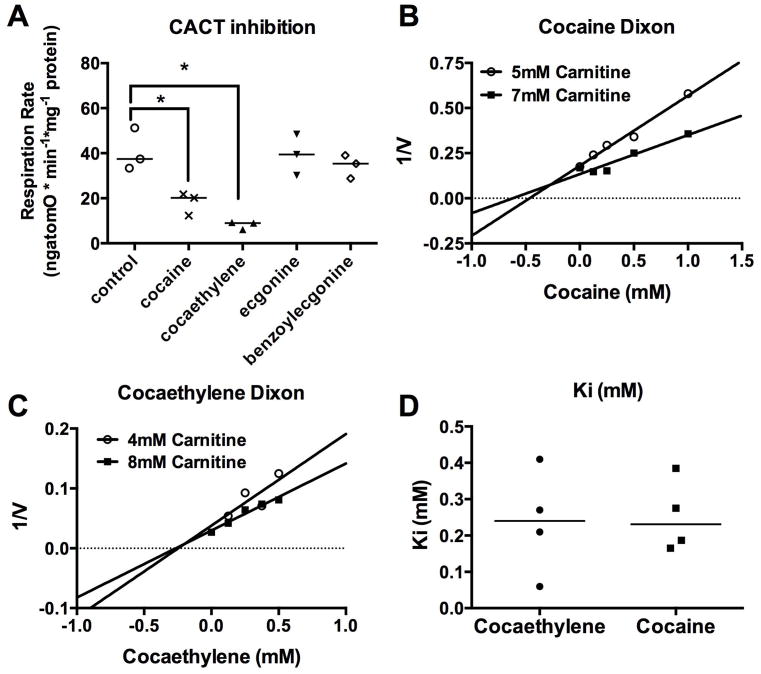
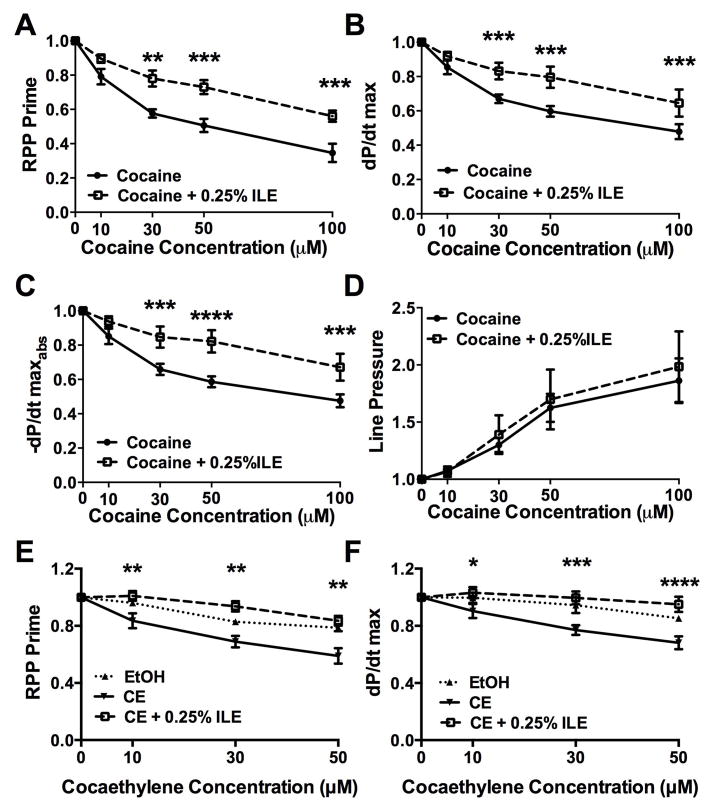
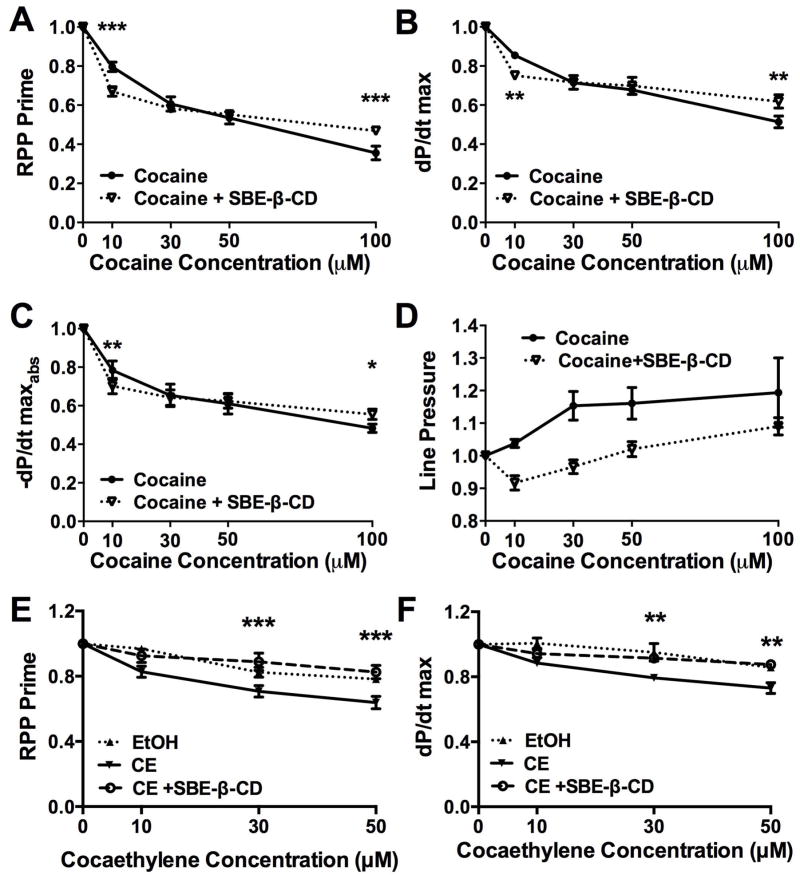
Treatment with lipid emulsion delayed onset of hypotension (140 seconds vs. 279 seconds; p = 0.008) and asystole (369 seconds vs. 607 seconds; p = 0.02) in whole animals. Cocaine and cocaethylene induced dose-dependent decreases in RPP, +dP/dtmax, and -dP/dtmaxabs (p < 0.0001) in Langendorff hearts; line pressure was increased by cocaine and cocaethylene infusion, but not altered by treatment. Lipid emulsion attenuated cocaine- and cocaethylene-induced cardiac depression. SBE-β-CD alone evoked a mild cardiodepressant effect (p < 0.0001) but attenuated further cocaine- and cocaethylene-induced decrements in cardiac contractility at high concentrations of drug (100 μmol/L; p < 0.001). Finally, both cocaine and cocaethylene, but not ecgonine and benzoylecgonine, inhibited lipid-dependent mitochondrial respiration by blocking carnitine exchange (p < 0.05).
A commercially available lipid emulsion was able to delay progression of cocaine cardiac toxicity in vivo. Further, it improved acute cocaine- and cocaethylene-induced cardiac toxicity in rat isolated heart while SBE-β-CD was effective only at the highest cocaine concentration. Further, both cocaine and cocaethylene inhibited lipid-dependent mitochondrial respiration. Collectively, this suggests that scavenging-independent effects of lipid emulsion may contribute to reversal of acute cocaine and cocaethylene cardiotoxicity, and the beneficial effects may involve mitochondrial lipid processing.
在美国,每年因可卡因中毒而前往急诊科就诊的人数超过50万,其中34%的病例同时伴有乙醇中毒。心脏毒性是可卡因和可口卡因过量使用的一种严重并发症,目前尚无特效解毒剂。由于脂质乳剂(英脱利匹特)可用于治疗亲脂性局部麻醉药中毒,而可卡因是一种两性局部麻醉药,因此作者测试了脂质乳剂是否能在体内减轻可卡因的心脏毒性。在可卡因和可口卡因毒性的离体心脏模型中,将脂质乳剂的效果与代谢惰性的磺丁基醚-β-环糊精(SBE-β-CD;Captisol)进行比较,以确定单纯的捕获作用是否能产生与具有多模式作用的脂质乳剂相似的益处。然后,作者测试了可卡因和可口卡因是否像布比卡因一样,在离体心脏线粒体中抑制基于脂质的代谢。
在整体动物实验中,对Sprague-Dawley大鼠进行麻醉、仪器植入,并预先给予脂质乳剂,随后持续输注可卡因,以评估可卡因毒性的发作时间。在离体实验中,将大鼠心脏置于非循环Langendorff系统中,用Krebs-Henseleit溶液灌注。在实验过程中持续监测心率、左心室最大收缩压(LVdevP)、左心室舒张压、最大收缩速率(+dP/dtmax)、最大舒张速率(-dP/dtmax)、速率压力乘积(RPP = 心率×LVdevP)和管路压力。在不存在或存在0.25%脂质乳剂或SBE-β-CD的情况下,生成对可卡因(10、30、50和100 μmol/L)和可口卡因(10、30和50 μmol/L)的剂量反应。在存在可卡因、可口卡因、芽子碱和苯甲酰芽子碱的情况下,测量肌原纤维间心脏线粒体中底物特异性耗氧率。
在整体动物中,脂质乳剂治疗可延迟低血压(140秒对279秒;p = 0.008)和心搏停止(369秒对607秒;p = 0.02)的发作。在Langendorff心脏中,可卡因和可口卡因可引起RPP、+dP/dtmax和-dP/dtmaxabs剂量依赖性降低(p < 0.0001);输注可卡因和可口卡因可使管路压力升高,但治疗未改变该压力。脂质乳剂可减轻可卡因和可口卡因引起的心脏抑制。单独使用SBE-β-CD可引起轻度心脏抑制作用(p < 0.0001),但在高浓度药物(100 μmol/L)时,可进一步减轻可卡因和可口卡因引起的心脏收缩力下降(p < 0.001)。最后,可卡因和可口卡因均可通过阻断肉碱交换抑制脂质依赖性线粒体呼吸(p < 0.05),而芽子碱和苯甲酰芽子碱则无此作用。
市售脂质乳剂能够在体内延迟可卡因心脏毒性的进展。此外,它可改善大鼠离体心脏中急性可卡因和可口卡因引起的心脏毒性,而SBE-β-CD仅在最高可卡因浓度时有效。此外,可卡因和可口卡因均可抑制脂质依赖性线粒体呼吸。总体而言,这表明脂质乳剂的非清除依赖性作用可能有助于逆转急性可卡因和可口卡因的心脏毒性,其有益作用可能涉及线粒体脂质处理。