Université Aix-Marseille, Hôpital Nord, Laboratoire d'Hématologie, Chemin des Bourrely, 13915 Marseille Cedex 20, France.
Université Aix-Marseille, Hôpital Nord, Laboratoire d'Hématologie, Chemin des Bourrely, 13915 Marseille Cedex 20, France ; Technologies Avancées pour la Génomique et la Clinique (TAGC)/unité INSERM U1090, route de Luminy, 13008 Marseille, France.
AIDS Res Ther. 2014 Nov 24;11:38. doi: 10.1186/1742-6405-11-38. eCollection 2014.
Abnormal NK phenotype and cytotoxic functions have been described in acute myeloid leukemia, chronic lymphocytic leukemia, myeloma and myelodysplastic syndromes. Defective NK cytotoxicity is due to decreased expression of the Natural Cytotoxicity Receptors (NCRs), 2B4/CD244/p38, or NKG2D. This prompted us to test the expression of these molecules on circulating NK cells from patients with AIDS-related lymphomas (RL) in comparison with HIV + patients without lymphoma, healthy subjects and HIV-negative patients with lymphoma.
Blood samples were analyzed by flow cytometry for NCRs, 2B4/CD244/p38 and NKG2D expression on NK cells defined as CD3-/CD56+ lymphocytes. We also analyzed by quantitative PCR specific RNA for NKp30/NCR3 and NKp46/NCR1.
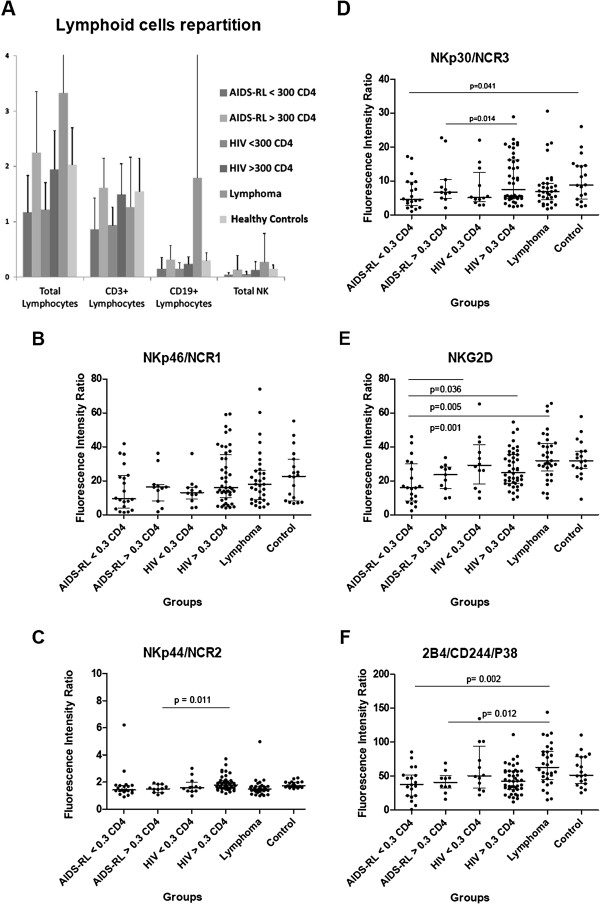
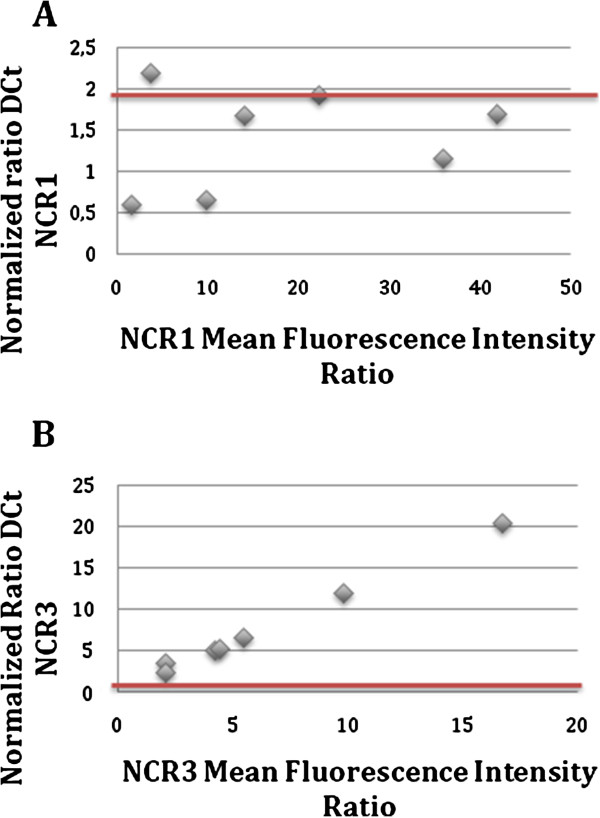
We could not detect any defect in NKp46/NCR1 expression between all groups. NKp44/NCR2, NKp30/NCR3 and NKG2D had lower expression in AIDS-RL in comparison with HIV + patients without lymphoma when compared to patients with similar (>0.3 G/L) CD4+ lymphocyte levels. Expression of 2B4/CD244/p38 was lower in AIDS-RL than in HIV-negative lymphoma. Comparison of specific NKp30/NCR3 and NKp46/NCR1 RNA showed increased steady state levels, despite decreased surface expression for NKp30/NCR3, suggesting abnormal post-transcriptional regulatory mechanisms.
We show a more pronounced defect in NK activating molecule when HIV infection is associated with lymphoma than when only one condition (HIV positivity or lymphoma) is present. Defective NK phenotype, in addition to CD4+ depletion and dysfunction, may participate to the increased incidence of lymphoma in HIV patients.
异常的自然杀伤(NK)表型和细胞毒性功能已在急性髓系白血病、慢性淋巴细胞白血病、骨髓瘤和骨髓增生异常综合征中被描述。NK 细胞毒性缺陷是由于自然细胞毒性受体(NCRs)、2B4/CD244/p38 或 NKG2D 的表达减少所致。这促使我们检测 AIDS 相关淋巴瘤(RL)患者循环 NK 细胞上这些分子的表达情况,并与无淋巴瘤的 HIV 阳性患者、健康对照和无 HIV 淋巴瘤患者进行比较。
通过流式细胞术分析 NK 细胞上 NCRs、2B4/CD244/p38 和 NKG2D 的表达,NK 细胞定义为 CD3-/CD56+淋巴细胞。我们还通过定量 PCR 分析了 NKp30/NCR3 和 NKp46/NCR1 的特异性 RNA。
我们发现所有组之间 NKp46/NCR1 表达均无缺陷。与具有相似 (>0.3 G/L) CD4+淋巴细胞水平的无淋巴瘤 HIV 阳性患者相比,AIDS-RL 患者 NKp44/NCR2、NKp30/NCR3 和 NKG2D 的表达水平较低。与 HIV 阴性淋巴瘤患者相比,AIDS-RL 患者 2B4/CD244/p38 的表达较低。尽管 NKp30/NCR3 的表面表达减少,但特异性 NKp30/NCR3 和 NKp46/NCR1 RNA 的比较显示稳定状态水平增加,表明存在异常的转录后调节机制。
当 HIV 感染与淋巴瘤相关时,与仅存在一种情况(HIV 阳性或淋巴瘤)时相比,NK 激活分子的缺陷更为明显。除 CD4+细胞耗竭和功能障碍外,NK 表型缺陷可能会导致 HIV 患者淋巴瘤发病率增加。