Eshetie Setegn, Unakal Chandrashekhar, Gelaw Aschalew, Ayelign Birhanu, Endris Mengistu, Moges Feleke
Department of Medicine, Debre Markos University, Debre Markos, Ethiopia.
Department of Microbiology, University of Gondar, Gondar, Ethiopia.
Antimicrob Resist Infect Control. 2015 Apr 17;4:12. doi: 10.1186/s13756-015-0054-7. eCollection 2015.
Updates on the epidemiology of antibiotic resistance bacterial pathogens is important. This is because the spread of multidrug resistant enterobacteriaceae (MDRE) and recently carbapenemase producing enterobacteriaceae (CPE) have emerged as a major public health concern in patients with urinary tract infections (UTIs). This study is therefore, aimed to assess the prevalence and associated risk factors of MDR and CPE among patients with UTIs.
A cross sectional study was conducted among 442 symptomatic UTI suspected patients. Data on socio-demographic characteristics, clinical information and possible risk factors were collected using structured questionnaire. Early morning mid-stream urine samples were collected and processed to characterize bacterial isolates. Disk diffusion method was used to determine the antibiotic susceptibility patterns of isolates. Carbapenemase producing strains were detected using CHROMagar KPC medium. Data were entered and analyzed using SPSS version 20. P-value <0.05 was considered as statistical significant.
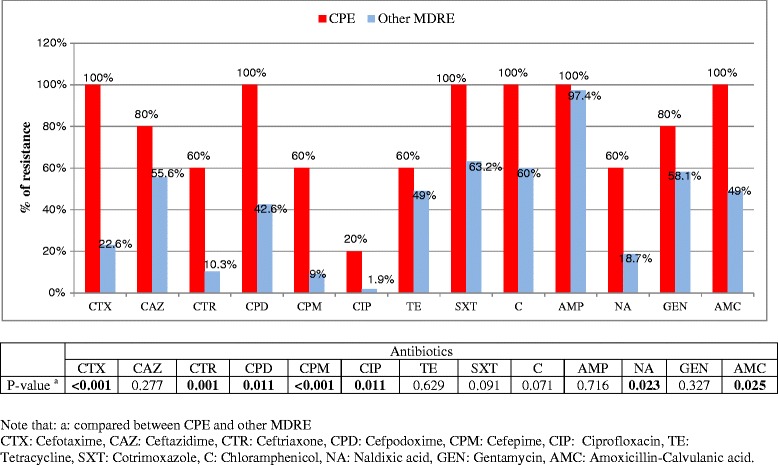
Among 442 patients enrolled a total of 183 Enterobacteriaceae were recovered. Of these isolates; 160 (87.4%) were MDRE; the most common isolates were K. pneumoniae and E.coli. Five (2.73%) of the isolates were found to be carbapenemase producers and all of CPE strains were 100% ESBL producers. Significant drug resistances were observed among CPE compared to other MDRE, low resistance rates were noted to ciprofloxacin (20%). Being female (OR 4.46; P = 0.018), age (OR 1.08; P = 0.001), hospitalization (OR 5.23; P = 0.006), and prior antibiotic use (OR 3.98; P = 0.04) were associated risk factors for MDRE.
High rates of MDR (87.4%) were observed among enterobacteriaceae uropathogens; K. pneumoniae and E.coli were the principal MDR isolates. Overall prevalence of CPE was 2.73% and all of these strains were 100% ESBL producer. Attributing risk factors for MDR UTIs were found to be sex (female), age, hospitalization, and history of antibiotic therapy. Therefore, efforts should be made to reduce patient hospital stay and maximize rational use of drugs. Additional and vigorous investigation especially on CPE should be encouraged.
了解抗生素耐药性细菌病原体的流行病学最新情况很重要。这是因为多重耐药肠杆菌科细菌(MDRE)的传播以及最近产碳青霉烯酶肠杆菌科细菌(CPE)的出现已成为尿路感染(UTI)患者的一个主要公共卫生问题。因此,本研究旨在评估UTI患者中MDR和CPE的患病率及相关危险因素。
对442例有症状的疑似UTI患者进行了一项横断面研究。使用结构化问卷收集社会人口学特征、临床信息和可能的危险因素数据。收集清晨中段尿样本并进行处理以鉴定细菌分离株。采用纸片扩散法确定分离株的抗生素敏感性模式。使用CHROMagar KPC培养基检测产碳青霉烯酶菌株。数据录入并使用SPSS 20版进行分析。P值<0.05被认为具有统计学意义。
在442例入组患者中,共分离出183株肠杆菌科细菌。在这些分离株中,160株(87.4%)为MDRE;最常见的分离株是肺炎克雷伯菌和大肠杆菌。5株(2.73%)分离株被发现产碳青霉烯酶,所有CPE菌株均为100%产超广谱β-内酰胺酶(ESBL)菌株。与其他MDRE相比,CPE中观察到显著的耐药性,环丙沙星的耐药率较低(20%)。女性(比值比[OR]4.46;P = 0.018)、年龄(OR 1.08;P = 0.001)、住院(OR 5.23;P = 0.006)和既往使用抗生素(OR 3.98;P = 0.04)是MDRE的相关危险因素。
在肠杆菌科尿路病原体中观察到较高的MDR发生率(87.4%);肺炎克雷伯菌和大肠杆菌是主要的MDR分离株。CPE的总体患病率为2.73%,所有这些菌株均为100%产ESBL菌株。发现MDR UTI的归因危险因素为性别(女性)、年龄、住院和抗生素治疗史。因此,应努力减少患者住院时间并最大限度地合理使用药物。应鼓励进行更多积极的调查,尤其是针对CPE的调查。