The University of Tokushima Graduate School, Tokushima, 770-0855 Japan.
Emergency and Disaster Medicine, Tokushima University Hospital, Tokushima, 770-8503 Japan.
J Intensive Care. 2014 Jun 2;2(1):34. doi: 10.1186/2052-0492-2-34. eCollection 2014.
To prevent endotracheal tube (ETT)-related complications during mechanical ventilation, ETT cuff pressure should be kept within proper range. In clinical settings, cuff pressure often decreases from target values.
We performed an experimental study to investigate the effects of measuring devices and endotracheal tubes on change in cuff pressure. We continuously measured cuff pressure by inserting a three-way stopcock in the middle of an ETT pilot balloon system. After adjusting the cuff pressure to 24 cmH2O, we disconnected and reconnected each cuff inflator to the inflation valve of the ETT and measured the changes in the cuff pressure. We measured the change in cuff pressure with different ETT sizes, cuff shapes, brands of cuff inflator, and with and without added extension tubes.
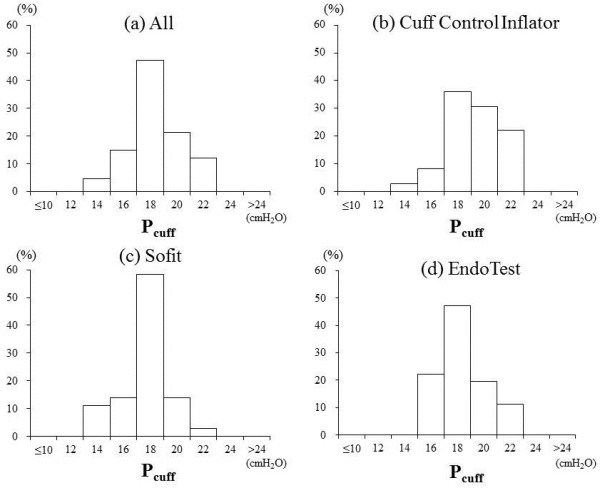
The cuff pressure decreased, on average, by 6.6 cmH2O (standard deviation 1.9), when connecting the cuff inflator to the pilot balloon. The measured cuff pressure was less than 20 cmH2O in 67% of the tests. The cuff pressure decreased more when an extension tube was used. The brand of cuff inflator made no difference to the pressure loss. The cuff pressure decreased more with ETTs of smaller size and with ETTs with pyriform cuffs.
Procedures to connect cuff inflators to inflation valves resulted in the loss of cuff pressure by 6.6 cmH2O on average.
为了预防机械通气期间气管内导管(ETT)相关并发症,应将 ETT 套囊压力保持在适当范围内。在临床环境中,套囊压力经常会从目标值下降。
我们进行了一项实验研究,以调查测量设备和气管内导管对套囊压力变化的影响。我们通过在 ETT 测压管系统的中间插入三通旋塞来连续测量套囊压力。在将套囊压力调整至 24cmH2O 后,我们断开并重新连接每个套囊充气器到 ETT 的充气阀,并测量套囊压力的变化。我们测量了不同 ETT 尺寸、套囊形状、套囊充气器品牌以及是否使用附加延长管对套囊压力变化的影响。
当将套囊充气器连接到测压管时,套囊压力平均下降 6.6cmH2O(标准差 1.9)。在 67%的测试中,测量的套囊压力小于 20cmH2O。使用延长管时,套囊压力下降更多。套囊充气器的品牌对压力损失没有影响。套囊压力随着 ETT 尺寸的减小和椭圆形套囊的 ETT 而减小更多。
将套囊充气器连接到充气阀的程序会导致套囊压力平均损失 6.6cmH2O。