Sengupta Papiya, Sessler Daniel I, Maglinger Paul, Wells Spencer, Vogt Alicia, Durrani Jaleel, Wadhwa Anupama
Outcomes Research™ Institute, University of Louisville, 501 E, Broadway, Suite 210, Louisville, KY 40202, USA.
BMC Anesthesiol. 2004 Nov 29;4(1):8. doi: 10.1186/1471-2253-4-8.
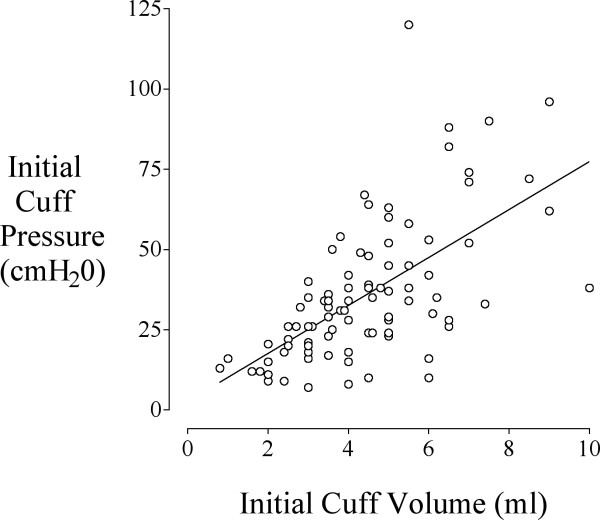
Cuff pressure in endotracheal (ET) tubes should be in the range of 20-30 cm H2O. We tested the hypothesis that the tube cuff is inadequately inflated when manometers are not used. METHODS: With IRB approval, we studied 93 patients under general anesthesia with an ET tube in place in one teaching and two private hospitals. Anesthetists were blinded to study purpose. Cuff pressure in tube sizes 7.0 to 8.5 mm was evaluated 60 min after induction of general anesthesia using a manometer connected to the cuff pilot balloon. Nitrous oxide was disallowed. After deflating the cuff, we reinflated it in 0.5-ml increments until pressure was 20 cmH2O. RESULTS: Neither patient morphometrics, institution, experience of anesthesia provider, nor tube size influenced measured cuff pressure (35.3 +/- 21.6 cmH2O). Only 27% of pressures were within 20-30 cmH2O; 27% exceeded 40 cmH2O. Although it varied considerably, the amount of air required to achieve a cuff pressure of 20 cmH2O was similar with each tube size. CONCLUSION: We recommend that ET cuff pressure be set and monitored with a manometer.
气管内(ET)导管的套囊压力应在20 - 30 cm H₂O范围内。我们检验了一个假设,即不使用压力计的时候,导管套囊充气不足。方法:经机构审查委员会批准,我们在一家教学医院和两家私立医院研究了93例接受全身麻醉且已置入ET导管的患者。麻醉医生对研究目的不知情。在全身麻醉诱导60分钟后,使用连接到套囊测压管的压力计评估7.0至8.5毫米型号导管的套囊压力。禁用氧化亚氮。放气后,我们以0.5毫升的增量重新给套囊充气,直到压力达到20 cmH₂O。结果:患者的形态计量学、机构、麻醉提供者的经验以及导管型号均未影响所测的套囊压力(35.3±21.6 cmH₂O)。只有27%的压力在20 - 30 cmH₂O范围内;27%超过40 cmH₂O。尽管差异很大,但达到20 cmH₂O套囊压力所需的空气量在每种导管型号中相似。结论:我们建议使用压力计来设定和监测ET套囊压力。