Cirenajwis Helena, Ekedahl Henrik, Lauss Martin, Harbst Katja, Carneiro Ana, Enoksson Jens, Rosengren Frida, Werner-Hartman Linda, Törngren Therese, Kvist Anders, Fredlund Erik, Bendahl Pär-Ola, Jirström Karin, Lundgren Lotta, Howlin Jillian, Borg Åke, Gruvberger-Saal Sofia K, Saal Lao H, Nielsen Kari, Ringnér Markus, Tsao Hensin, Olsson Håkan, Ingvar Christian, Staaf Johan, Jönsson Göran
Department of Clinical Sciences, Division of Oncology and Pathology, Lund University, Lund, Sweden.
Department of Clinical Sciences, Division of Surgery, Lund University, Lund, Sweden.
Oncotarget. 2015 May 20;6(14):12297-309. doi: 10.18632/oncotarget.3655.
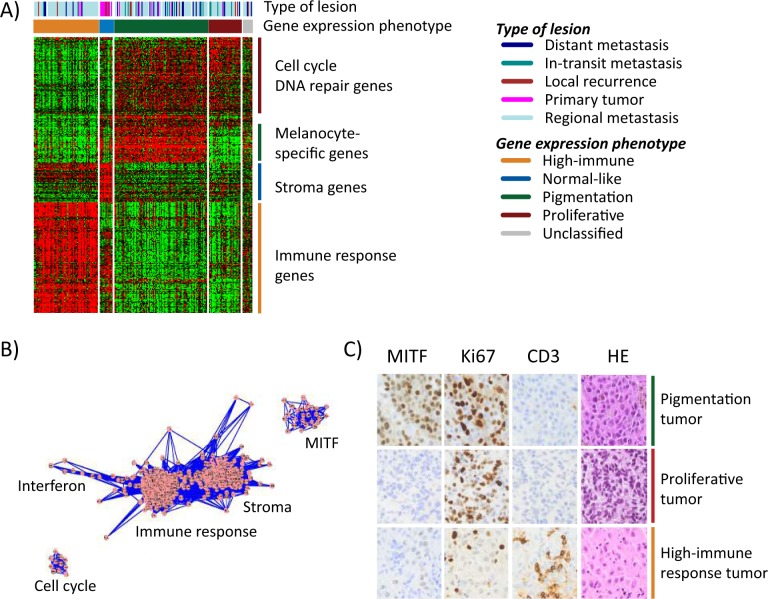
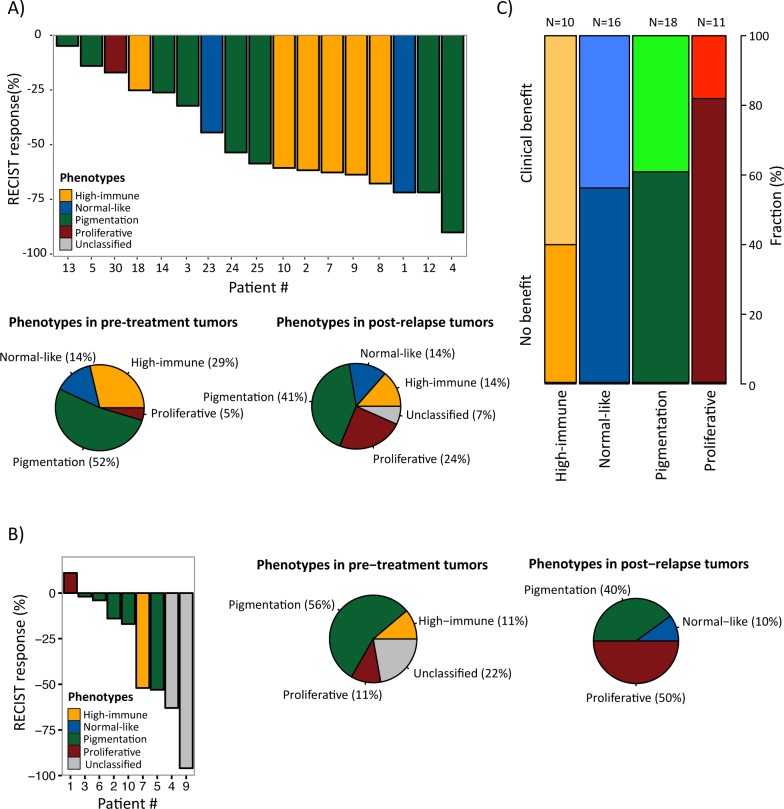
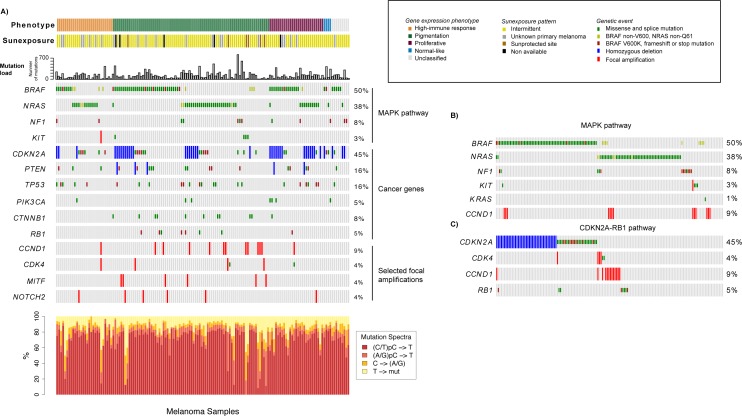
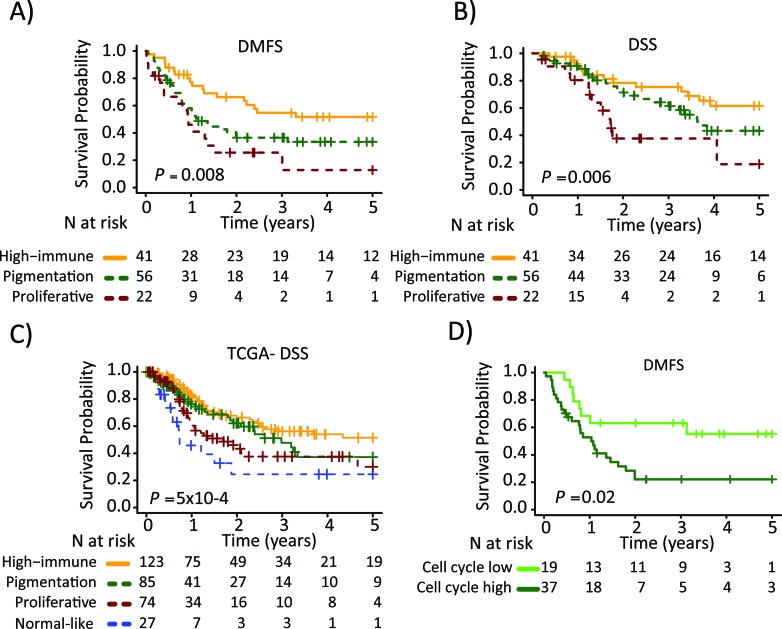
Melanoma is currently divided on a genetic level according to mutational status. However, this classification does not optimally predict prognosis. In prior studies, we have defined gene expression phenotypes (high-immune, pigmentation, proliferative and normal-like), which are predictive of survival outcome as well as informative of biology. Herein, we employed a population-based metastatic melanoma cohort and external cohorts to determine the prognostic and predictive significance of the gene expression phenotypes. We performed expression profiling on 214 cutaneous melanoma tumors and found an increased risk of developing distant metastases in the pigmentation (HR, 1.9; 95% CI, 1.05-3.28; P=0.03) and proliferative (HR, 2.8; 95% CI, 1.43-5.57; P=0.003) groups as compared to the high-immune response group. Further genetic characterization of melanomas using targeted deep-sequencing revealed similar mutational patterns across these phenotypes. We also used publicly available expression profiling data from melanoma patients treated with targeted or vaccine therapy in order to determine if our signatures predicted therapeutic response. In patients receiving targeted therapy, melanomas resistant to targeted therapy were enriched in the MITF-low proliferative subtype as compared to pre-treatment biopsies (P=0.02). In summary, the melanoma gene expression phenotypes are highly predictive of survival outcome and can further help to discriminate patients responding to targeted therapy.
黑色素瘤目前在基因水平上根据突变状态进行分类。然而,这种分类并不能最佳地预测预后。在先前的研究中,我们定义了基因表达表型(高免疫、色素沉着、增殖和正常样),这些表型可预测生存结果并提供生物学信息。在此,我们采用基于人群的转移性黑色素瘤队列和外部队列来确定基因表达表型的预后和预测意义。我们对214例皮肤黑色素瘤肿瘤进行了表达谱分析,发现与高免疫反应组相比,色素沉着组(HR,1.9;95%CI,1.05 - 3.28;P = 0.03)和增殖组(HR,2.8;95%CI,1.43 - 5.57;P = 0.003)发生远处转移的风险增加。使用靶向深度测序对黑色素瘤进行进一步的基因特征分析发现,这些表型具有相似的突变模式。我们还使用了接受靶向治疗或疫苗治疗的黑色素瘤患者的公开可用表达谱数据,以确定我们的特征是否能预测治疗反应。在接受靶向治疗的患者中,与治疗前活检相比,对靶向治疗耐药的黑色素瘤在MITF低增殖亚型中富集(P = 0.02)。总之,黑色素瘤基因表达表型对生存结果具有高度预测性,并且可以进一步帮助区分对靶向治疗有反应的患者。