Stoner Susan A, Arenella Pamela B, Hendershot Christian S
Alcohol and Drug Abuse Institute, University of Washington, Seattle, Washington, United States of America.
Department of Psychiatry, University of New Mexico, Albuquerque, New Mexico, United States of America.
PLoS One. 2015 Apr 24;10(4):e0124613. doi: 10.1371/journal.pone.0124613. eCollection 2015.
Naltrexone is a front-line treatment for alcohol use disorders, but its efficacy is limited by poor medication adherence. This randomized controlled trial evaluated whether a mobile health intervention could improve naltrexone adherence.
Treatment-seeking participants with an alcohol use disorder (N = 76) were randomized to intervention and control conditions. All participants received naltrexone (50 mg/day) with a medication event monitoring system (MEMS) and a prepaid smartphone, and received a daily text message querying medication side effects, alcohol use, and craving. Those in the intervention arm received additional medication reminders and adherence assessment via text message.
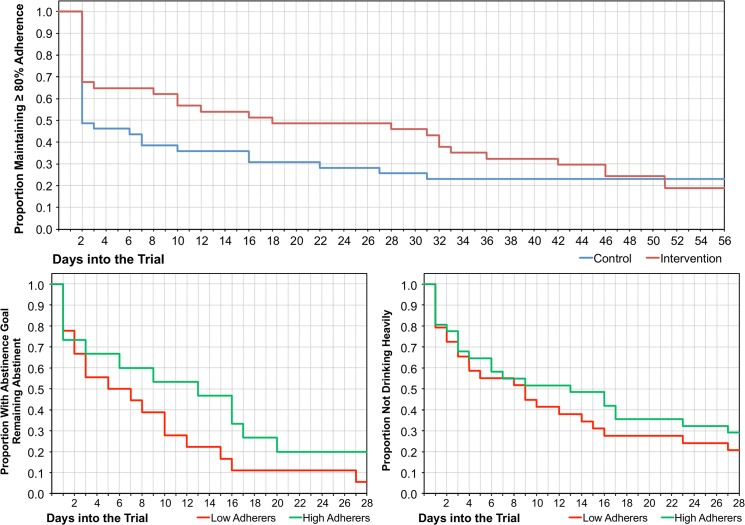
The primary outcome, proportion of participants with adequate adherence (defined as ≥80% of prescribed doses taken through Week 8), did not differ between groups in intent-to-treat analyses (p = .34). Mean adherence at study midpoint (Week 4) was 83% in the intervention condition and 77% in the control condition (p = .35). Survival analysis found that the intervention group sustained adequate adherence significantly longer (M = 19 days [95% CI = 0.0-44.0]) than those in the control group (M = 3 days [95% CI = 0.0-8.1]) during the first month of treatment (p = .04). Medication adherence did not predict drinking outcomes.
These results suggest that in the context of daily monitoring and assessment via cell phone, additional text message reminders do not further improve medication adherence. Although this initial trial does not provide support for the efficacy of text messaging to improve adherence to pharmacotherapy for alcohol use disorders, additional trials with larger samples and alternate designs are warranted.
ClinicalTrials.gov: NCT01349985.
纳曲酮是酒精使用障碍的一线治疗药物,但其疗效因药物依从性差而受限。这项随机对照试验评估了移动健康干预措施是否能提高纳曲酮的依从性。
寻求治疗的酒精使用障碍参与者(N = 76)被随机分为干预组和对照组。所有参与者均接受纳曲酮(50毫克/天)治疗,并配备药物事件监测系统(MEMS)和预付费智能手机,每天收到询问药物副作用、饮酒情况和渴望程度的短信。干预组的参与者还通过短信收到额外的用药提醒和依从性评估。
在意向性分析中,主要结局指标,即依从性良好的参与者比例(定义为在第8周服用规定剂量的≥80%)在两组之间没有差异(p = 0.34)。研究中点(第4周)时,干预组的平均依从率为83%,对照组为77%(p = 0.35)。生存分析发现,在治疗的第一个月,干预组维持足够依从性的时间显著长于对照组(M = 19天[95%CI = 0.0 - 44.0])(M = 3天[95%CI = 0.0 - 8.1])(p = 0.04)。药物依从性并不能预测饮酒结果。
这些结果表明,在通过手机进行日常监测和评估的情况下,额外的短信提醒并不能进一步提高药物依从性。尽管这项初步试验并未支持短信对改善酒精使用障碍药物治疗依从性的疗效,但仍有必要进行更多样本量更大和设计不同的试验。
ClinicalTrials.gov:NCT01349985。