
形状封闭型髋关节置换柄的早期下沉与翻修手术延迟相关。对24项RSA研究和56项生存率研究的系统评价与荟萃分析。
Early subsidence of shape-closed hip arthroplasty stems is associated with late revision. A systematic review and meta-analysis of 24 RSA studies and 56 survival studies.
作者信息
van der Voort Paul, Pijls Bart G, Nieuwenhuijse Marc J, Jasper Jorrit, Fiocco Marta, Plevier Josepha W M, Middeldorp Saskia, Valstar Edward R, Nelissen Rob G H H
机构信息
a 1 Department of Orthopaedics, Biomechanics and Imaging Group , Leiden University Medical Center, Leiden.
d 4 Department of Medical Statistics and Bioinformatics , Leiden University Medical Center, Leiden.
出版信息
Acta Orthop. 2015;86(5):575-85. doi: 10.3109/17453674.2015.1043832.
BACKGROUND AND PURPOSE
Few studies have addressed the association between early migration of femoral stems and late aseptic revision in total hip arthroplasty. We performed a meta-regression analysis on 2 parallel systematic reviews and meta-analyses to determine the association between early migration and late aseptic revision of femoral stems.
PATIENTS AND METHODS
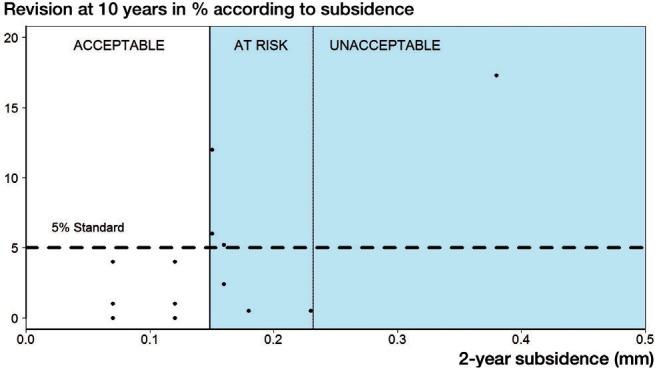
Of the 2 reviews, one covered early migration data obtained from radiostereometric analysis (RSA) studies and the other covered long-term aseptic revision rates obtained from survival studies with endpoint revision for aseptic loosening. Stems were stratified according to the design concept: cemented shape-closed, cemented force-closed, and uncemented. A weighted regression model was used to assess the association between early migration and late aseptic revision, and to correct for confounders. Thresholds for acceptable and unacceptable migration were determined in accordance with the national joint registries (≤ 5% revision at 10 years) and the NICE criteria (≤ 10% revision at 10 years).
RESULTS
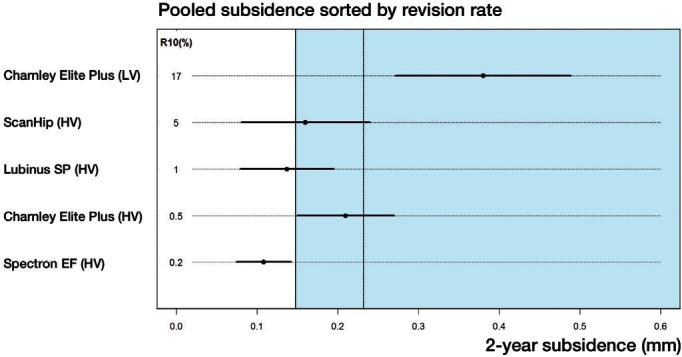
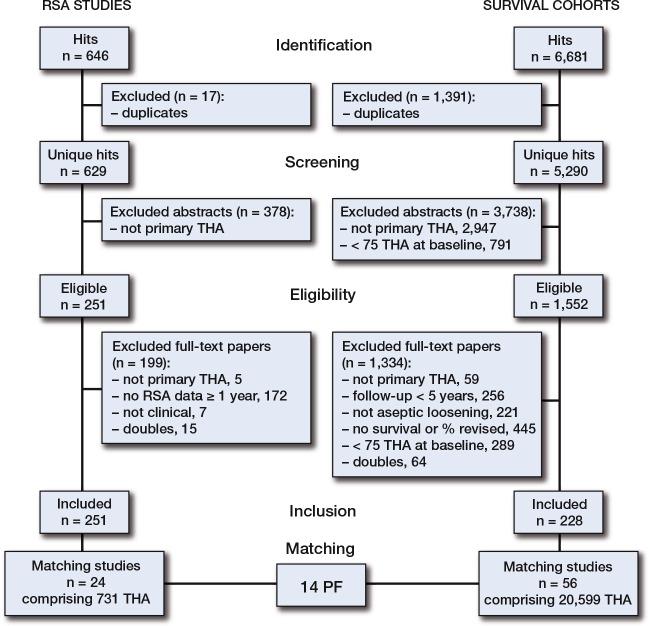
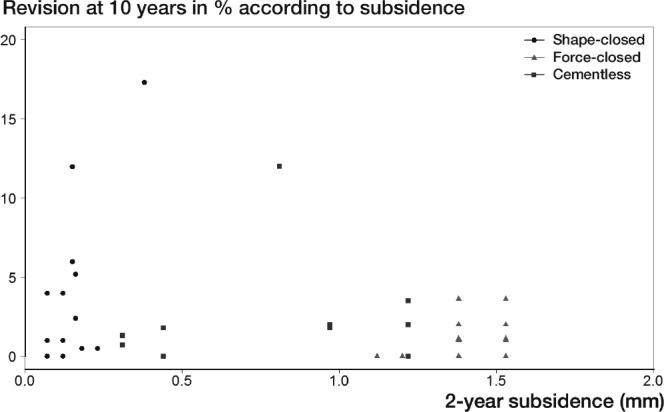
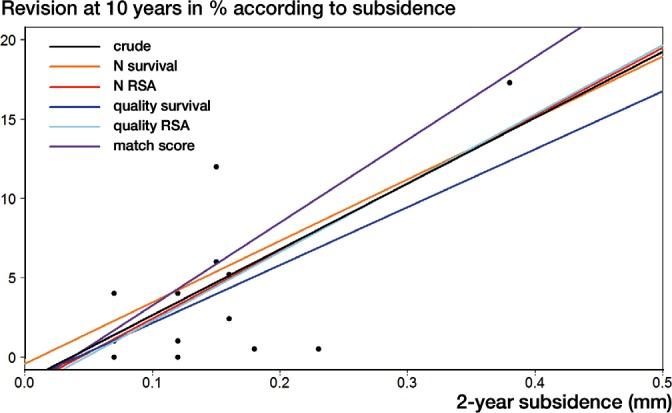
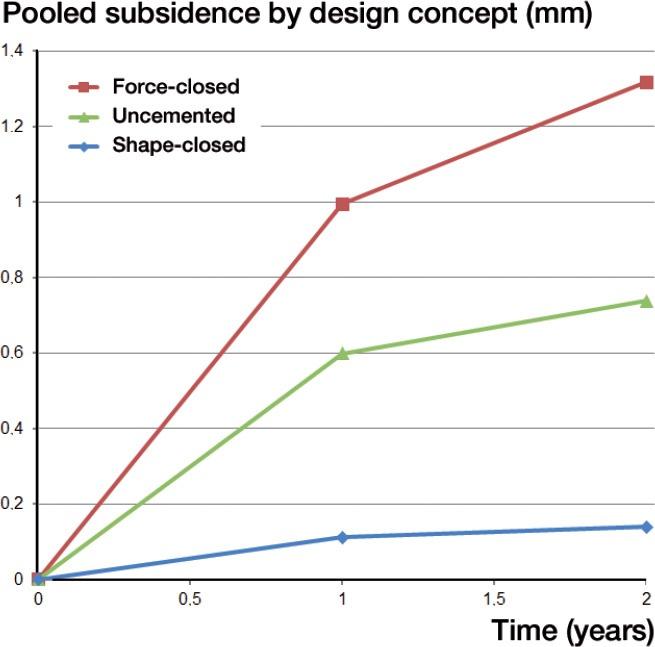
24 studies (731 stems) were included in the RSA review and 56 studies (20,599 stems) were included in the survival analysis review. Combining both reviews for the 3 design concepts showed that for every 0.1-mm increase in 2-year subsidence, as measured with RSA, there was a 4% increase in revision rate for the shape-closed stem designs. This association remained after correction for age, sex, diagnosis, hospital type, continent, and study quality. The threshold for acceptable migration of shape-closed designs was defined at 0.15 mm; stems subsiding less than 0.15 mm in 2 years had revision rates of less than 5% at 10 years, while stems exceeding 0.15 mm subsidence had revision rates of more than 5%.
INTERPRETATION
There was a clinically relevant association between early subsidence of shape-closed femoral stems and late revision for aseptic loosening. This association can be used to assess the safety of shape-closed stem designs. The published research is not sufficient to allow us to make any conclusions regarding such an association for the force-closed and uncemented stems.
背景与目的
很少有研究探讨全髋关节置换术中股骨柄早期移位与晚期无菌性翻修之间的关联。我们对两项平行的系统评价和荟萃分析进行了Meta回归分析,以确定股骨柄早期移位与晚期无菌性翻修之间的关联。
患者与方法
在这两项评价中,一项涵盖了从放射立体测量分析(RSA)研究中获得的早期移位数据,另一项涵盖了从以无菌性松动为终点翻修的生存研究中获得的长期无菌性翻修率。股骨柄根据设计理念进行分层:骨水泥型形状封闭、骨水泥型力封闭和非骨水泥型。采用加权回归模型评估早期移位与晚期无菌性翻修之间的关联,并校正混杂因素。根据国家关节登记处(10年翻修率≤5%)和英国国家卫生与临床优化研究所(NICE)标准(10年翻修率≤10%)确定可接受和不可接受移位的阈值。
结果
RSA评价纳入了24项研究(731个股骨柄),生存分析评价纳入了56项研究(20599个股骨柄)。对这3种设计理念的两项评价进行合并分析显示,用RSA测量,2年下沉每增加0.1mm,形状封闭型股骨柄设计的翻修率增加4%。在校正年龄、性别、诊断、医院类型、大洲和研究质量后,这种关联仍然存在。形状封闭型设计可接受移位的阈值定义为0.15mm;2年下沉小于0.15mm的股骨柄在10年时的翻修率小于5%,而超过0.15mm下沉的股骨柄翻修率超过5%。
解读
形状封闭型股骨柄早期下沉与晚期无菌性松动翻修之间存在临床相关关联。这种关联可用于评估形状封闭型股骨柄设计的安全性。已发表的研究不足以让我们就力封闭型和非骨水泥型股骨柄的这种关联得出任何结论。
 Zotero 插件