Weinstock R S, Guerci B, Umpierrez G, Nauck M A, Skrivanek Z, Milicevic Z
Endocrinology, Diabetes and Metabolism, Upstate Medical University, Syracuse, NY, USA.
Diabetology, Metabolic Disease and Nutrition, University of Lorraine, CIC Inserm ILCV, CHU, Nancy, France.
Diabetes Obes Metab. 2015 Sep;17(9):849-58. doi: 10.1111/dom.12479. Epub 2015 May 20.
To compare the once-weekly glucagon-like peptide-1 (GLP-1) receptor dulaglutide with the dipeptidyl peptidase-4 (DPP-4) inhibitor sitagliptin after 104 weeks of treatment.
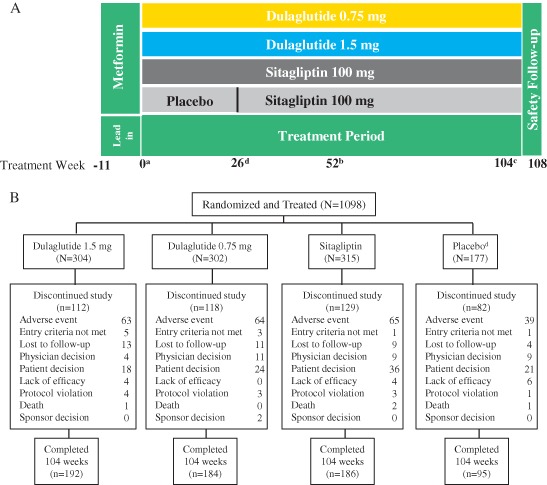
This AWARD-5 study was a multicentre, double-blind trial that randomized participants to dulaglutide (1.5 or 0.75 mg) or sitagliptin 100 mg for 104 weeks or placebo (reported separately) for 26 weeks. Change in glycated haemoglobin (HbA1c) concentration from baseline was the primary efficacy measure. A total of 1098 participants with HbA1c concentrations ≥7.0% (≥53.0 mmol/mol) and ≤9.5% (≤80.3 mmol/mol) were randomized, and 657 (59.8%) completed the study. We report results for dulaglutide and sitagliptin at the final endpoint.
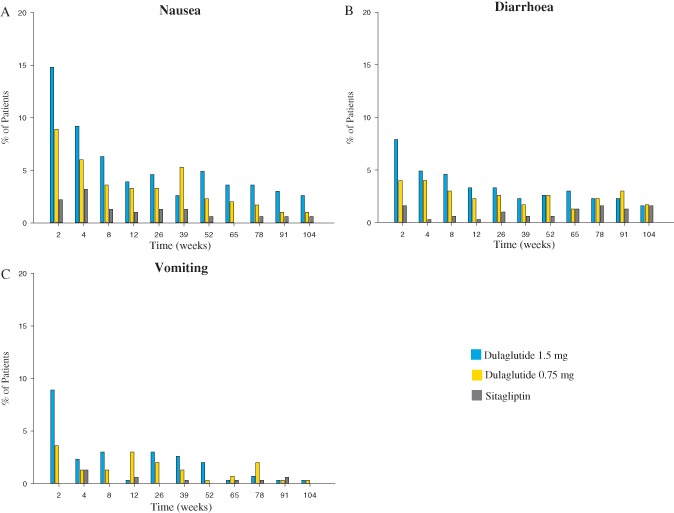
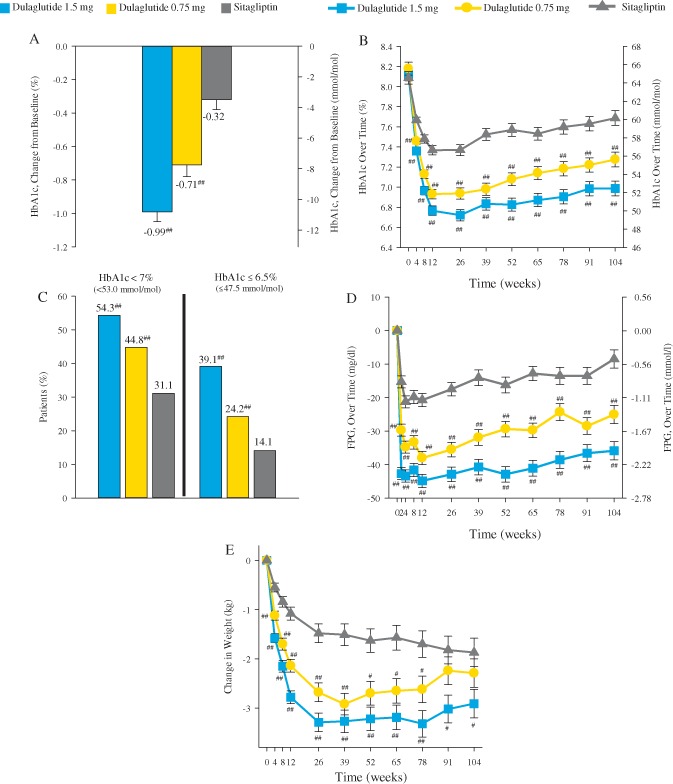
Changes in HbA1c at 104 weeks were (least squares mean ± standard error) -0.99 ± 0.06% (-10.82 ± 0.66 mmol/mol), -0.71 ± 0.07% (-7.76 ± 0.77 mmol/mol) and -0.32 ± 0.06% (-3.50 ± 0.66 mmol/mol) for dulaglutide 1.5 mg, dulaglutide 0.75 mg and sitagliptin, respectively (p < 0.001, both dulaglutide doses vs sitagliptin). Weight loss was greater with dulaglutide 1.5 mg (p < 0.001) and similar with 0.75 mg versus sitagliptin (2.88 ± 0.25, 2.39 ± 0.26 and 1.75 ± 0.25 kg, respectively). Gastrointestinal adverse events were more common with dulaglutide 1.5 and 0.75 mg versus sitagliptin (nausea 17 and 15% vs 7%, diarrhoea 16 and 12% vs 6%, vomiting 14 and 8% vs 4% respectively). Pancreatic, thyroid, cardiovascular and hypersensitivity safety were similar across groups.
Dulaglutide doses provided superior glycaemic control and dulaglutide 1.5 mg resulted in greater weight reduction versus sitagliptin at 104 weeks, with acceptable safety.
比较治疗104周后每周一次的胰高血糖素样肽-1(GLP-1)受体激动剂度拉糖肽与二肽基肽酶-4(DPP-4)抑制剂西格列汀的疗效。
这项AWARD-5研究是一项多中心、双盲试验,将参与者随机分为度拉糖肽组(1.5或0.75mg)或西格列汀100mg组,治疗104周,或安慰剂组(单独报告)治疗26周。糖化血红蛋白(HbA1c)浓度相对于基线的变化是主要疗效指标。共有1098名HbA1c浓度≥7.0%(≥53.0mmol/mol)且≤9.5%(≤80.3mmol/mol)的参与者被随机分组,657名(59.8%)完成了研究。我们报告度拉糖肽和西格列汀在最终终点的结果。
104周时,度拉糖肽1.5mg组、度拉糖肽0.75mg组和西格列汀组的HbA1c变化分别为(最小二乘均值±标准误)-0.99±0.06%(-10.82±0.66mmol/mol)、-0.71±0.07%(-7.76±0.77mmol/mol)和-0.32±0.06%(-3.50±0.66mmol/mol)(度拉糖肽两个剂量组与西格列汀相比,p<0.001)。度拉糖肽1.5mg组体重减轻更多(p<0.001),0.75mg组与西格列汀组体重减轻相似(分别为2.88±0.25、2.39±0.26和1.75±0.25kg)。度拉糖肽1.5mg和0.75mg组的胃肠道不良事件比西格列汀组更常见(恶心分别为17%和15% vs 7%,腹泻分别为16%和12% vs 6%,呕吐分别为14%和8% vs 4%)。各组的胰腺、甲状腺、心血管和超敏反应安全性相似。
度拉糖肽各剂量组的血糖控制效果更佳,104周时,度拉糖肽1.5mg组比西格列汀组体重减轻更多,且安全性可接受。