Morton Andrew, Marland Jamie R K, Cousin Michael A
Centre for Integrative Physiology, University of Edinburgh, Hugh Robson Building, George Square, Edinburgh, Scotland.
J Neurochem. 2015 Aug;134(3):405-15. doi: 10.1111/jnc.13132. Epub 2015 May 14.
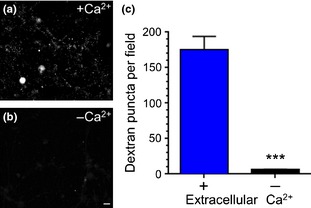
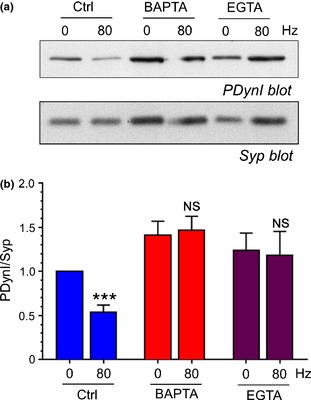
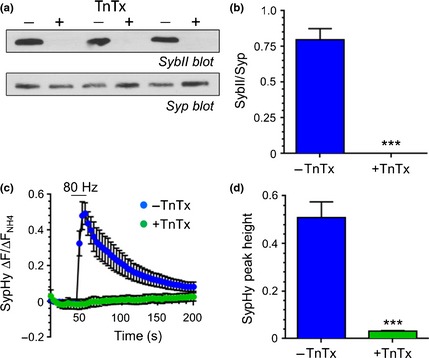
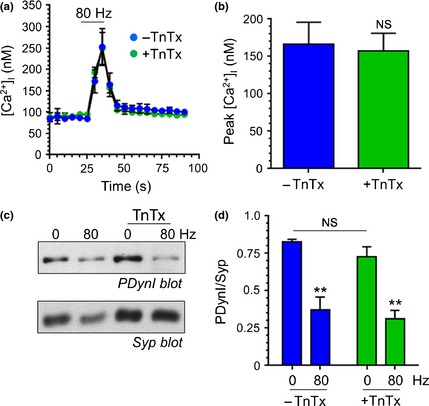
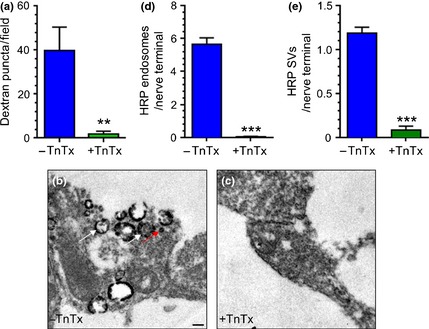
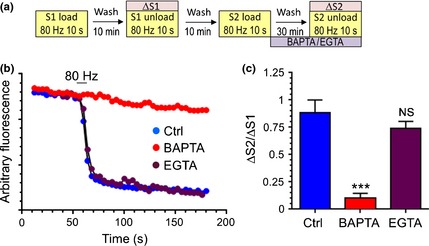
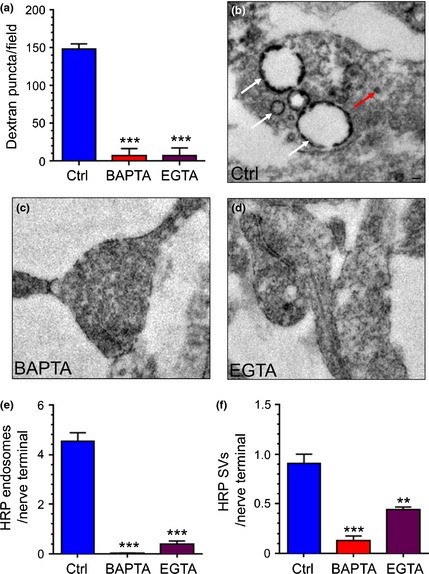
Activity-dependent bulk endocytosis (ADBE) is the dominant synaptic vesicle (SV) endocytosis mode in central nerve terminals during intense neuronal activity. By definition this mode is triggered by neuronal activity; however, key questions regarding its mechanism of activation remain unaddressed. To determine the basic requirements for ADBE triggering in central nerve terminals, we decoupled SV fusion events from activity-dependent calcium influx using either clostridial neurotoxins or buffering of intracellular calcium. ADBE was monitored both optically and morphologically by observing uptake of the fluid phase markers tetramethylrhodamine-dextran and horse radish peroxidase respectively. Ablation of SV fusion with tetanus toxin resulted in the arrest of ADBE, but had no effect on other calcium-dependent events such as activity-dependent dynamin I dephosphorylation, indicating that SV exocytosis is necessary for triggering. Furthermore, the calcium chelator EGTA abolished ADBE while leaving SV exocytosis intact, demonstrating that ADBE is triggered by intracellular free calcium increases outside the active zone. Activity-dependent dynamin I dephosphorylation was also arrested in EGTA-treated neurons, consistent with its proposed role in triggering ADBE. Thus, SV fusion and increased cytoplasmic free calcium are both necessary but not sufficient individually to trigger ADBE. Activity-dependent bulk endocytosis (ADBE) is the dominant synaptic vesicle (SV) endocytosis mode in central nerve terminals during intense neuronal activity. To determine the minimal requirements for ADBE triggering, we decoupled SV fusion events from activity-dependent calcium influx using either clostridial neurotoxins or buffering of intracellular calcium. We found that SV fusion and increased cytoplasmic free calcium are both necessary but not sufficient to trigger ADBE.
在强烈的神经元活动期间,活动依赖性批量内吞作用(ADBE)是中枢神经末梢中占主导地位的突触小泡(SV)内吞模式。根据定义,这种模式由神经元活动触发;然而,关于其激活机制的关键问题仍未得到解决。为了确定中枢神经末梢中ADBE触发的基本要求,我们使用梭菌神经毒素或缓冲细胞内钙的方法,将SV融合事件与活动依赖性钙内流解耦。通过分别观察液相标记物四甲基罗丹明-葡聚糖和辣根过氧化物酶的摄取,从光学和形态学上监测ADBE。用破伤风毒素消除SV融合导致ADBE停止,但对其他钙依赖性事件如活动依赖性动力蛋白I去磷酸化没有影响,表明SV胞吐作用是触发所必需的。此外,钙螯合剂EGTA消除了ADBE,同时使SV胞吐作用保持完整,表明ADBE是由活性区外的细胞内游离钙增加触发的。在EGTA处理的神经元中,活动依赖性动力蛋白I去磷酸化也被阻止,这与其在触发ADBE中的作用一致。因此,SV融合和细胞质游离钙增加都是触发ADBE所必需的,但单独而言并不充分。在强烈的神经元活动期间,活动依赖性批量内吞作用(ADBE)是中枢神经末梢中占主导地位的突触小泡(SV)内吞模式。为了确定触发ADBE的最低要求,我们使用梭菌神经毒素或缓冲细胞内钙的方法,将SV融合事件与活动依赖性钙内流解耦。我们发现,SV融合和细胞质游离钙增加都是触发ADBE所必需的,但并不充分。