Wilkos Ewelina, Brown Timothy Jb, Slawinska Ksenia, Kucharska Katarzyna A
Department of Neuroses, Personality and Eating Disorders Institute of Psychiatry and Neurology, Warsaw, Poland.
Department of Medical Education, Hull York Medical School, Hull, UK.
Neuropsychiatr Dis Treat. 2015 Apr 10;11:1031-8. doi: 10.2147/NDT.S78037. eCollection 2015.
The essential role of the thalamus in neurocognitive processes has been well documented. In contrast, relatively little is known about its involvement in social cognitive processes such as recognition of emotion, mentalizing, or empathy.
This study was designed to compare the performance of eight patients (five males, three females, mean age ± SD: 63.7±7.9 years) at early stage of unilateral thalamic lesions and eleven healthy controls (six males, five females, 49.6±12.2 years) in neurocognitive tests (CogState Battery: Groton Maze Learning Test, GML; Groton Maze Learning Test-Delayed Recall, GML-DR; Detection Task, DT; Identification Task, IT; One Card Learning Task, OCLT; One Back Task, OBT; Two Back Task, TBT; Set-Shifting Task, S-ST) and other well-known tests (Benton Visual Retention Test, BVRT; California Verbal Learning Test, CVLT; The Rey-Osterrieth Complex Figure Test, ROCF; Trail Making Test, TMT part A and B; Color - Word Stroop Task, CWST; Verbal Fluency Test, VFT), and social cognitive tasks (The Penn Emotion Recognition Test, ER40; Penn Emotion Discrimination Task, EmoDiff40; The Penn Emotional Acuity Test, PEAT40; Reading the Mind in the Eyes Test, revised version II; Toronto Alexithymia Scale, TAS-20).
Thalamic-damaged subjects were included if they experienced a single-episode ischemic stroke localized in right or left thalamus. The patients were examined at 3 weeks after the stroke onset. All were right handed. In addition, the following clinical scales were used: the Mini-Mental State Examination (MMSE), Spielberger State-Trait Anxiety Inventory (STAI), Beck Depression Inventory (BDI II). An inclusion criteria was a minimum score of 23/30 in MMSE.
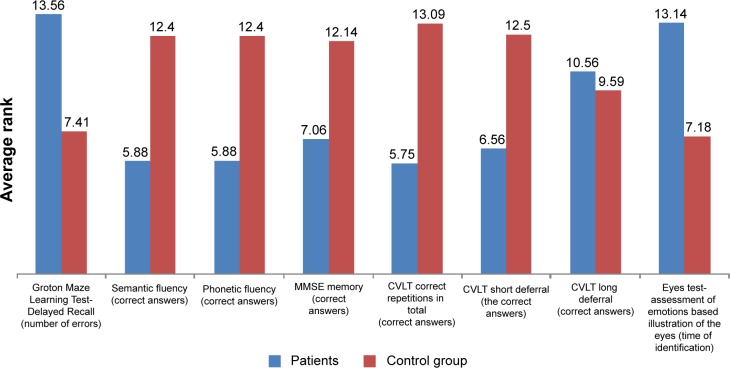
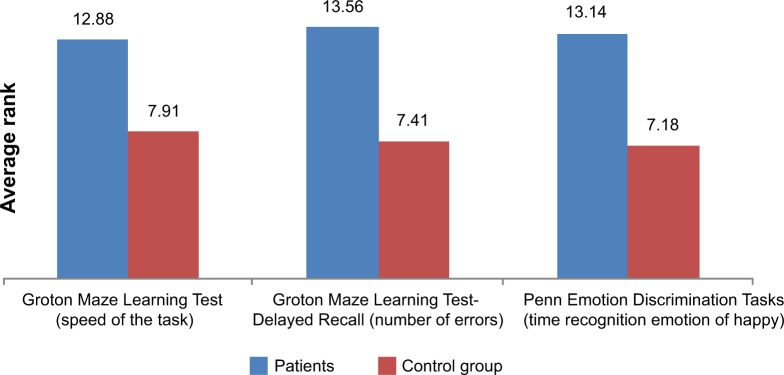
Compared with the healthy controls, patients revealed significantly lower scores in CVLT, GML-DR, and VFT. Furthermore, compared to healthy controls, patients showed significantly delayed recognition of "happiness" in EmoDiff40 and significantly worse performance on Reading the Mind in the Eyes Test, revised version II. Neuropsychological assessment demonstrated some statistically significant deficits in learning and remembering both verbal and visual material, long-term information storing, problem solving, and executive functions such as verbal fluency.
Patients at early stage of unilateral thalamic stroke showed both neurocognitive and social cognitive deficits. Further research is needed to increase understanding about diagnosis, early treatment, and prognosis of patients with thalamic lesions.
丘脑在神经认知过程中的重要作用已有充分记载。相比之下,对于其在诸如情感识别、心理理论或共情等社会认知过程中的参与情况,人们了解得相对较少。
本研究旨在比较8例单侧丘脑病变早期患者(5例男性,3例女性,平均年龄±标准差:63.7±7.9岁)和11名健康对照者(6例男性,5例女性,49.6±12.2岁)在神经认知测试(CogState测试组合:格罗顿迷宫学习测试,GML;格罗顿迷宫学习测试-延迟回忆,GML-DR;检测任务,DT;识别任务,IT;单卡学习任务,OCLT;单背任务,OBT;双背任务,TBT;定势转换任务,S-ST)以及其他知名测试(本顿视觉保持测试,BVRT;加利福尼亚言语学习测试,CVLT;雷-奥斯特里赫复杂图形测试,ROCF;连线测验,TMT A和B部分;颜色-词语斯特鲁普任务,CWST;言语流畅性测试,VFT)和社会认知任务(宾夕法尼亚情感识别测试,ER40;宾夕法尼亚情感辨别任务,EmoDiff40;宾夕法尼亚情感敏锐度测试,PEAT40;读心术测试,修订版II;多伦多述情障碍量表,TAS-20)中的表现。
纳入标准为经历过右侧或左侧丘脑单发性缺血性卒中的丘脑损伤受试者。患者在卒中发作后3周接受检查。所有患者均为右利手。此外,还使用了以下临床量表:简易精神状态检查表(MMSE)、斯皮尔伯格状态-特质焦虑量表(STAI)、贝克抑郁量表(BDI II)。纳入标准为MMSE最低得分为23/30。
与健康对照者相比,患者在CVLT、GML-DR和VFT中的得分显著更低。此外,与健康对照者相比,患者在EmoDiff40中对“快乐”的识别明显延迟,在读心术测试修订版II中的表现明显更差。神经心理学评估显示,在学习和记忆言语及视觉材料、长期信息存储、解决问题以及执行功能(如言语流畅性)方面存在一些具有统计学意义的缺陷。
单侧丘脑卒中早期患者存在神经认知和社会认知缺陷。需要进一步研究以增进对丘脑病变患者的诊断、早期治疗和预后的了解。