Xia Shu, Kohli Manish, Du Meijun, Dittmar Rachel L, Lee Adam, Nandy Debashis, Yuan Tiezheng, Guo Yongchen, Wang Yuan, Tschannen Michael R, Worthey Elizabeth, Jacob Howard, See William, Kilari Deepak, Wang Xuexia, Hovey Raymond L, Huang Chiang-Ching, Wang Liang
Department of Oncology, Tongji Hospital of Tongji Medical College, Huazhong University of Science and Technology, Wuhan, China.
Department of Pathology and MCW Cancer Center, Medical College of Wisconsin, Milwaukee, WI, USA.
Oncotarget. 2015 Jun 30;6(18):16411-21. doi: 10.18632/oncotarget.3845.
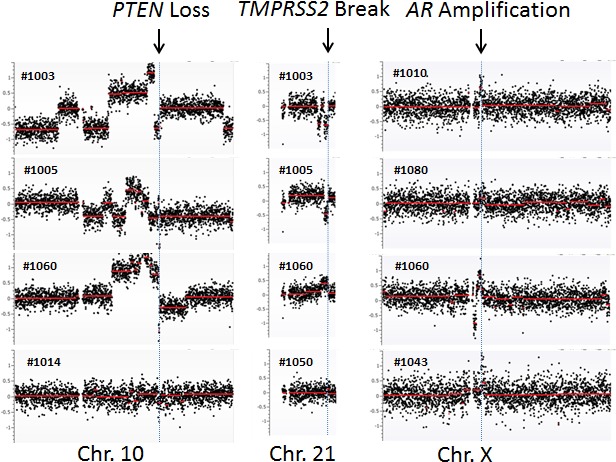
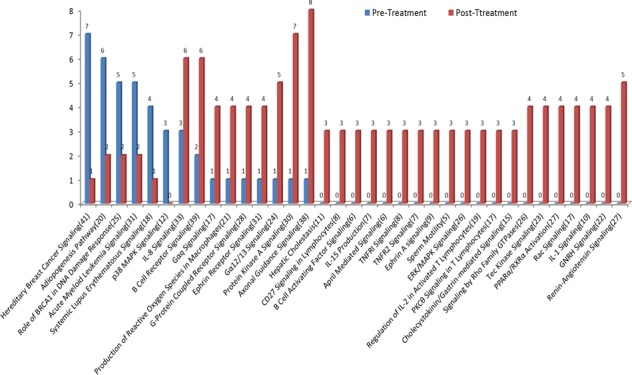
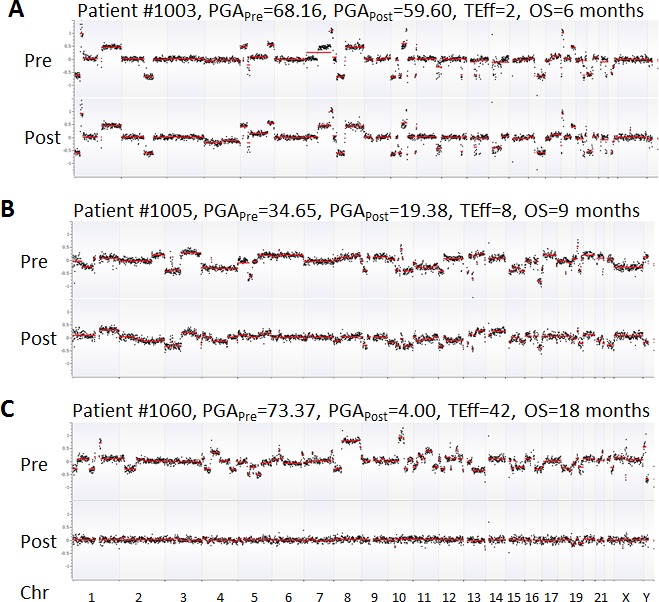
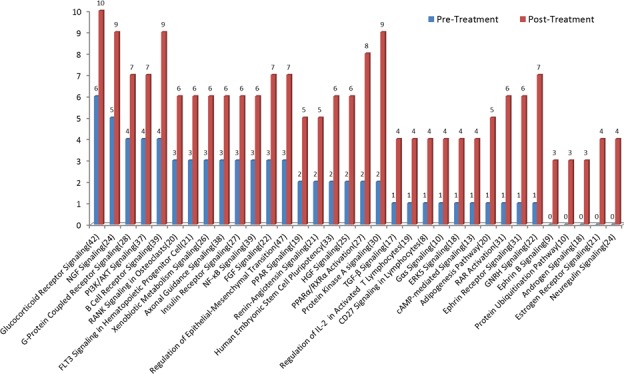
Liquid biopsies, examinations of tumor components in body fluids, have shown promise for predicting clinical outcomes. To evaluate tumor-associated genomic and genetic variations in plasma cell-free DNA (cfDNA) and their associations with treatment response and overall survival, we applied whole genome and targeted sequencing to examine the plasma cfDNAs derived from 20 patients with advanced prostate cancer. Sequencing-based genomic abnormality analysis revealed locus-specific gains or losses that were common in prostate cancer, such as 8q gains, AR amplifications, PTEN losses and TMPRSS2-ERG fusions. To estimate tumor burden in cfDNA, we developed a Plasma Genomic Abnormality (PGA) score by summing the most significant copy number variations. Cox regression analysis showed that PGA scores were significantly associated with overall survival (p < 0.04). After androgen deprivation therapy or chemotherapy, targeted sequencing showed significant mutational profile changes in genes involved in androgen biosynthesis, AR activation, DNA repair, and chemotherapy resistance. These changes may reflect the dynamic evolution of heterozygous tumor populations in response to these treatments. These results strongly support the feasibility of using non-invasive liquid biopsies as potential tools to study biological mechanisms underlying therapy-specific resistance and to predict disease progression in advanced prostate cancer.
液体活检,即对体液中的肿瘤成分进行检测,已显示出预测临床结果的前景。为了评估浆细胞游离DNA(cfDNA)中与肿瘤相关的基因组和基因变异及其与治疗反应和总生存期的关联,我们应用全基因组和靶向测序技术检测了20例晚期前列腺癌患者的血浆cfDNA。基于测序的基因组异常分析揭示了前列腺癌中常见的位点特异性增益或缺失,如8q增益、AR扩增、PTEN缺失和TMPRSS2-ERG融合。为了估计cfDNA中的肿瘤负荷,我们通过汇总最显著的拷贝数变异来制定血浆基因组异常(PGA)评分。Cox回归分析表明,PGA评分与总生存期显著相关(p < 0.04)。在雄激素剥夺治疗或化疗后,靶向测序显示参与雄激素生物合成、AR激活、DNA修复和化疗耐药的基因发生了显著的突变谱变化。这些变化可能反映了杂合肿瘤群体对这些治疗的动态演变。这些结果有力地支持了使用非侵入性液体活检作为潜在工具来研究治疗特异性耐药背后的生物学机制并预测晚期前列腺癌疾病进展的可行性。