Doyle Tomas, Goujon Caroline, Malim Michael H
Department of Infectious Diseases, King's College London, 2nd Floor, Borough Wing, Guy's Hospital, London Bridge, London SE1 9RT, UK.
Nat Rev Microbiol. 2015 Jul;13(7):403-13. doi: 10.1038/nrmicro3449. Epub 2015 Apr 27.
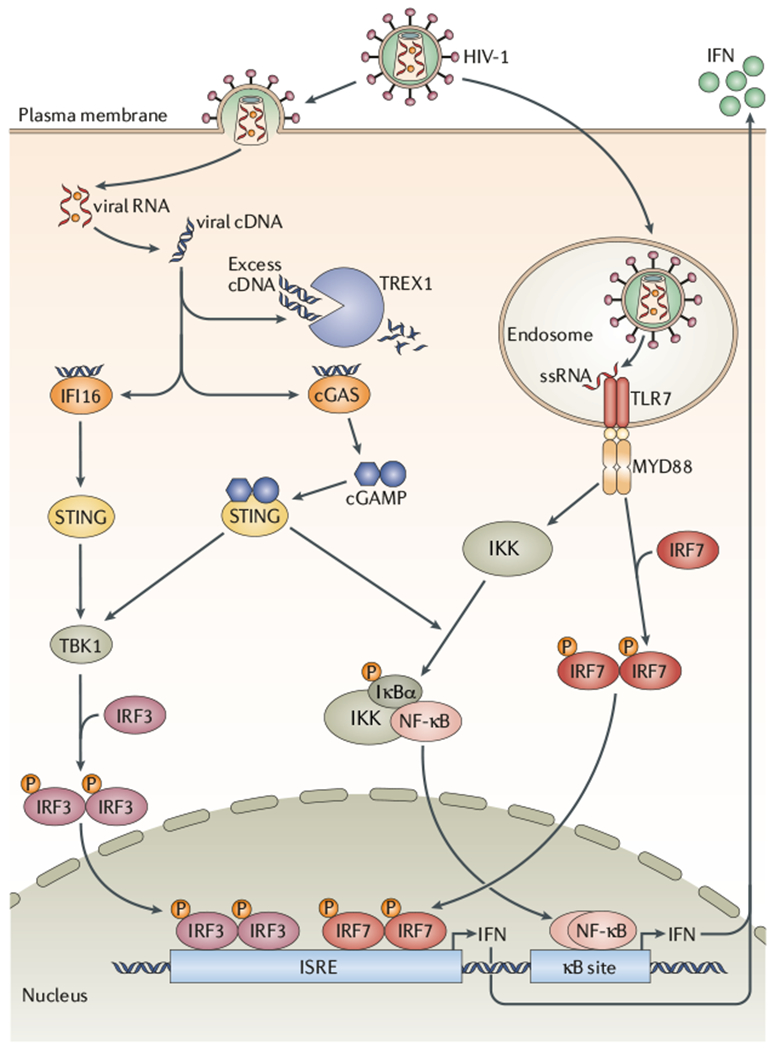
The ability of interferons (IFNs) to inhibit HIV-1 replication in cell culture models has long been recognized, and the therapeutic administration of IFNα to HIV-1-infected patients who are not receiving antiretroviral therapy produces a clear but transient decrease in plasma viral load. Conversely, studies of chronic HIV-1 infection in humans and SIV-infected animal models of AIDS show positive correlations between elevated plasma levels of IFNs, increased expression of IFN-stimulated genes (ISGs), biomarkers of inflammation and disease progression. In this Review, we discuss the evidence that IFNs can control HIV-1 replication in vivo and debate the controversial role of IFNs in promoting the pathological sequelae of chronic HIV-1 infection.
干扰素(IFNs)在细胞培养模型中抑制HIV-1复制的能力早已得到认可,对于未接受抗逆转录病毒治疗的HIV-1感染患者,给予IFNα进行治疗会使血浆病毒载量出现明显但短暂的下降。相反,对人类慢性HIV-1感染以及感染猴免疫缺陷病毒(SIV)的艾滋病动物模型的研究表明,血浆中IFNs水平升高、IFN刺激基因(ISGs)表达增加、炎症生物标志物与疾病进展之间存在正相关。在本综述中,我们讨论了IFNs能够在体内控制HIV-1复制的证据,并对IFNs在促进慢性HIV-1感染病理后遗症方面存在争议的作用展开讨论。