Gibbons Jacqueline A, Ouatas Taoufik, Krauwinkel Walter, Ohtsu Yoshiaki, van der Walt Jan-Stefan, Beddo Vanessa, de Vries Michiel, Mordenti Joyce
Medivation, Inc., 36th Floor, 525 Market Street, San Francisco, CA, 94105, USA.
Astellas Pharma Europe B.V., Leiden, The Netherlands.
Clin Pharmacokinet. 2015 Oct;54(10):1043-55. doi: 10.1007/s40262-015-0271-5.
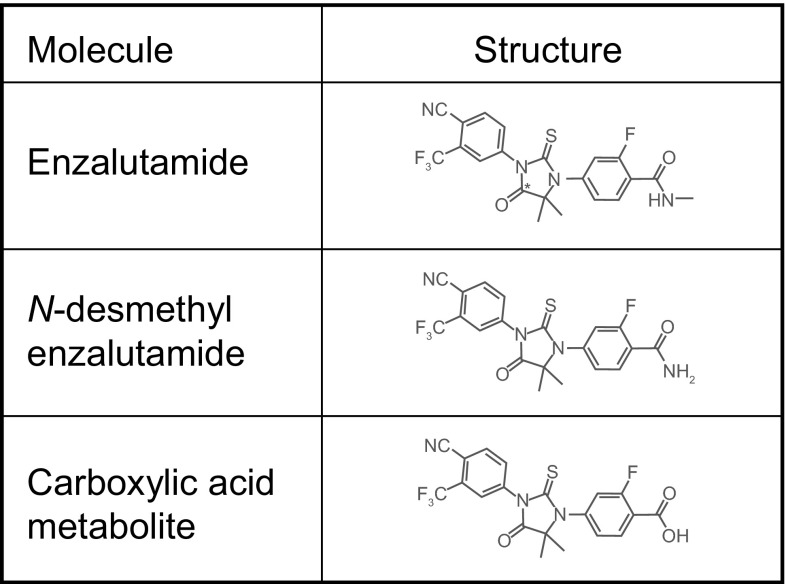
Oral enzalutamide (160 mg once daily) is approved for the treatment of metastatic castration-resistant prostate cancer (mCRPC). This article describes the pharmacokinetics of enzalutamide and its active metabolite N-desmethyl enzalutamide.
Results are reported from five clinical studies.
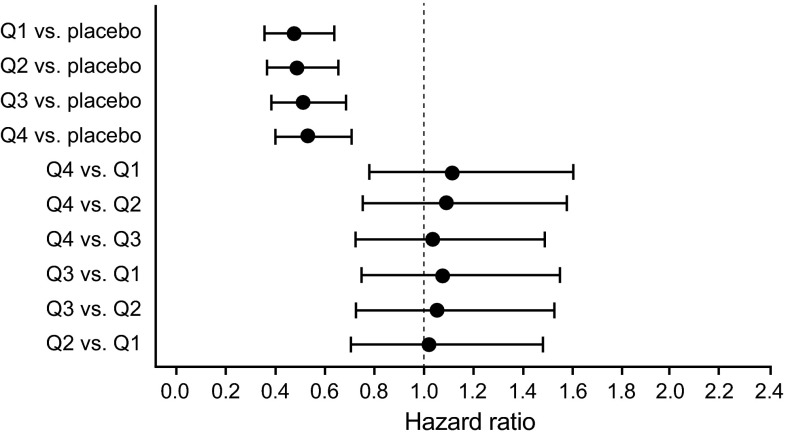
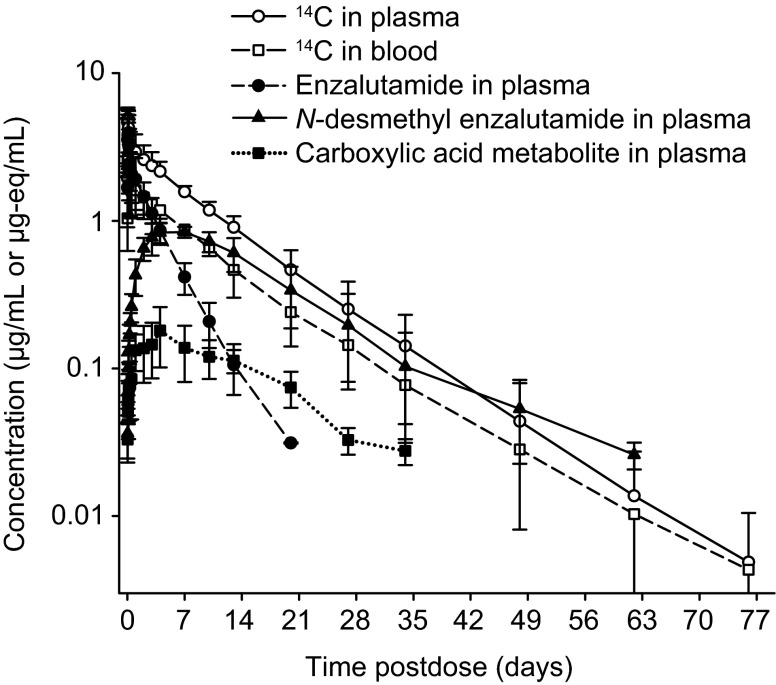
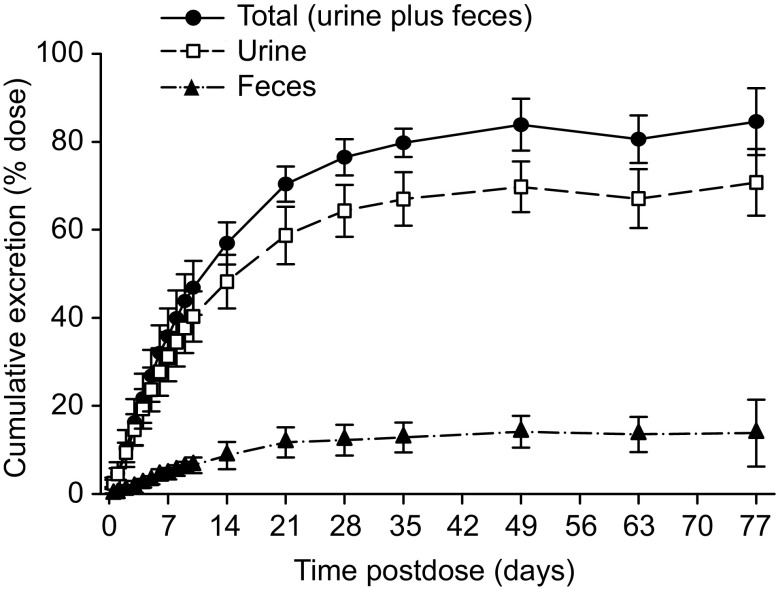
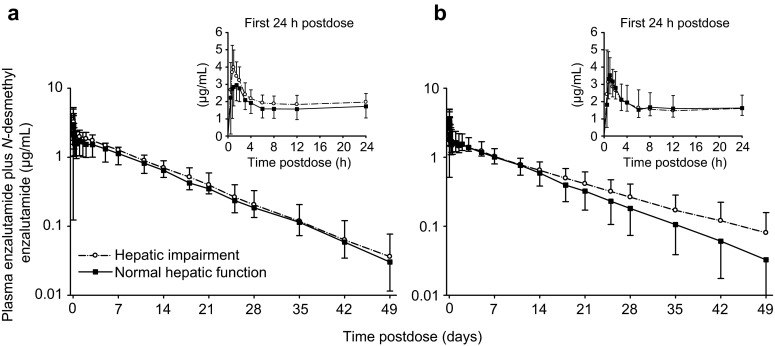
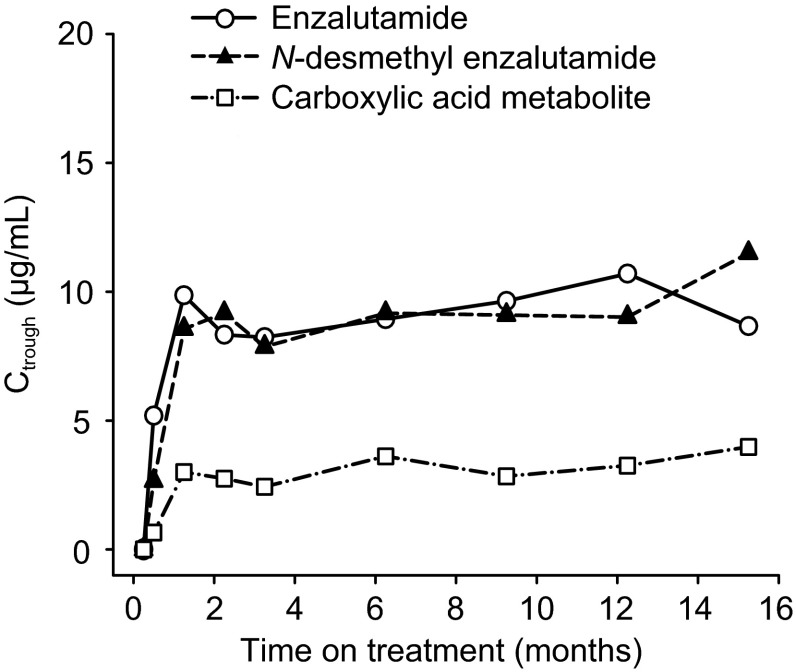
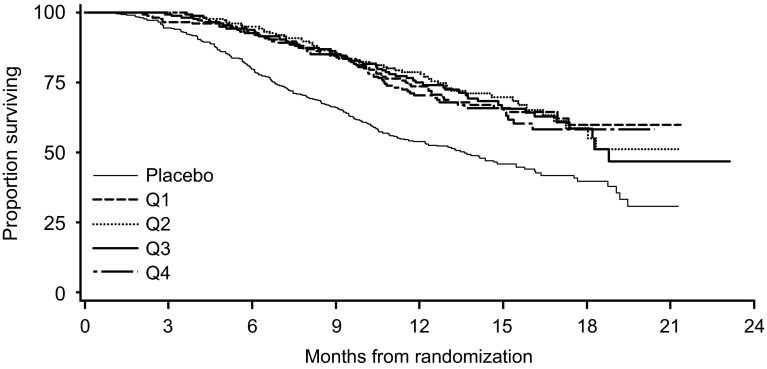
In a dose-escalation study (n = 140), enzalutamide half-life was 5.8 days, steady state was achieved by day 28, accumulation was 8.3-fold, exposure was approximately dose proportional from 30-360 mg/day, and intersubject variability was ≤30 %. In a mass balance study (n = 6), enzalutamide was primarily eliminated by hepatic metabolism. Renal excretion was an insignificant elimination pathway for enzalutamide and N-desmethyl enzalutamide. In a food-effect study (n = 60), food did not have a meaningful effect on area under the plasma concentration-time curve (AUC) of enzalutamide or N-desmethyl enzalutamide, and in an hepatic impairment study, AUC of the sum of enzalutamide plus N-desmethyl enzalutamide was similar in men with mild (n = 6) or moderate (n = 8) impairment (Child-Pugh Class A and B) versus men with normal hepatic function (n = 14). In a phase III trial, an exposure-response analysis of steady-state predose (trough) concentrations (C trough) versus overall survival (n = 1103) showed that active treatment C trough quartiles for 160 mg/day were uniformly beneficial relative to placebo, and no threshold of C trough was associated with a statistically significant better response.
Enzalutamide has predictable pharmacokinetics, with low intersubject variability. Similar efficacy was observed in patients across the concentration/exposure range associated with a fixed oral dose of enzalutamide 160 mg/day.
口服恩杂鲁胺(每日一次,每次160毫克)已被批准用于治疗转移性去势抵抗性前列腺癌(mCRPC)。本文描述了恩杂鲁胺及其活性代谢产物N-去甲基恩杂鲁胺的药代动力学。
报告了五项临床研究的结果。
在一项剂量递增研究(n = 140)中,恩杂鲁胺的半衰期为5.8天,在第28天达到稳态,蓄积倍数为8.3倍,在30 - 360毫克/天的剂量范围内,暴露量与剂量大致成比例,受试者间变异性≤30%。在一项质量平衡研究(n = 6)中,恩杂鲁胺主要通过肝脏代谢消除。肾脏排泄对于恩杂鲁胺和N-去甲基恩杂鲁胺来说是一条不重要的消除途径。在一项食物影响研究(n = 60)中,食物对恩杂鲁胺或N-去甲基恩杂鲁胺的血浆浓度-时间曲线下面积(AUC)没有显著影响,并且在一项肝功能损害研究中,与肝功能正常的男性(n = 14)相比,轻度(n = 6)或中度(n = 8)肝功能损害(Child-Pugh A级和B级)男性中恩杂鲁胺加N-去甲基恩杂鲁胺的AUC相似。在一项III期试验中,对稳态给药前(谷值)浓度(C谷)与总生存期(n = 1103)的暴露-反应分析表明,相对于安慰剂,160毫克/天的活性治疗C谷四分位数均具有益处,并且没有C谷阈值与统计学上显著更好的反应相关。
恩杂鲁胺具有可预测的药代动力学,受试者间变异性低。在与每日160毫克固定口服剂量相关的浓度/暴露范围内的患者中观察到了相似的疗效。