Tate Courtney M, Mc Entire Jacquelyn, Pallini Roberto, Vakana Eliza, Wyss Lisa, Blosser Wayne, Ricci-Vitiani Lucia, D'Alessandris Quintino Giorgio, Morgante Liliana, Giannetti Stefano, Larocca Luigi Maria, Todaro Matilde, Benfante Antonina, Colorito Maria Luisa, Stassi Giorgio, De Maria Ruggero, Rowlinson Scott, Stancato Louis
Discovery Research, Eli Lilly and Company, Indianapolis, United States of America.
Department of Neurosurgery, Università Cattolica del Sacro Cuore, Rome, Italy.
PLoS One. 2015 Apr 28;10(4):e0125697. doi: 10.1371/journal.pone.0125697. eCollection 2015.
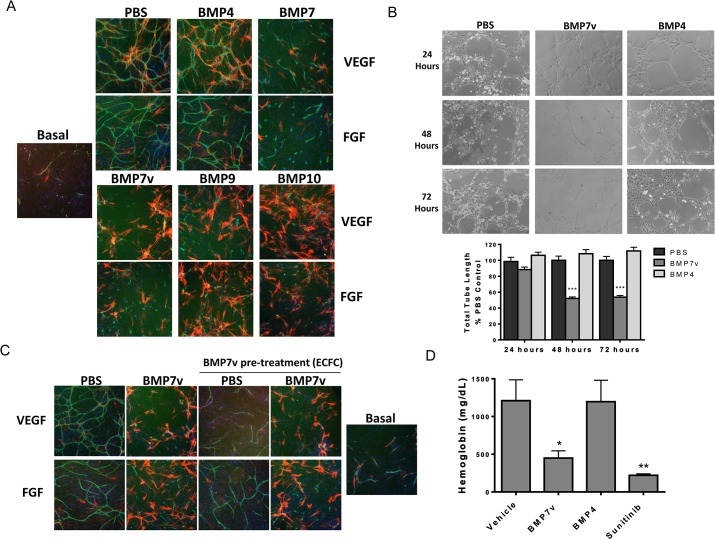
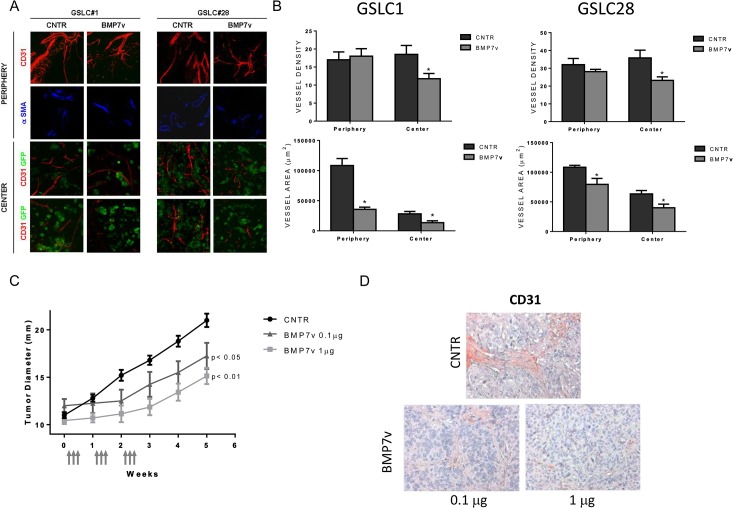
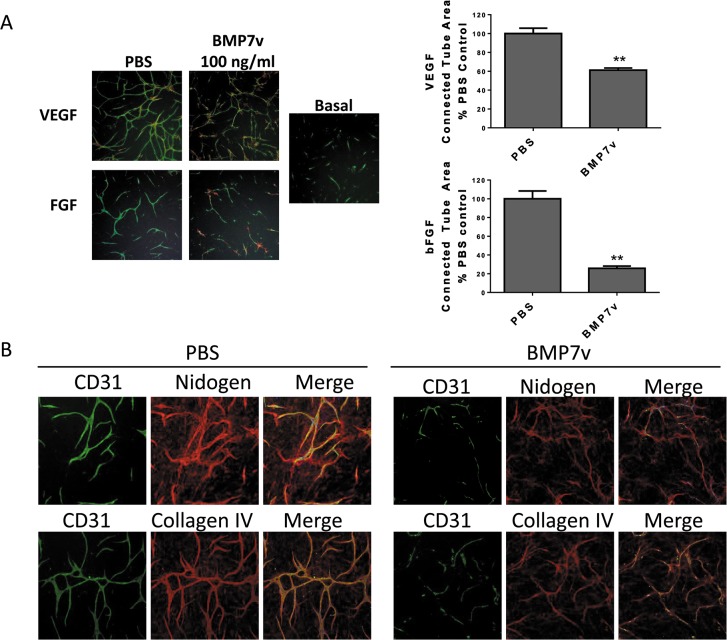
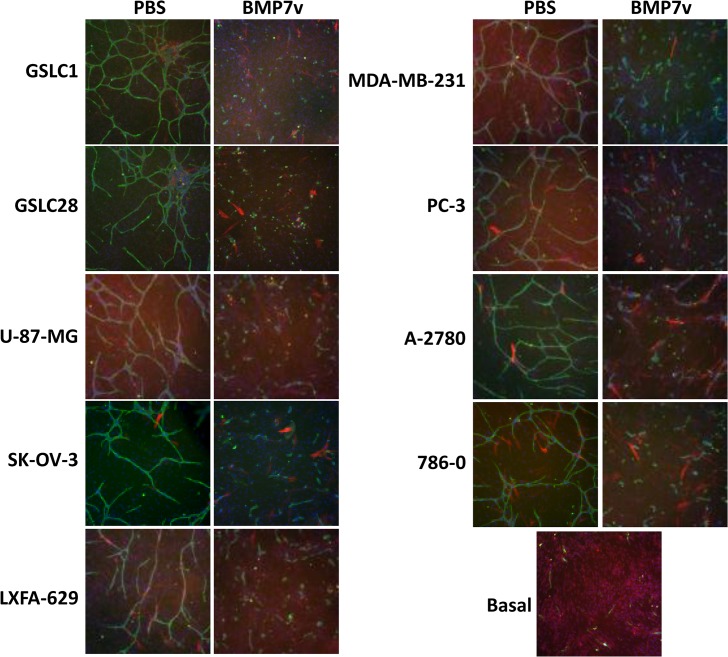
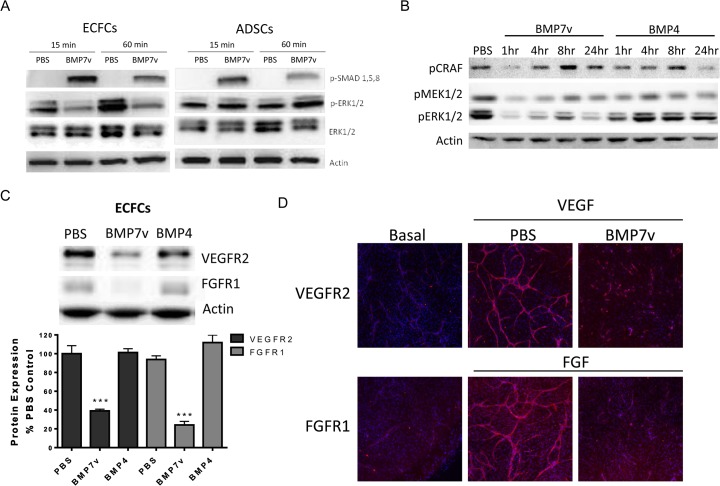
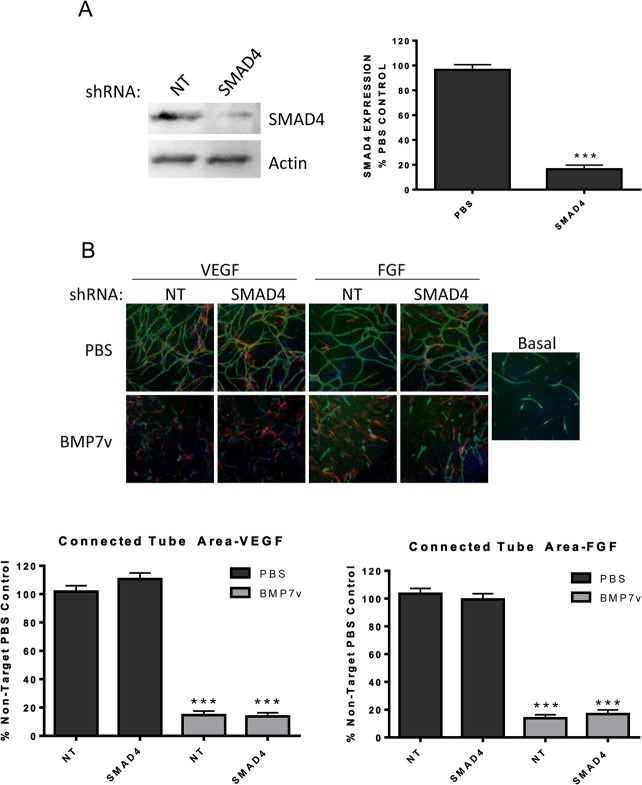
Bone morphogenetic proteins (BMPs), members of the TGF-β superfamily, have numerous biological activities including control of growth, differentiation, and vascular development. Using an in vitro co-culture endothelial cord formation assay, we investigated the role of a BMP7 variant (BMP7v) in VEGF, bFGF, and tumor-driven angiogenesis. BMP7v treatment led to disruption of neo-endothelial cord formation and regression of existing VEGF and bFGF cords in vitro. Using a series of tumor cell models capable of driving angiogenesis in vitro, BMP7v treatment completely blocked cord formation. Pre-treatment of endothelial cells with BMP7v significantly reduced their cord forming ability, indicating a direct effect on endothelial cell function. BMP7v activated the canonical SMAD signaling pathway in endothelial cells but targeted gene knockdown using shRNA directed against SMAD4 suggests this pathway is not required to mediate the anti-angiogenic effect. In contrast to SMAD activation, BMP7v selectively decreased ERK and AKT activation, significantly decreased endothelial cell migration and down-regulated expression of critical RTKs involved in VEGF and FGF angiogenic signaling, VEGFR2 and FGFR1 respectively. Importantly, in an in vivo angiogenic plug assay that serves as a measurement of angiogenesis, BMP7v significantly decreased hemoglobin content indicating inhibition of neoangiogenesis. In addition, BMP7v significantly decreased angiogenesis in glioblastoma stem-like cell (GSLC) Matrigel plugs and significantly impaired in vivo growth of a GSLC xenograft with a concomitant reduction in microvessel density. These data support BMP7v as a potent anti-angiogenic molecule that is effective in the context of tumor angiogenesis.
骨形态发生蛋白(BMPs)是转化生长因子-β(TGF-β)超家族的成员,具有多种生物学活性,包括对生长、分化和血管发育的调控。我们使用体外共培养内皮索形成试验,研究了一种BMP7变体(BMP7v)在血管内皮生长因子(VEGF)、碱性成纤维细胞生长因子(bFGF)和肿瘤驱动的血管生成中的作用。BMP7v处理导致体外新内皮索形成的破坏以及现有VEGF和bFGF索的消退。使用一系列能够在体外驱动血管生成的肿瘤细胞模型,BMP7v处理完全阻断了索的形成。用BMP7v预处理内皮细胞显著降低了它们形成索的能力,表明对内皮细胞功能有直接影响。BMP7v在内皮细胞中激活了经典的SMAD信号通路,但使用针对SMAD4的短发夹RNA(shRNA)进行靶向基因敲低表明,该通路不是介导抗血管生成作用所必需的。与SMAD激活相反,BMP7v选择性降低ERK和AKT激活,显著降低内皮细胞迁移,并下调参与VEGF和FGF血管生成信号的关键受体酪氨酸激酶(RTKs)的表达,分别为血管内皮生长因子受体2(VEGFR2)和碱性成纤维细胞生长因子受体1(FGFR1)。重要的是,在作为血管生成测量指标的体内血管生成栓试验中,BMP7v显著降低血红蛋白含量,表明抑制了新生血管生成。此外,BMP7v显著降低胶质母细胞瘤干细胞样细胞(GSLC)基质胶栓中的血管生成,并显著损害GSLC异种移植瘤的体内生长,同时微血管密度降低。这些数据支持BMP7v作为一种有效的抗血管生成分子,在肿瘤血管生成的背景下具有作用。